Only the most stubborn, or those who feel they have nothing left to lose, are still holding out in Ceuta. There are now just a few thousand of them — Sudanese, Ethiopians, Egyptians, Somalians, Algerians and even a handful of Palestinians — refusing to leave their small foothold: a makeshift camp on a hillside at the edge of the city.
Most of the 60,000 people who streamed across the border into the Spanish enclave last week have since gone back to Morocco, many worn down by hunger and exhaustion. Some returned voluntarily, while others were pushed along by the military. A number even admitted they gave up after finding they could no longer charge their mobile phones.
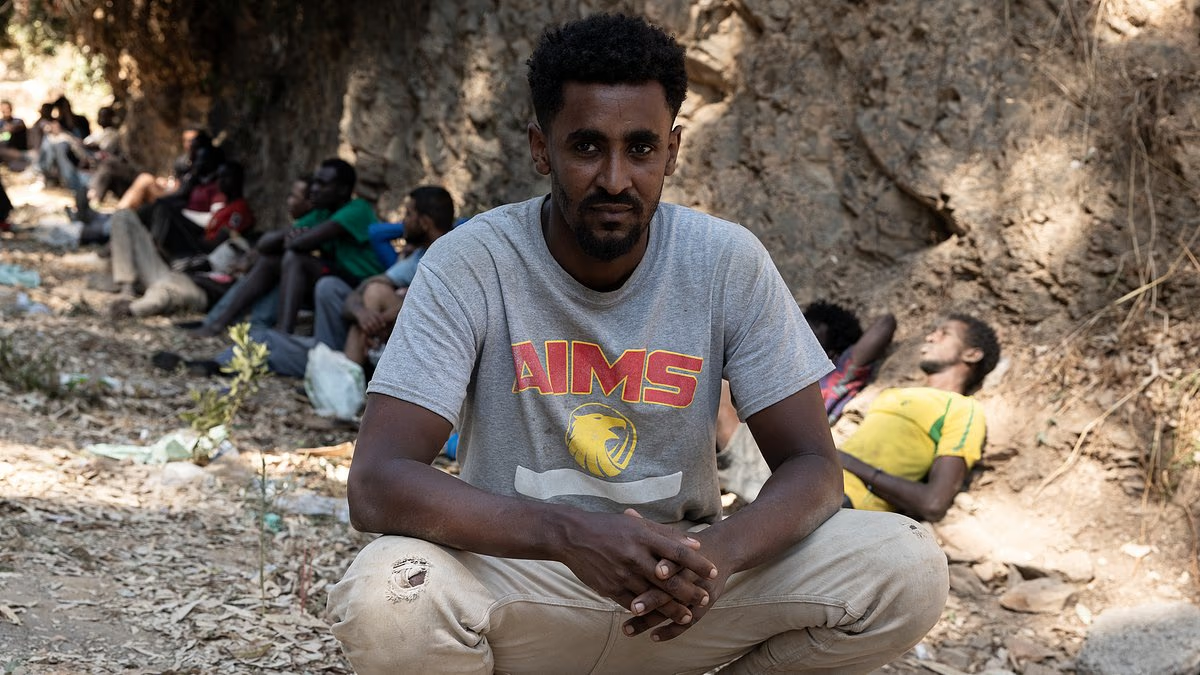
‘I won’t go back though, not like those people,’ says one of the remaining holdouts, Yared Teka, 27, a former professional handball player from Ethiopia. ‘I am determined to get to mainland Europe and if I fail I will die here trying.’
Before Thursday’s mass arrival — the largest illegal border crossing in the history of the European Union — Yared had spent months in Morocco, as he puts it, ‘hiding in the mountains’. From time to time he tried to slip across the frontier, only to be stopped. ‘Then I saw all these people arriving so I ran and joined them. I am here now so why should I return? I have no money and I have barely eaten in two days, but I want to get work in Madrid.’
Social media helped fuel last week’s sudden rush toward Ceuta, but so too did the policies of Spain’s socialist prime minister, Pedro Sanchez.
Like tens of thousands of others, Yared and his companions had spent years moving across North Africa, searching for a vulnerable point in Europe’s fortified border system. Mr Sanchez’s contentious policy, which allowed migrants living illegally in Spain to apply for residency status in April, appeared to offer exactly that opening. The programme had initially expected 500,000 applications, but by the time it was brought to a close in June, 1.2 million people had registered. For migrants such as Yared, it looked like a chance too significant to ignore.

Unlike most of the 60,000 people who crossed into Ceuta and have since returned to Morocco, 27-year-old Ethiopian Yared Teka says he has no intention of moving on
‘We turned to Spain like flowers to the sun,’ he says. With no food and no money, he concedes he is ‘suffering’, but the pull of Europe remains powerful. ‘It is just so tempting to think that the mainland is only 20km away. Near but far.’
Unlike the rest of Spain, Ceuta is not part of the EU’s borderless Schengen Area, so to Yared, the mainland is plenty more than the width of the Mediterranean away.
Yet as he talks, he gestures towards a white building behind him, Ceuta’s immigration centre.
‘We know that the people in there are the lucky ones,’ he says. Guarded by police, the centre houses 600 migrants who have access to water and food.
‘They are not processing any more of us,’ he adds, a grimace crossing his features. ‘They give us nothing now, not even water, which they handed out up until yesterday but then stopped. I genuinely think they want us to die.’
Around us, hundreds of men lie under trees, some sleeping, many more engaged in murmured conversations. But the camp suddenly comes alive with the promise of food. Men surround a car that has stopped further up the hill. A concerned local has brought bread but only enough for a fortunate few.
MORE STORY: Girl, 13, Bitten by Barracuda on Turks and Caicos Birthday Trip
A Palestinian man, Ahmed Zayda, says he doesn’t have the energy to run. He says he left Gaza during the 2014 conflict with Israel and was drawn the following year to Germany – where he stayed for eight years – because of then-Chancellor Angela Merkel’s open-door immigration policy. She temporarily suspended EU rules and welcomed a million refugees, mostly fleeing the war in Syria.

Spanish authorities have installed a 1,600ft-long barrier along Ceuta’s Tarajal breakwater, a stretch of coast used by migrants during Thursday’s crossings
‘Now it is the turn of Spain to be kind to us,’ says Ahmed. ‘But we need to get there first. This place isn’t good to us. We can’t go into town without police hassling us.’
Another migrant, Jalal Idris, 20, from Cameroon, shows off his England shirt with David Beckham’s name on the back. ‘I love England and this is the shirt I swam here in. I think it brought me luck.’
Away from the camp, Ceuta was beginning to return to normal. For the first time since the ‘invasion’ – as many here call it – Spaniards were leaving their homes and going about their business. Until now many had simply been too scared to do so. On Saturday, Spanish authorities installed a 1,600ft-long containment barrier along the Tarajal breakwater – a stretch of coast used during last week’s crossings. It features a weighted curtain to stop migrants from swimming under the structure.
One hotel manager said: ‘There are some [migrants] still hanging around but they’ve mainly all gone. I think many got caught up in the social media excitement and didn’t really intend staying longer than a few days.’
However, yesterday evening, 150 of the migrants marched through the city carrying an injured man wrapped in a blanket, who they claimed was attacked by police.
The men, who were mainly Moroccan, scattered after being charged by baton-wielding police officers. They left the injured man lying in the street. Paramedics carried him away 20 minutes later.
Only hardliners remain, but not just on this side of the border. Yesterday the Daily Mail visited the Moroccan town of Fnideq where many of the migrants hid before last Thursday. Some said they had been encouraged by Moroccan border guards. Yet none of the authorities were taking chances yesterday. Dozens of police trucks were lined up on the Moroccan side and beyond them, in the mountains, soldiers stood surveying all before them with binoculars.
At the nearest beach to the border we saw discarded shoes and clothes. Barbed wire stretches across its entrance.
Morocco, it seemed, was also getting back to normal. But in the hills overlooking Fnideq a group of Sudanese men who swam to Ceuta – only to be expelled by the military on Saturday – were regrouping, awaiting another opportunity. They sleep on slopes where nothing grows beyond stunted shrubs.
‘We are back in Morocco but we aren’t giving up,’ one of the men told me. ‘We will wait for another chance to get into Ceuta and hopefully Spain.’ Just then a police van screeches to a halt and two officers jump out. The men scatter. ‘See you in Spain,’ cries one, as he scrambles up the hill.