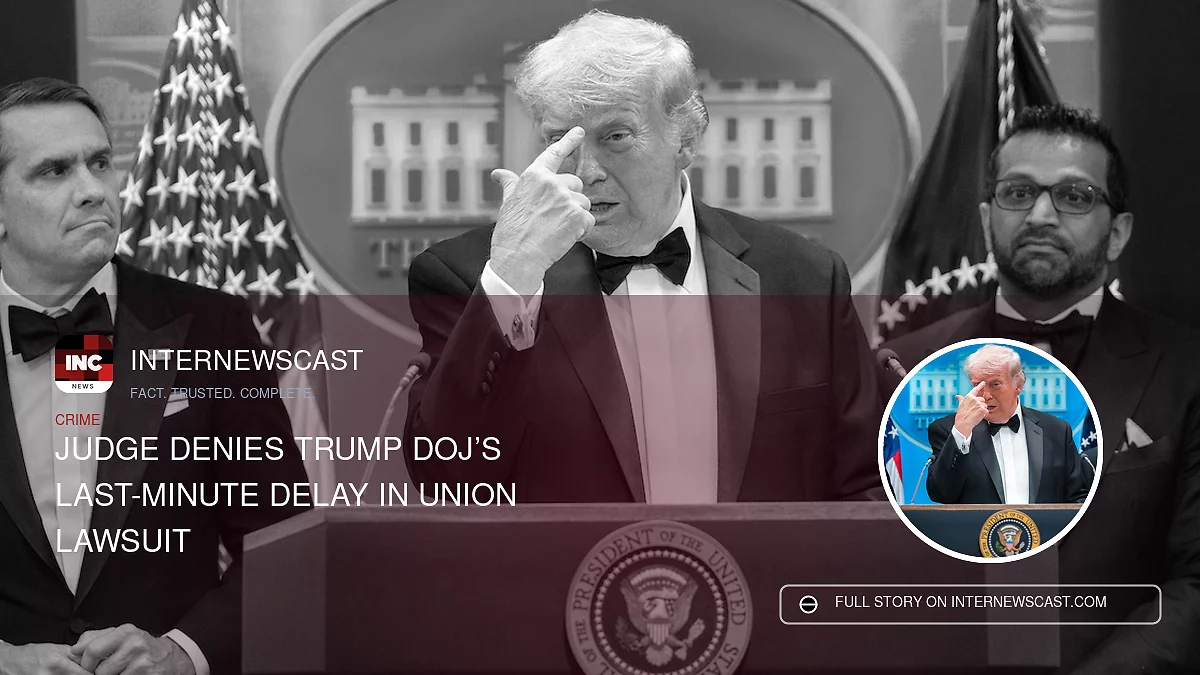

President Donald Trump gestures while speaking in the James Brady Press Briefing Room at the White House following a shooting incident outside the ballroom during the annual White House Correspondents’ Association dinner in Washington, Saturday, April 25, 2026. Acting Attorney General Todd Blanche and FBI Director Kash Patel look on (AP Photo/Jose Luis Magana).
A federal district judge in Washington state has rejected a last-minute bid by the Trump administration to secure additional time in a closely watched lawsuit involving organized labor and collective bargaining rights.
The U.S. Department of Justice on Tuesday afternoon asked for a two-week extension to respond to the plaintiff’s request for a preliminary injunction in the case, United Power Trades Organization v. Trump. Government lawyers sought to move their response deadline to Aug. 18.
The timing proved costly. The government’s request was submitted on the very day its response was due, even though the plaintiffs had filed their preliminary injunction motion in mid-July. It also landed at 4:14 p.m., close to the end of the business day — a detail that did not appear to sit well with the court.
“The Court DENIES without prejudice Defendants’ motion to extend time to respond to Plaintiff’s motion for preliminary injunction for failure to show good cause and for violation of the local rules,” U.S. District Judge Lauren J. King, who was appointed by President Joe Biden, ruled.
In a brief minute order, the judge pointed to the local rules governing deadline extensions. While those rules allow the court to “for good cause, extend the time,” King’s order indicated that Justice Department attorneys had waited too long to ask.
“A motion for relief from a deadline should, whenever possible, be filed sufficiently in advance of the deadline to allow the court to rule on the motion prior to the deadline,” the order concluded, citing another rule. “Parties should not assume that the motion will be granted and must comply with the existing deadline unless the court orders otherwise.”
The Justice Department then tried again, filing a renewed motion for an extension. The second version was more detailed than the first: the initial request ran three pages, while the new filing stretched to six pages.
The new request also offers an excuse for the delay.
“Approximately one month after it filed the Complaint, Plaintiff filed a motion for preliminary injunction, with a noting date of August 11, 2026,” the revamped request reads. “Plaintiff mailed a copy of the Motion to the U.S. Attorney’s Office, which it received on July 20, 2026. Unfortunately, due to an administrative error, the mailed Motion did not come to undersigned counsel’s attention until today, August 4, which is also the date that Defendants’ response to the Motion is due.”
The second-try motion goes on to issue a mea culpa as well.
“While the U.S. Attorney’s Office has not yet been able to ascertain exactly how or why this mistake occurred, this Office appreciates that it is our responsibility to be aware of motions properly served on this Office and to respond to them in a timely manner, rather than ask for relief from a court deadline at the last hour,” the filing reads.
That admission of fault is sourced from a substantially similar document penned by Assistant U.S. Attorney James Strong, who works out of the currently embattled Western District of Washington.
Strong’s declaration offers a more detailed timeline of fault.
From that filing:
At approximately 2:00 p.m., on August 4, 2026, I learned that Plaintiff had filed a motion for preliminary injunction on July 14, 2026, and had mailed a copy of the motion to the U.S. Attorney’s Office, which was received on July 20, 2026.
I did not receive either the mailed copy of the Motion from our mailroom staff, or an email notifying me about the Motion. Instead, I learned about the Motion after happening upon a scanned version of it located on our shared file drive on August 4, 2026.
To that end, Strong says “it is impossible to file a timely response by the due date.” And, for at least the third time, the government says the plaintiffs in the case have “no objection” to the extension.
Strong’s two-page personal affidavit then apologizes once again.
“At this point, I do not know exactly how or why this mistake occurred,” the filing concludes. “I have raised this issue with my management within the Civil Division. Both management and I appreciate that it is our Office’s responsibility to be aware of motions properly served on this Office and to respond to them in a timely manner, rather than ask for relief from a court deadline at the last hour.”
The underlying lawsuit was filed by the union representing the U.S. Army Corps of Engineers. The litigation aims to stop the federal government from terminating its collective bargaining agreement. In an executive order issued in late March 2025, President Donald Trump stated that the union was no longer the formal representative body for the Corps’ workers.
The post ‘The court denies’: Judge swats down Trump admin’s 11th-hour request for more time in union lawsuit, DOJ frantically issues mea culpas and excuses for ‘mistake’ and delay first appeared on Law & Crime.


