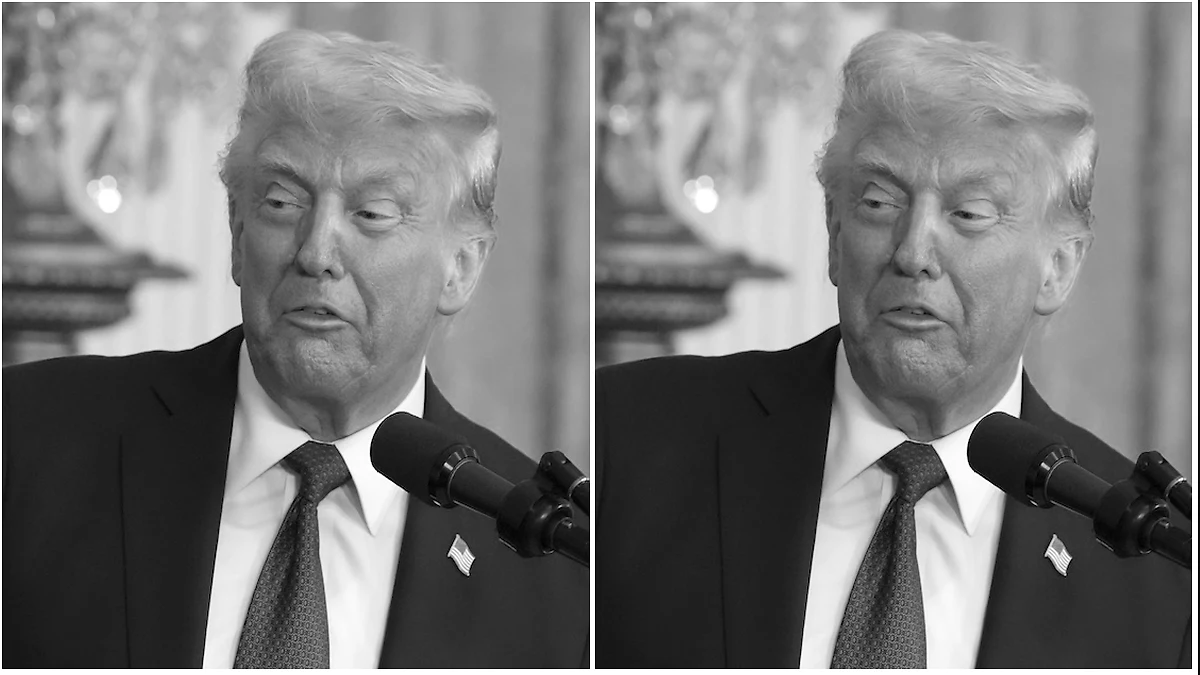

President Donald Trump speaks at a reception marking Greek Independence Day in the East Room of the White House on Monday, March 24, 2025, in Washington (AP Photo/Jacquelyn Martin).
Maine is asking a federal court to keep the Trump administration from forcing its hand over certain state license plates sought by federal agents, according to a court filing submitted earlier this week.
The dispute began in May, when the U.S. Department of Justice sued the Pine Tree State and Secretary of State Shenna Bellows. In its 18-page lawsuit, the DOJ claims Maine’s Bureau of Motor Vehicles improperly rejected requests from federal immigration agents seeking confidential, undercover license plates.
Bellows, whose office oversees the BMV, has previously said she would not approve unmarked plates for immigration agents unless she can be assured the plates “won’t be used for lawless purposes.”
Federal officials argue Maine is unlawfully targeting the federal government, with Immigration and Customs Enforcement, or ICE, and other immigration agencies at the center of the conflict.
At issue is a change made by Maine’s secretary of state to the application for confidential law enforcement license plates. The updated form requires applicants to attest that the plates will not be used for immigration enforcement.
Maine frames the requirement as part of “Maine’s legitimate decision not to join in with the federal government to carry out federal policy.”
In its motion, the state also points to Maine law, arguing that Bellows has “absolute discretionary authority over” whether such license plates are issued.
“Here, the United States is asking the Court to re-write a Maine statute providing the Secretary with sole authority to decide on a case-by-case basis whether to authorize a law enforcement vehicle to operate with a confidential State of Maine license plate,” the motion continues.
Maine argues that its license plate rules do not affect whether immigration agents can perform their jobs.
“Maine has not acted to ‘interrupt’ or stand between the federal government and enforcement of its immigration policies,” the motion continues. “Instead, Maine has merely opted not to contribute the State’s resources toward efforts that assist in disguising a different government’s vehicles from Maine’s citizens.”
The filing goes on like this:
If there is legitimate immigration policy to pursue within State borders, Maine is not stopping the federal government from executing it. It has not attempted to bar federal vehicles from its roads. Nor does Maine subject the federal government to any special requirement before entering the State.
Maine also says the DOJ “incorrectly” claimed that “confidential license plates are ‘otherwise available’ to them under Maine law.”
In other words, the state says the DOJ got the law wrong by arguing that Maine is only subjecting “federal law enforcement” to case-by-case review. Rather, the state notes, all license plates are subject to such review.
“Given the breathtaking scope of the federal government’s demand, it would be difficult to concoct a better example of an attempt to ‘commandeer state executive and legislative officials to implement federal policies’ in violation of the Tenth Amendment,” the motion to dismiss goes on. “The Court should not bless these efforts.”
The post ‘Federal government seeks to hijack’: Maine implores judge to dismiss Trump admin lawsuit after refusing to provide undercover license plates to ICE agents first appeared on Law & Crime.


