

ISLAMABAD – Pakistan’s foreign minister said Sunday that a newly signed defense pact with Saudi Arabia and Turkey is not aimed at any state and could be joined by other countries in the region.
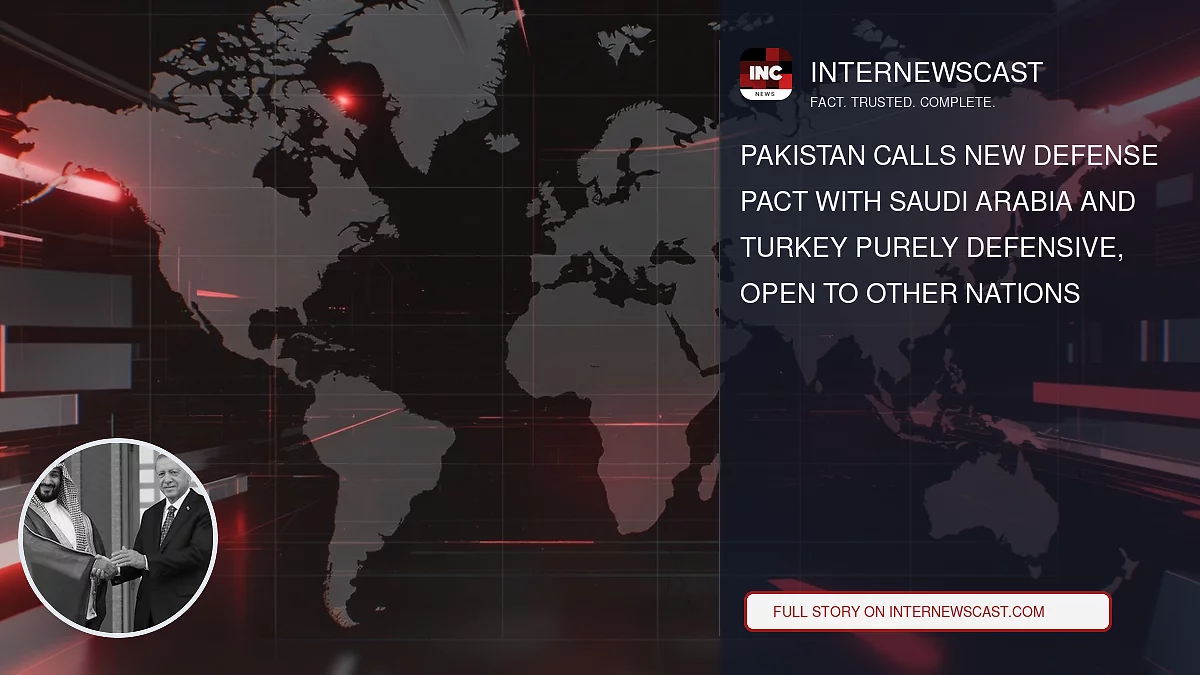
The Mecca Joint Defense Agreement was finalized Friday by Saudi Crown Prince Mohammed bin Salman, Turkish President Recep Tayyip Erdogan and Pakistani Prime Minister Shehbaz Sharif, marking a major step in trilateral security cooperation as tensions between the United States and Iran remain elevated.
In a post on X, Foreign Minister Ishaq Dar described the accord as “purely defensive in nature,” saying participation would be open to states prepared to respect its principles and settle disputes peacefully. He said the deal underscored a common commitment to expanding strategic security coordination.
Dar’s remarks came a day after Turkish Foreign Minister Hakan Fidan also stressed that the agreement was not directed at Iran or any other country.
Under the terms outlined in statements from the three governments, “any armed attack against any one of the three states shall be regarded as an attack against them all.” Dar said that provision aligns with the right to individual and collective self-defense recognized under Article 51 of the U.N. Charter.
Pakistan, Dar added, would keep engaging with countries throughout the region in pursuit of lasting peace and stability.
“The Makkah Accord does not abrogate or replace any existing bilateral or multilateral agreements between these countries, or with other countries or organizations,” he wrote.
The statement followed public celebrations held overnight. Landmarks in Islamabad, Pakistan’s capital, and in Saudi cities were lit up in the colors of the Saudi, Turkish and Pakistani flags.
The three countries bring significant but differing capabilities to the arrangement. Pakistan has extensive military experience and is the Muslim world’s only nuclear-armed country; Saudi Arabia brings substantial economic resources and regional influence; and NATO member Turkey has a large military and an increasingly sophisticated domestic defense industry.
In Islamabad, defense analysts cautioned against viewing the agreement as the equivalent of NATO, despite its collective-defense provision. Abdullah Khan, an Islamabad-based defense analyst, said that although the agreement was signed during a period of heightened regional tensions, it should not be interpreted as being directed against Iran or another country.
Pakistan and Saudi Arabia have maintained close military ties for decades and signed a separate mutual-defense agreement in September 2025. Pakistan and Turkey also have expanded military and defense-industrial cooperation in recent years


