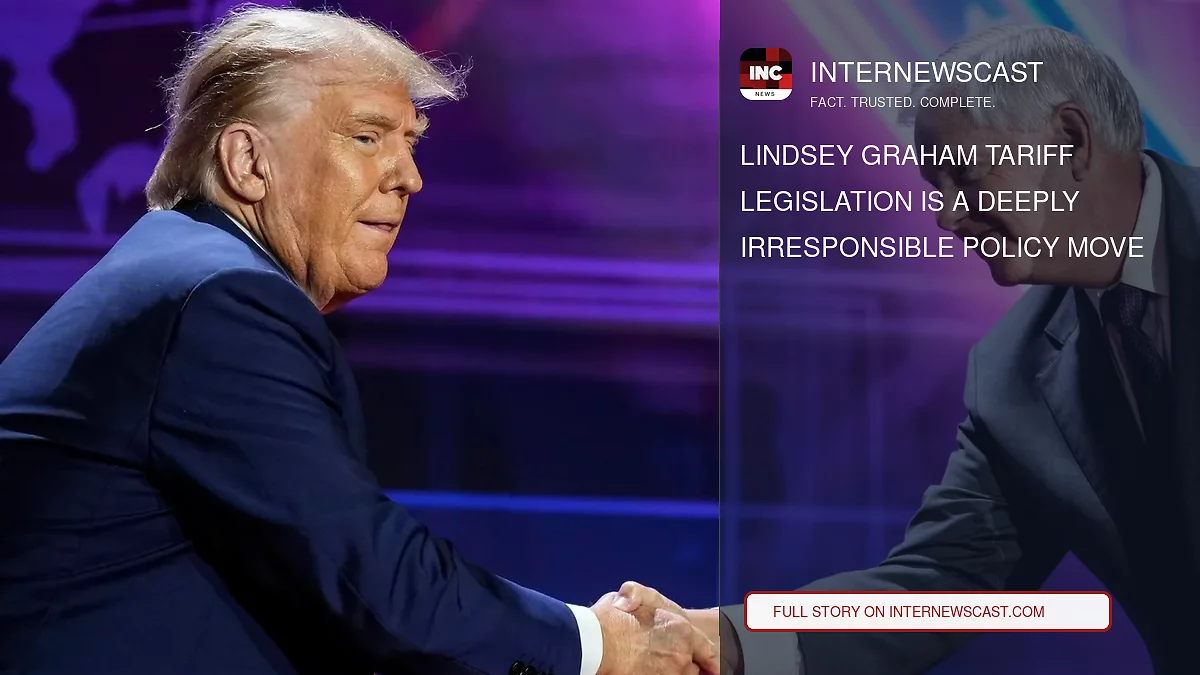

Political control in Washington is never permanent. Majorities rise and fall, presidents come and go, and powers granted in one moment often return in another under very different leadership. That basic lesson of American politics appears to be getting lost on congressional Republicans and the conservative media voices cheering them on.
Consider the Wall Street Journal editorial board. In another surprisingly favorable take on the Sanctioning Russia and Iran Act, after previously offering similar praise, the board conceded last week what should be an obvious concern: the “wisdom of ceding more tariff authority to the White House.” Exactly.
It was not long ago that markets recoiled when the Trump White House imposed tariffs unilaterally, despite serious questions about the constitutional footing for such actions. Now Congress is contemplating giving that same president clearer constitutional backing to pursue policies that would harm not only the U.S. economy and the global economy, but the very principles of sound economics.
Yet the Journal’s editorialists sought to reassure readers who may be uneasy about a bill empowering presidents to slap tariffs as high as 100% on other countries. The message, in effect, was that the president would not be quite that powerful.
As the Journal put it, “the bill includes some important restrictions on how the President can use it. The language limits the number of countries that can be tariffed.” In practical terms, the Graham-backed measure would allow Trump to “only” target countries with significant trade ties to Russia, a category that, as the Journal noted with noticeable enthusiasm, includes India and China. But that is hardly a minor detail.
Imagine, for a moment, Democrats passing a bill named in tribute to one of their own ideological icons—Bernie Sanders, Elizabeth Warren or perhaps Alexandria Ocasio-Cortez—while handing the executive branch expanded taxing authority. Not to worry, the New York Times editorial board might assure skeptics, the president could “only” tax the wealthiest Americans.
The reaction from the right would be swift and justified. The issue would not merely be that affluent Americans supply a disproportionate share of the investment capital that fuels startups, job creation and innovation. It would be that the very wealthiest individuals provide an especially large share of the capital that powers long-term economic progress. That point is worth keeping in mind when evaluating the Graham legislation.
The Journal’s editorial board seems to suggest that because this new tariff authority would apply only to a limited group of countries engaged in global trade, the danger is manageable. That conclusion deserves far more skepticism.
Not all trading relationships are equal. Put another way, the Chinese people are conducting what is a passionate love affair with American goods of all kinds. Which helped explain the previous market corrections in response to President Trump’s thoroughly mindless tariffs. Rest assured, the market reaction wasn’t trader nailbiting over tariffs levied on Peru, South Sudan, and the Marshall Islands. Get it?
In short, the assurances about the Graham legislation offered by the most important source of freedom and free market opinion in the world are hardly mitigated by the limited number of countries that Trump would have power to foist tariffs on. That’s because Trump’s not interested in Micronesia, but he is interested in China and India, the two largest importers of “Russian oil,” by far. Still confused?
If so, conduct a few Google searches of the largest foreign markets for the most valuable U.S. companies, followed by a refresher on the basic of trade. And if time is short, the basics will be laid out here in fifteen short words: if producers in other countries can’t sell to us, they also can’t buy from us.
The Graham legislation doesn’t just vandalize economics, it’s incredibly irresponsible. The Wall Street Journal editorial board will ideally come to agreement with the previously expressed sentiment, particularly when it’s remembered that Donald Trump thankfully won’t be president forever.


