
New York City may have found a productive use for one of its least popular commodities: the stifling heat trapped inside government transit hubs.
Excess warmth from Lower Manhattan’s notoriously sweltering subway platforms could soon be captured and redirected, cooling riders underground while helping heat nearby municipal buildings, officials said Monday.
Mayor Zohran Mamdani and MTA Chair Janno Lieber announced that the city and the transit agency will jointly study whether a thermal energy network, known as a TEN, can be installed at the Brooklyn Bridge-City Hall and Chambers Street subway stations.
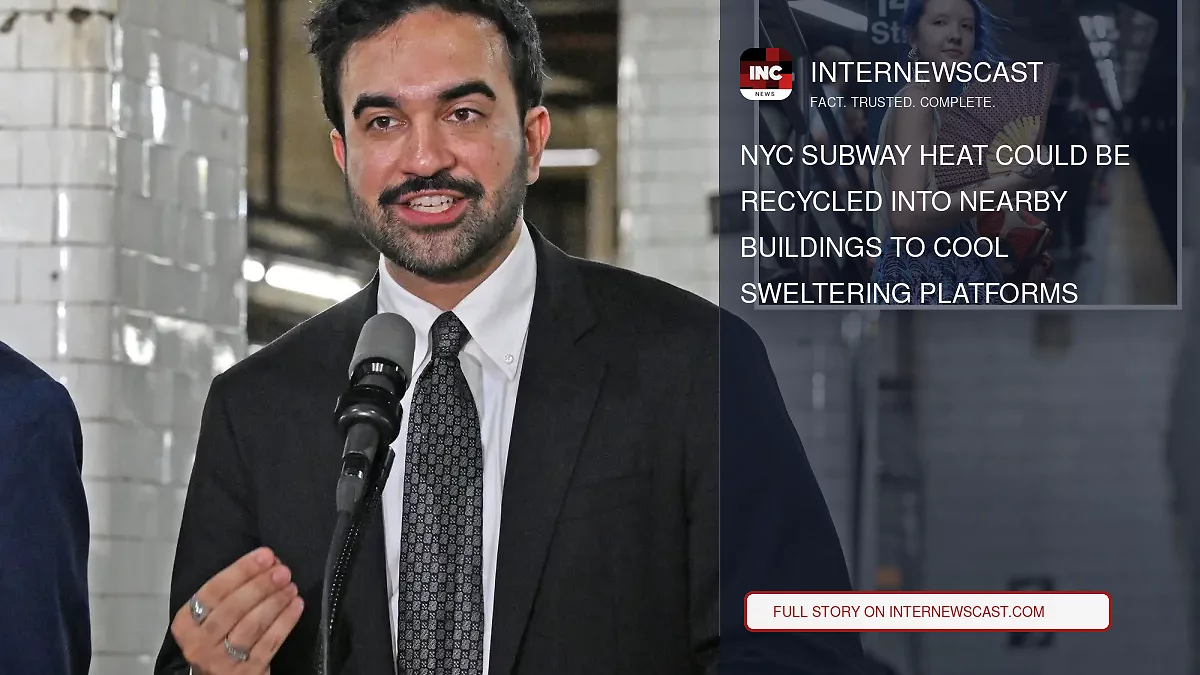
Thermal energy networks use geothermal technology to collect, store and move heat from one place to another. In this case, the system could draw heat out of punishingly hot spaces such as the Chambers Street J/Z platform — where Mamdani was visibly sweating during a news conference at the aging station.
“Anyone who has stood on a subway platform in August knows that our stations do not just get hot — they turn into underground saunas,” the always-suited mayor said.
“If you, like me, do not know what a summer suit is and choose instead to commute in a wool one, let me tell you, it is far from a therapeutic experience,” he joked.
The planned “thermal energy network feasibility study” will examine whether heat accumulating in the subway during the summer can be stored and used in winter to warm public buildings, including City Hall, the David Dinkins Municipal Building, Tweed Courthouse and Surrogate’s Court, Mamdani said.
Officials said a contract for the feasibility study must first be awarded by the fall, with design work potentially beginning in early 2027.
The project would be the first TEN in a US transit system, officials said.
The Brooklyn Bridge-City Hall and Chambers Street stations are the among the “sweatiest” in the subway system, Lieber said.
“The average temperatures last summer peaked at 96 degrees, and every year it’s actually getting hotter because of climate change,” the MTA honcho said.
“This technology has never been tested before in a transit system here in this country, but it is being used elsewhere in the city, like in St. Patrick’s (Cathedral), because it could be a real win-win.”
The project would include radiant cooling technology to absorb heat from the Brooklyn Bridge-City Hall platforms — and potentially those on Chambers Street as well — and transfer it through pipes to geothermal boreholes, officials said.
Those boreholes will be drilled beneath an abandoned Chambers Street platform, an ideal location for testing the technology because it would disrupt passengers, the officials said.
“We would capture heat in boreholes that will run 500 to 600 feet underground, and install a system of circulating pumps and pipes that will use the heat from below our city surface to warm the offices where our municipal workers are hard at work powering this incredible city,” Mamdani said.
The work at Chambers Street would dovetail with a project announced last week by Gov. Kathy Hochul to modernize the dilapidated, 113-year-old subway station.
The restoration project — which will be funded by congestion pricing tolls — will replace damaged ceramic tiles and mosaics, replace or modify stairs and doors, plug leaks, install new lighting and give the station a fresh coat of paint, among other fixes, officials said.
Hochul’s office put out a release touting the geothermal project.
But neither the governor, nor anyone from her office, sweated it out with Mamdani and Lieber for their underground news conference.