
Anyone planning a getaway to a far-flung destination — or even browsing winter sun holidays — may want to take note of the latest findings from the Health Protection Surveillance Centre.
Following a sharp fall in infections during the Covid-19 pandemic, tropical disease cases have been climbing again in the years since travel restrictions were lifted.
Illnesses reported in Ireland include malaria, leprosy, Mpox, giardiasis, West Nile fever, typhoid and dengue fever.
Health experts say the rise is not without explanation, with the trend largely tied to a simple factor: Irish people are travelling abroad more frequently.
Dr Graham Fry, of the Tropical Medical Bureau, says that despite economic pressures and global instability, Irish travellers are still taking international trips in significant numbers.
‘People are travelling for the familiar reasons — holidays, for one, and business trips as well,’ he says.
‘Then there are NGO and humanitarian trips, where people may be heading to places such as Congo or other areas affected by disasters.’

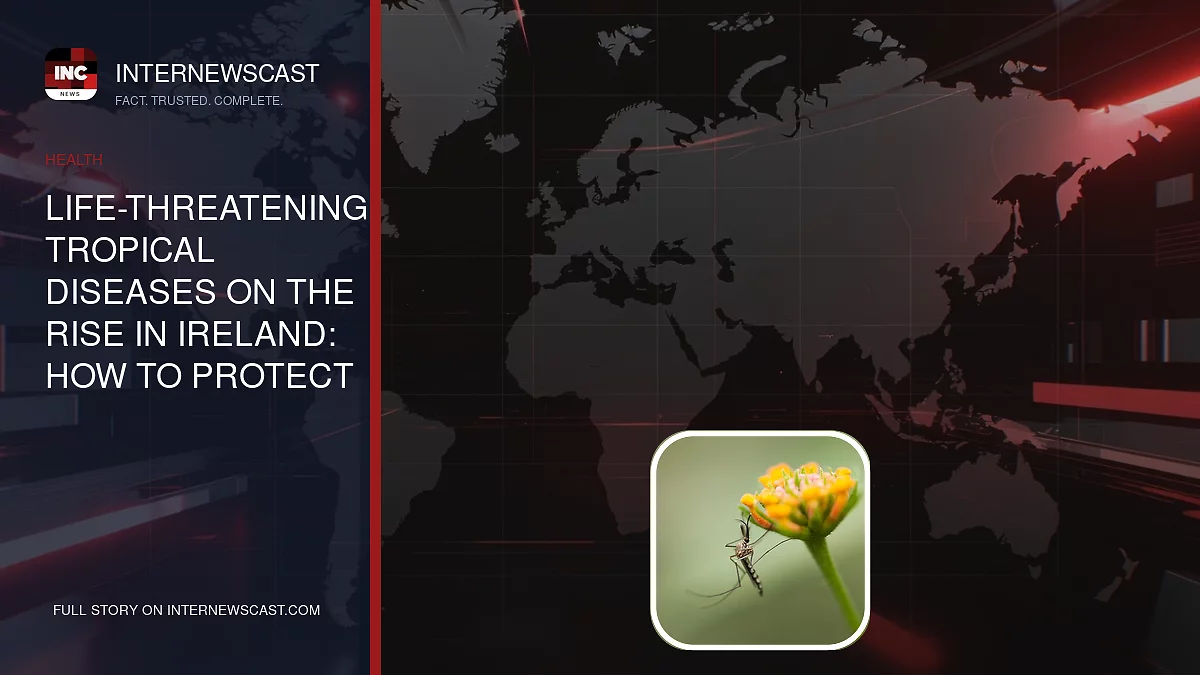
Mosquitoes are spreading further north across Europe
At certain times of the year, and if there is a specific crisis in a certain region, charities and humanitarian organisations mobilise to that area.
‘You will have a huge increase in NGO travel if there is, for example, an earthquake or a tsunami,’ says Dr Fry.
‘There’s business travel as well going on throughout the world. India is perhaps one of the main places that people are travelling to from that point of view, but also parts of Africa as well.’
As air travel has become cheaper, our holiday destinations have become more adventurous but that brings more risk of catching something nasty.
Cases of malaria are rising in Europe now and the incidences of the illness here reached 71 cases in 2025.
Global warming is playing a part in the rise of malaria cases, but it is travel more so, according to Dr Fry.
‘The mosquitoes are moving further north so we definitely have mosquito issues occurring in southern Europe and moving into northern Europe,’ he says.
‘Both mosquitos and ticks are moving up and though we haven’t seen issues with these in Ireland, there are certainly other countries in Europe experiencing problems that they haven’t had in the past.’
Mosquitoes spread a number of illnesses including malaria, dengue fever, zika, chikungunya, West Nile virus and yellow fever.
But any cases recorded in Ireland have been contracted elsewhere.
‘Mosquitos are a vector – they are just carrying a disease from person X to person Y, so they aren’t causing the disease, just moving it from person to person,’ Dr Fry says.
‘Though we do have some mosquitos in Ireland, the reason these diseases don’t spread here is because there aren’t enough mosquitoes and, because of our climate, the ones that do live here don’t survive long enough to spread anything.
‘Swords [in Dublin] has always been the area that people talk about having mosquitoes, mainly because it is close to the airport.’

Dr Graham Fry of the Tropical Medical Bureau
This is because holidaymakers aren’t the only ones travelling in from abroad and mosquitoes have been found to hitch a ride with passengers on planes.
‘Just two weeks ago it was reported that four baggage handlers in Frankfurt Airport got malaria when none of them had been travelling,’ says Dr Fry.
So at least one infected mosquito must have travelled in by plane, in cargo, and it is suspected it then bit the handlers as soon as it saw daylight.
‘Obviously there is no malaria in Germany,’ says Dr Fry. ‘When a mosquito sucks up something from a human or an animal depending on what that something is, it depends on how long it takes for it to be passed to the next person.
‘Malaria is caused by a parasite called plasmodium; dengue, chikungunya and zika are all viruses.
‘It depends on how long it takes before that bug is ready to be passed on to the next person. In malaria, it’s days and days. In viruses, it can be very rapid.
‘Our mosquitoes in Ireland don’t live long enough to actually have that cycle for malaria. That’s why there’s a huge difference between East Africa and West Africa with regard to the amount of malaria transmission.
‘In West Africa there is much more transmission because in East Africa the climate changes between hotter and colder throughout the year.
‘In West Africa, it’s hot and humid throughout the year so the mosquitoes can survive longer.
‘They only live for about 14 days. In Ireland, the mosquitoes would actually die within six or seven days. So we have a very different situation.’
As the population of the world is increasing, so are our temperatures and so mosquitoes and the likes of ticks are moving further north too, gaining traction now as far up as the middle of Europe.
You can contract a vector-borne disease or illness anywhere where there are mosquitos.
With the rise of holiday spots like Thailand and Bali, zika virus has become a concern for travellers who then wish to have a child.
‘Zika doesn’t cause problems for adults but if you have the virus and get pregnant it can cause microcephaly in unborn children,’ Dr Fry says.
This is why it is important that, if you have travelled to a country where zika is prevalent, you get tested afterwards to see if there is an infection.
Like malaria, chikungunya and dengue fever cause issues for adults. Chikungunya causes high fever, severe joint pain – often in hands and feet – muscle pain, headache and rash, and the joint pain can linger after the virus is gone.
It is common in tropical and subtropical areas of Asia, Africa and the Americas, with an expanding presence in parts of southern Europe, transmitted by aedes mosquitoes, known also as tiger mosquitoes, which are daytime biting mosquitos with black and white stripes.
Dengue fever is a viral infection that is usually mild and passes after about seven days but in rare cases, it can be very serious and life-threatening.
It is prevalent in the same areas of Asia, Africa and the Americas but is also now prevalent in some parts of France, Spain, Italy, Croatia and Greece thanks to the spread of the tiger mosquito.
Parts of Europe are now considered high risk for dengue fever.
‘Significant numbers of West Nile virus and chikungunya outbreaks were reported in mainland Europe in summer 2025, but no cases were reported in Ireland associated with travel to mainland Europe,’ the HSPC’s latest report said.
‘In December 2025, HPSC received six delayed notifications of chikungunya, spanning from February to November 2025.’
Malaria notifications in Ireland had a majority of cases originating from sub-Saharan Africa.
While leprosy is incredibly rare in Ireland, Dr Fry insists it is worth checking out in anyone who has been travelling and appears with undiagnosed nerve problems in the legs.
‘If we see someone present with this, leprosy should be on the differential diagnosis list for the healthcare professional,’ he insists.
‘So someone like myself, we should be thinking about leprosy, even though it’s not at all likely and is much more likely to be some other neurologic disease. But there still are leprosy cases, maybe 500,000 throughout the world.’
Mpox is also still in Ireland but this is transferred by skin-on-skin contact so is more likely to be a sexually-transmitted disease.
Dr Fry has just returned from working in a hospital in the Congo where, in the north-east of the country, there has been an Ebola outbreak.
But he feels for now it is unlikely to spread outside the Congo as the area is contained by an ongoing war which makes movement difficult because of major security issues.

Giardiasis, often mistaken for IBS, looks like a clown under a microscope. Photo: Getty Images
Closer to home, giardiasis is an infection that can often be mistaken for irritable bowel syndrome.
‘It’s a parasite which is very comical under a microscope as it looks like a clown,’ says Dr Fry. ‘When it goes into your body, it will cause loose bowel motions, bowel pain, all those sorts of things. Those patients may turn up at their GP for what appears to be irritable bowel syndrome and, of course, if you don’t do a test, you won’t know it is giardiasis.’
It is caused by swallowing untreated water from lakes, rivers, streams or unverified public supplies; eating food washed or handled in contaminated conditions or poor hand hygiene.
‘There have been outbreaks in England as well,’ says Dr Fry, insisting that it is essential that any travellers with IBS-like symptoms get tested.
Additionally we have cryptosporidium being talked about by some health boards and similar parasites are not confined to tropical areas.
‘There is an outbreak of cyclospora in the United States at the minute, it is another of these single-cell parasites,’ Dr Fry says. ‘Over 6,000 cases of it have been recorded in the US and it is affecting 47 states at the moment.
‘If you’re going to the States on holiday, that might be an issue and, of course, there are zones of Lyme disease in the States. It was first recognised in Lyme, a town in Connecticut. So, if people are going to the States, you certainly want to avoid tick bites.’
To avoid getting ill while on holidays or travelling or bringing something unwanted home with you, Dr Fry says vaccination is good, but it’s not enough to simply rely on that. Common sense, he says, is just as important. There are also some things he would advise people to avoid.
‘If you are going almost anywhere abroad with your family for a holiday, you need to be careful about going to petting zoos,’ says Dr Fry. ‘The animals there may have ticks or fleas on them, they also might have been licking the backside of one another and then lick you.
‘Practically every year in the States there is an outbreak of rabies in a petting farm from an animal getting a bat bite and then they have to trace the thousands of people who went through those petting zoo doors.
‘I am the most boring person because when I’m out for a meal I will not eat food that I’m not happy with.
‘One of the main foods that I always talk about is shellfish – bivalves, mussels, oysters, clams, scallops, those sorts of things.
‘They are filter feeders, they suck in sewage. When you and I go to the loo, we flush the loo, it disappears.’
Here we have treatment plants to deal with the waste but in some countries sewage goes straight into the sea.
‘Cooking kills a lot of bugs but we only steam shellfish and open the shell to eat them and that is asking for trouble,’ Dr Fry says.
‘When people go on holidays, we forget that we are so fortunate here and we don’t have a lot of the problems that other people across the world have, so we need to think a little more about what we are doing.
‘For example, there is a new variant of Covid in India, Taiwan and China at the moment.
‘I just think for the Irish people to travel, they really need to bring common sense with them.
‘Vaccines are great but they’re not perfect. You still have to have your personal hygiene considerations.
‘When you’re on an escalator and your hand is holding the rubber moving handrail, who else held that before you? Did they cough into their hand and then put their hand on it?
‘It’s simply a matter of having good hygiene at all times and being aware, rather than being hysterical.’


