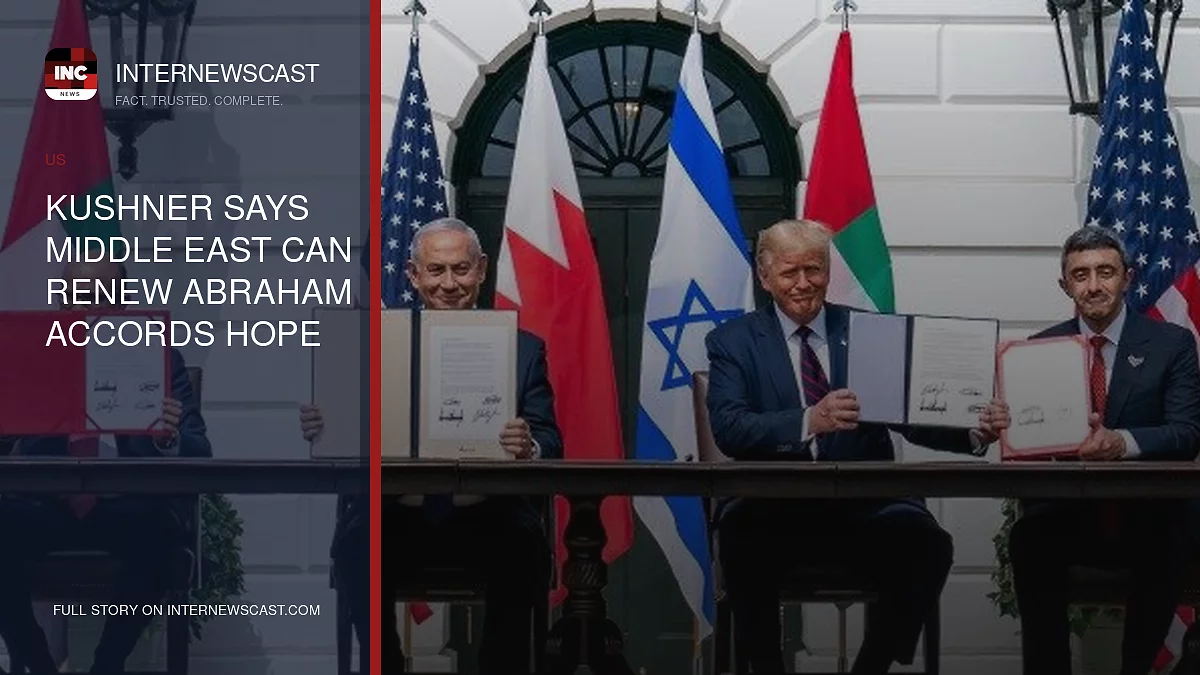

Six years after President Donald Trump introduced the Abraham Accords, Jared Kushner used the anniversary Thursday to say the Middle East has arrived at another pivotal moment—one that, in his view, could allow the region to extend the momentum of the landmark normalization deals and “do it again.”
“Six years ago, President Trump launched the Abraham Accords and opened a new chapter of peace, partnership, and prosperity in the Middle East,” Kushner, Trump’s son-in-law and one of the central figures behind the agreements, wrote in a post on X.
He reflected on the skepticism that surrounded the effort at the time. “Many said it was impossible,” Kushner wrote. “But with courageous leadership, persistence, and a small group of people willing to challenge old assumptions, we proved that the impossible could be achieved.”
According to Kushner, the Abraham Accords marked a sharp departure from decades of diplomatic orthodoxy that, he argued, had kept the region “trapped by old ideas and failed frameworks that managed conflict rather than solved it, and too often created incentives that perpetuated division and instability.”
The premise, he said, was straightforward: rather than emphasizing long-standing divisions, leaders should create practical connections that encourage cooperation. Kushner pointed to stronger people-to-people ties, rising trade and investment, closer security coordination and real-world gains that give nations and citizens alike “a stake in peace.”
Kushner credited the accords with generating “billions in trade, joint innovation, new friendships and partnerships,” then shifted from the agreements’ legacy to what he described as a fresh opening for diplomacy and regional cooperation.
“The Middle East is once again at an inflection point,” he wrote. “There are breakthrough opportunities today that many will say are impossible. But we have seen what can happen when leaders reject conventional thinking, focus on common interests, and have the courage to pursue a better future.”
Kushner said the Abraham Accords proved that entrenched assumptions about the Middle East can be overturned. “Now we have an opportunity to build an even broader movement around cooperation, shared prosperity and security—and replace the failed ideas of the past with a new model that gives people across the region something better to believe in and build toward,” he wrote.
“We surprised the world once,” he concluded. “With the right leadership, focus, patience and courage, I believe we can do it again.”
Israeli President Isaac Herzog responded to Kushner by crediting Trump and his team for forging the agreements and joining his call to expand them.
“The 6th anniversary of the Abraham Accords, forged by your team under President Trump’s leadership, is an important milestone for peace in the Middle East,” Herzog wrote.
“It is a moment to reflect on the remarkable partnerships that we have built across our region,” Herzog continued. “It is also a moment to look to the future and chart the road ahead together.”
“I firmly believe that this is just the beginning,” he added. “Now is the time for us all to work to expand this circle of peace across the Middle East to the benefit of all our peoples.”
Trump has also repeatedly called for expanding the Abraham Accords, telling – News at the G7 in June that he expected additional countries to join and pointing to the agreements’ durability during the war with Iran.
“Do you notice that even during that period of conflict, nobody dropped out? Nobody said, ‘Oh, gee, I’m going to drop out.’ Nobody,” Trump said.
“I think they’re all going to come in now into the Abraham Accords,” he added. “The only conflict was a place called Iran, and I understand that. It’s a little bit tough when people were afraid of Iran. But I think they’re going to all start coming in.”
The relationship between Israel and the UAE deepened considerably during the conflict, with Israel reportedly deploying an Iron Dome battery, interceptors, and dozens of IDF personnel to the UAE to help defend it against Iranian missile and drone attacks. Subsequent reporting indicated the Emiratis also carried out strikes against Iran in close coordination with Israel and the United States.
Trump has continued to press for expansion since then. Late last month, he said approval of a U.S.-Saudi civil nuclear agreement would be “totally subject to Saudi Arabia joining the very respected and successful Abraham Accords.” The prospect of Saudi-Israeli normalization was also discussed days later during Trump’s White House meeting with Israeli Prime Minister Benjamin Netanyahu.
The Abraham Accords, brokered during Trump’s first term, established normalization between Israel and the United Arab Emirates and Bahrain in 2020, with Morocco subsequently normalizing relations with Israel and Sudan joining the broader accords process.