
When the Prince of Wales spoke to Eugene Levy last October about what his future reign might look like, he made clear that he sees change as central to his vision for the monarchy.
‘I think it’s safe to say that change is on my agenda. Change for good. And I embrace that and I enjoy that change – I don’t fear it,’ Prince William said candidly on the actor’s television series, underlining his desire to help shape a more modern Royal Family.
Over the past few years, William has increasingly defined his own path within the Firm, taking a more progressive approach and stepping away from certain royal customs. Among them are his well-known reluctance to wear a kilt, a reduced number of overseas tours and his decision to make Windsor’s Forest Lodge his family’s ‘forever home’.
Royal commentator Richard Fitzwilliams says the Prince of Wales’s ‘unconventional’ style is worthy of praise. Even so, he believes William could strengthen both Britain and the monarchy by choosing to uphold some of the most cherished royal traditions.
Mr Fitzwilliams told The Daily Mail: ‘It was totally understandable that he should have prioritised his family in the early years and his insistence on privacy for them was essential, especially considering the extraordinary scrutiny they will face in later life.
‘Yet considering the magnitude of the job he one day will be asked to take on, with King Charles still battling cancer, it is surely important that he takes on more.’
The royal expert added: ‘Earlier after his marriage he was with the RAF Search and Rescue and then the East Anglian Air Ambulance Service, but his reluctance to take on public duties led to the accusatory nickname “Work Shy Wills”, implying he only took on what he wanted to do.’
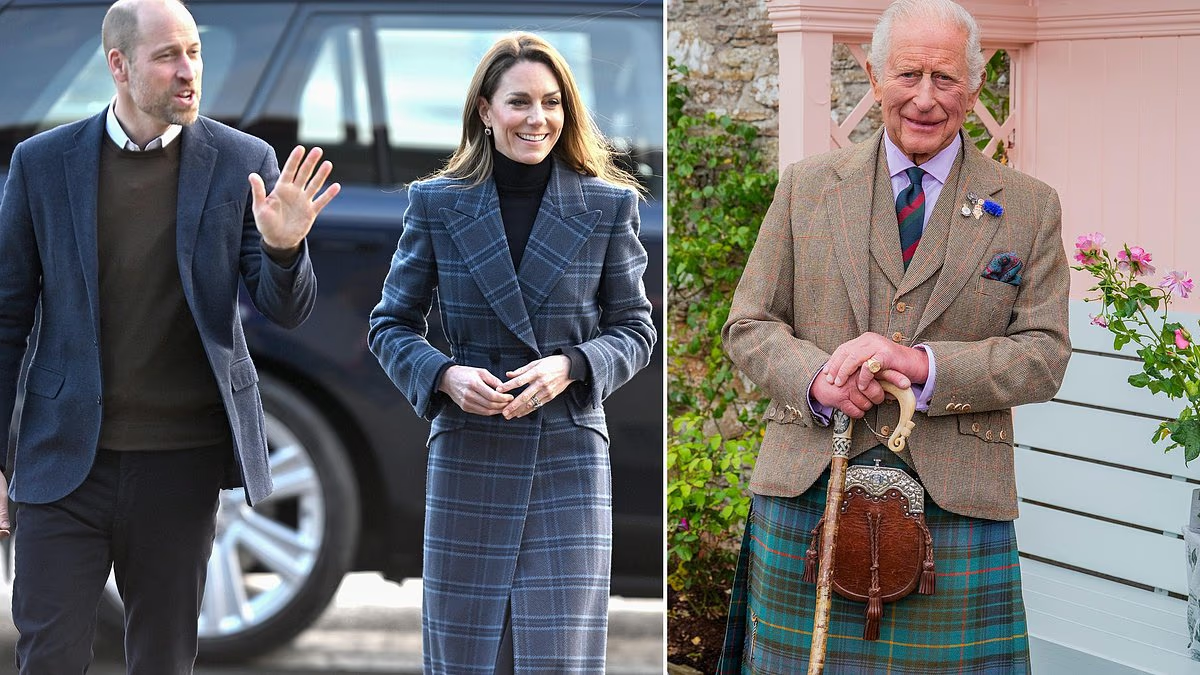
His remarks come after King Charles was pictured last week smiling broadly as he planted the King’s Rose in the historic Gardens of Mey during his annual Scottish break, while dressed in a traditional kilt.
However, while donning Scottish attire has long been considered a royal tradition during visits and engagements north of the Border, William has not shown such a keen interest in continuing this unofficial dress code.

According to royal expert Richard Fitzwilliams, it would now ‘benefit both Britain and the monarchy’ for Prince William to embrace some celebrated royal traditions. Pictured: the Prince and Princess of Wales in Stirling, Scotland in January

Last week, King Charles was photographed beaming as he planted the King’s Rose in the historic Gardens of Mey on his annual Scottish break – dressed in a traditional kilt

However, while donning Scottish attire has long been considered a royal tradition during visits and engagements north of the Border, William has not shown such a keen interest in continuing this unofficial dress code. Pictured: William with his father Charles at Balmoral in 1997
The prince even had the choice to wear one for his university graduation ceremony in June 2005. Instead, he chose to wear a traditional suit with a white bow tie and black silk academic gown with a red lining.
While Mr Fitzwilliams acknowledged that ‘there is no reason any public figure should be forced to wear something they feel doesn’t suit them’, the kilt still serves a key purpose in Scotland.
‘It is the national dress of Scotland, once banned by the English after the Jacobite Uprising,’ he explained.
‘I don’t feel he should feel forced to wear it, but there are occasions where the Scots would undoubtedly appreciate it.’
Yet the Scottish kilt is not the first tradition William appears to have deviated from – with royal onlookers often noting that the Prince and Princess of Wales have taken on far less international royal tours than other couples.
‘Obviously, Catherine’s health has been a priority. We rejoice in her recovery and in the success of her recent trip to Italy. Yet the last royal tour they undertook as a couple was to the Caribbean in 2022,’ Mr Fitzwilliams said.
He added: ‘A trip to capitalise on the support for the monarchy in the Antipodes would be a splendid idea and should be arranged as should, in time, trips elsewhere in the Commonwealth and visits to our European allies, following in King Charles’s footsteps.
‘This would be a brilliant use of our soft power, bearing in mind the Waleses have ratings Britain of over 70 per cent which is superb and should be maximised.’

The Prince and Princess of Wales have taken on far less international royal tours than other couples. Mr Fitzwilliams notes that there last one was to the Carribbean in 2022 (pictured)
Mr Fitzwilliams further explained that the Prince of Wales’s ‘unconventional approach’ towards royal traditions extends towards his view on royal patronages.
‘Royal patronages are highly valued,’ explained the royal expert. ‘King Charles has nearly 700, Princess Anne over 300, the Duke and Duchess of Edinburgh over 70 each.
‘The Waleses have only around 60, though they undoubtedly do more for those they support. Indeed their success is meteoric, which is why it would surely make sense to do more.’
Indicative of William’s more modern approach, the prince has taken a different attitude towards the Duchy of Cornwall, the estate he inherited from his father upon the King’s accession to the throne.
In an interview with the Telegraph’s Royal Editor Hannah Furness last year, who spent a day travelling alongside the Prince of Wales as he visited his tenants, the royal shared how he was modernising the land and property empire.
This includes encouraging people involved with the Duchy to speak openly, with the Prince telling his staff to ‘please give [everyone] proper authority to say what’s really going on. Not being polite because I’m in the room,’ ahead of a meeting in Dartmoor.
Elsewhere, Matthew Morris, the rural director of the Duchy, revealed how employees ‘no longer feel the need to put on a tie when the Duke of Cornwall is in town’ – perhaps unlike when Charles – who is often smartly dressed in a full suit – visited.
The publication also noted how William will communicate with staff via WhatsApp and ask questions over the social media platform in order to keep updated.
He added that the Prince – who is looking to improve the estate so it has even more of a positive social impact, while keeping its key community spirit – and his team are ‘seeking to remove any ambiguity’.
Mr Fitzwilliams noted that, in his view, the Prince of Wales should ‘continue King Charles’s transparency in revealing the amount of tax he pays’.

William and Kate’s ‘forever home’ is said to be Windsor’s Forest Lodge, rather than Buckingham Palace or any other more traditional royal residence, such as Kensington Palace
He also added that William and Kate’s decision to select Windsor’s Forest Lodge as their ‘forever home’ showcases their commitment to bucking tradition in favour of what is best for their family.
William, for instance, was raised primarily at Kensington Palace and Highgrove House, while Charles was brought up at Buckingham Palace and Clarence House.
However, Our News Outlet has previously been told that it is William’s ‘intention’ to remain in their new Grade II-listed property even after he accedes to the throne.
‘This is for the long term and it’s their intention to stay in Forest Lodge once he becomes king,’ a source said.
Although well beyond the means of most families, Forest Lodge is certainly not grand – particularly when it comes to an heir to the throne.
William’s decision to live there shows his determination to adopt a more ‘relatable’ way of living, in comparison with the vast 30-room Royal Lodge previously occupied by Andrew Mountbatten-Windsor, or Prince Edward’s Bagshot Park, which is said to boast between 50 and 120 rooms.
Adding that the Waleses decision to live at Forest Lodge was ‘expected’, Mr Fitzwilliams added: ‘There is no need for the monarch to live “above the shop”.
‘But it is also a pity as visitors , and there will be more of them, often feel they might catch a glimpse of the monarch and this does add a certain cachet to the Palace.’