

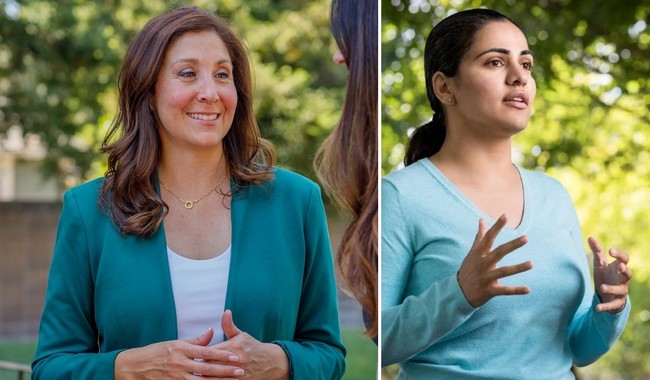
Voters in California’s 14th Congressional District head to the polls tomorrow, Tuesday, August 18, 2026, for a special election to fill the House seat vacated earlier this year by Eric Swalwell’s resignation. The contest pits Melissa Hernandez, president of the BART Board of Directors and a former mayor of Dublin, California, against Aisha Wahab, the Assistant Majority Leader in the California State Senate.
Both candidates bring compelling personal stories to the race. Hernandez, the daughter of migrant farm workers and a single mother, points to a background that includes both public service and some private-sector business experience. Wahab was born in New York City, orphaned young and later adopted by a family in Fremont, California. She also cites business experience before launching her political career at the city level in 2018. On her campaign website, Wahab identifies herself as the first Afghan American woman elected to public office.
On policy, the two Democrats are separated more by tone than by sweeping ideological divides, at least based on the platforms presented on their campaign websites. Hernandez says she would work to “drive down the costs of housing, healthcare, and childcare, protect Social Security and Medicare from cuts, and prioritize growing small businesses to strengthen our local economy,” though her site offers few specifics on how she would achieve those goals. On immigration, she is sharply critical of ICE while saying she “supports smart border security and regional cooperation to address the root causes driving migration, not political stunts that put families in danger.”
Wahab’s agenda broadly tracks with Hernandez’s on many domestic issues, though her campaign website does not address immigration, legal or otherwise. One area where Wahab strikes a more forceful note is foreign policy, particularly on war and military engagement:
We must end open-ended deployments, stop unauthorized air campaigns, and return service members from conflicts that lack clear goals or a responsible conclusion. The best way to honor our troops is not to send them into wars that political leaders cannot explain and refuse to end.
America is strongest when our word carries weight, our alliances are trusted, and our military is used only as a true last resort. A responsible foreign policy can protect our country, reunite military families, rebuild relationships abroad, and prevent another generation from inheriting wars that should have ended long ago.
In other words, a message that may sound more restrained and anti-interventionist than some voters might expect from the party’s recent foreign policy establishment.
With few major policy contrasts defining the race, the campaign for California’s 14th Congressional District has increasingly centered on attacks and outside spending. Hernandez has drawn a significant share of her campaign financing from beyond the district, including support from establishment Democrats who are breaking with their own party’s endorsement of Wahab. She has also benefited from millions of dollars tied to the United Democracy Project, described as a “nonpartisan super PAC affiliated with the American Israel Public Affairs Committee (AIPAC).” The PAC has distributed multiple anti-Wahab mailers, including attacks accusing her of weakening laws aimed at combating child sexual exploitation.
Adding another unusual wrinkle, Hernandez and Wahab are not finished with each other after Tuesday’s vote. The same two candidates are scheduled to face off again in November 2026 for a full term in Congress, meaning the winner of the special election could return to Washington only briefly before having to defend the seat as an incumbent just three months later.
It is not difficult to envision Wahab, should she win, to swiftly align herself with the Alexandria Ocasio-Cortez effort to be progressive in nature but moderate in tone as part of an effort to broaden her national appeal before 2028. Certainly her minority status would be a feather in the Democrat cap. Wahab easily outpaced Hernandez in the two previous 2026 primary elections, one for the November ballot and one to fill the remainder of Swalwell’s term. Should she do so again in the two upcoming elections, she could well join Ocasio-Cortez in the category of politicians not to ignore.
Editor’s Note: The Democrat Party has never been less popular as voters reject its globalist agenda.
Help us continue exposing Democrats’ plans to lead America down a dangerous path. Join RedState VIP and use promo code FIGHT to receive 60% off your membership.