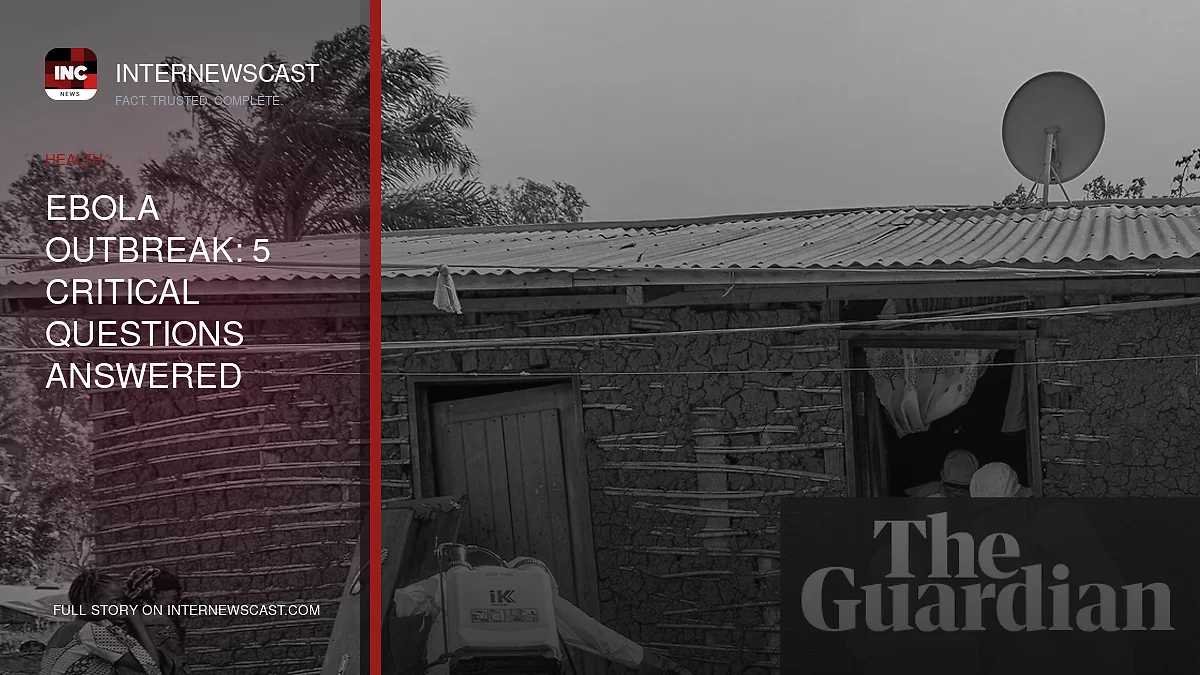

Since 15 May, the Democratic Republic of the Congo has recorded nearly 5,000 Ebola cases and more than 2,000 deaths, making this the largest and deadliest Ebola outbreak in the country’s history.
Dr Jean Kaseya, director general of the Africa Centres for Disease Control and Prevention (Africa CDC), warned during a mid-August media briefing that the crisis is heading toward becoming “the largest one in the world”.
Why are case and death figures still increasing?
Although the Ebola outbreak was officially announced on 15 May, health experts believe the virus had already been circulating silently for months. That delay has left responders struggling to regain control. “The outbreak had a big head start, it is still way ahead of us and we are playing catch-up,” Dr Tedros Adhanom Ghebreyesus, the World Health Organization (WHO) director general, said last week.
The latest surge is being driven by the Bundibugyo virus, a less common strain of Ebola for which there is no approved vaccine or licensed treatment. With no targeted medical tool available, frontline health teams are depending on labor-intensive public health measures: finding suspected cases, isolating patients for care, and tracking their contacts for continued monitoring.
Uganda managed to contain its own flare-up after infected travellers arrived from the DRC, declaring the outbreak over after 20 confirmed cases and two deaths.
The situation has proved far harder to control in Ituri and North Kivu, the DRC provinces reporting the highest case numbers. Ongoing armed conflict has forced tens of thousands of people from their homes, making contact tracing extremely difficult. Africa CDC estimates that responders are currently tracking only about 12% of contacts, far below the 95% target needed to curb transmission.
In response, authorities are shifting strategy. Health teams are preparing to go house to house in search of people showing Ebola symptoms, while local representatives in every village will be recruited to help strengthen the outbreak response.
Where are the 850 people who tested positive but are unaccounted for?
By 15 August, officials had confirmed 4,945 cases. Of those, 730 people were receiving care in treatment centres, 1,040 had survived the virus, and 2,325 deaths had been recorded.
That leaves 850 people who have tested positive, but are unaccounted for in the number of patients, survivors and victims. People who have the virus, but whose whereabouts are unknown, represent a high risk of onward Ebola transmission.
In the hardest-hit areas, many locals have extremely little trust in the authorities. They ask why the government is suddenly present, when communities had been struggling alone before – including with other diseases such as cholera and malaria.
Mistrust translates into infected people coming forward for treatment late, if at all – and sometimes, fleeing Ebola treatment centres because they do not trust that they will get the necessary care there.
Some families prefer to care for their loved ones at home – and, if they die, to follow their usual burial practices that involve touching the bodies. Ebola is spread through body fluids, and carers without the proper protective equipment face a high risk of infection.
Is money that has been promised reaching the frontline?
The availability of banknotes has been a real issue for paying workers involved in the response. The airport in Bunia, the provincial capital of Ituri, has been closed to commercial flights for months, making it harder to bring cash in.
In remote areas, there are no banks and mobile money systems are unavailable, says Prof Yap Boum, of Africa CDC. “The frontline responders, the community healthcare workers, the people working in treatment centres […] you need to pay them with cash.
“If you don’t have the cash in the city, and therefore in those villages, it’s difficult to run some operations,” he says.
Some staff, including nurses and the teams in charge of safe burials, have gone on strike over the lack of pay. In the face of attacks from the community, many of whom do not believe the Ebola outbreak is even real, they say they “see no point in risking our lives” without compensation.
The new, village-based approach that goes from door to door will need more workers and probably be more expensive than the approach up to now.
However, officials have insisted that payment problems are being ironed out.
Africa CDC says $518m (£382m) is needed for the direct health response to Ebola, and another $882m to tackle surrounding humanitarian issues.
Donors including the US, EU, African Union member states, the World Bank and its Pandemic Fund have pledged more than enough to cover that amount – but not all the funding has been released. Tedros said last week that only $264m of the $518m had been disbursed. Getting ahead of the outbreak, he warned, “depends on financing”.
Do we have any treatments or vaccines available?
In the wake of Covid-19, the world launched an ambitious initiative to make diagnostics, therapeutics and vaccines available within 100 days of any future pandemic. And while Ebola is not a pandemic, the International Pandemic Preparedness Secretariat has been tracking progress on that basis. The world is not going to meet the 100-day deadline – but there has been progress.
Testing is now available in labs in Ituri, rather than requiring samples to be sent to Kinshasa for confirmation.
Safety trials have begun of two vaccines designed specifically to protect against the Bundibugyo strain. And new evidence suggests that an existing Ebola vaccine called Ervebo, designed to fight the Zaire strain of the virus, may offer enough cross-protection against Bundibugyo to cut death rates, even if it does not prevent infection – officials are planning to roll it out on that basis.
Trials have begun on some drugs both as treatment and as prophylaxis when given to someone exposed to a Bundibugyo patient.
In the coming months, the cost and access to any drugs or vaccines that prove successful in trials are likely to be a test of international solidarity.
What will things look like in another 100 days?
The outbreak will not be over by the start of December. But WHO officials hope a renewed focus, and shifting their approach to actively seeking cases on a village-by-village basis will reverse the spread of the disease in the DRC within three months.
One early indicator of progress would be a fall in the case-fatality rate – the proportion of people testing positive who die, which has risen in recent weeks. As of 15 August, it stood at 47%.
A high death rate is likely to reflect people coming forward late, when it is harder for doctors to treat them, and cases not being reported. A fall would suggest improvements in tracing efforts, as well as potentially better treatment.
Another key thing to watch for is any further spread to neighbouring countries – South Sudan, which neighbours Ituri, has its own ongoing humanitarian crisis that would make a response to Ebola harder. Authorities in the country have been stepping up surveillance, including by training health workers in border towns to spot signs and symptoms of the disease.
Potential vaccines and treatments, and an intensified response, are reasons to be hopeful. But if current efforts fail to bear fruit, the outbreak is on course to surpass the biggest on record, which killed more than 11,000 people in west Africa between 2014 and 2016.