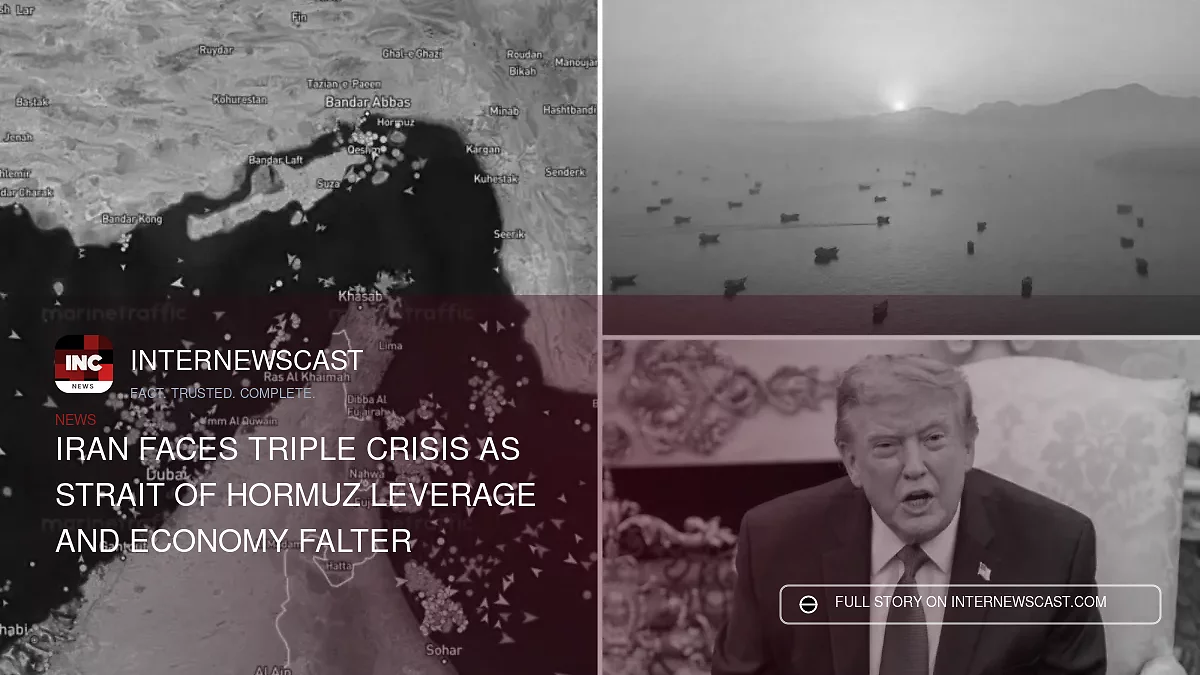

Iran’s supreme leader is facing intensifying pressure as the war grinds on, with Tehran’s influence over the Strait of Hormuz showing signs of erosion, state finances tightening and senior political figures openly pressing the ruling Islamists to seek an exit from the conflict.
In the latest stage of the fighting, a growing number of vessels have been moving through Hormuz with little fanfare. Nearly 200 ships transited the strait last week, according to figures from the UK Maritime Trade Operations Center.
That marks a 400% jump over the past two weeks. Maritime analysts at Kpler said the increase in traffic making safe passage — supported by US Navy escorts — suggests Iran has effectively lost partial control of the crucial waterway.
But while more ships and oil cargoes are getting through, Iran’s own crude exports have fallen to near zero under the renewed American blockade of its ports and President Trump’s “economic D-Day” measures.
Recent satellite imagery has shown little to no activity at Iran’s Kharg Island oil hub, leaving Tehran with few ways to cushion an economy already battered by historically high inflation and unemployment.
Relief appears unlikely in the near term as Washington continues to expand sanctions on the Islamic republic under its maximum-pressure campaign, with Treasury Secretary Scott Bessent warning that additional penalties could follow.
Last week, the United Arab Emirates suspended all trade with Iran in response to renewed missile fire, cutting off a key export hub that had helped Tehran blunt the impact of US sanctions.
The Islamic republic “depends heavily on the UAE, not because the UAE itself produces one-third of Iran’s imports, but because it serves as a major gateway for Iran to access third-country goods and commercial infrastructure,” Mohammad Farzanegan, a professor of Middle Eastern economics at Germany’s University of Marburg, told The Associated Press.
The reality facing Iran’s plummeting economy led the regime to threaten any other Gulf ally with retaliation if it decides to join America’s economic war.
“Any country that becomes a partner in creating economic restrictions against us will be regarded by us as an enemy,” Mohsen Rezaei, Iran’s new security chief, said in an interview with state broadcasters.
With its control over the strait and its economy coming under strain, Iran is also contending with a fracture in its leadership over the state of the war.
Hardliners like Rezaei and the Islamic Revolutionary Guard Corps maintain that they can endure any pressure while inflicting their own harm on the US and its allies.
Meanwhile, Iranian President Masoud Pezeshkian has repeatedly warned that mounting economic pressure on Tehran is taking its toll, while cautioning against “humiliatingly” backing down “before the enemy.”
“The war must come to an end at some point,” Pezeshkian said in a speech Friday, per state media. “It is better that we demonstrate our strength and dignity today and tell the world that we have won and that we are ending the war.”
Iranian Parliament Speaker Mohammad Bagher Ghalibaf also underscored the national security risks the country faces if the theocratic regime continues to deal with a full-blown economic crisis.
“No matter how much military power we have, if our people are struggling and the country lacks financial circulation and economic growth, we will not achieve progress,” he said, per Iranian state media. “As someone who has experienced war, [I] understand the true value of peace.”
Supreme leader Mojtaba Khamenei, who is believed to be severely injured, “probably gay,” and has not been seen publicly since the war began, finally resurfaced last week in a 15-second video.
The clip, which is not dated and gives no indication as to when it was filmed, shows Khamenei — who succeeded his father after he was killed by Israeli bombs in the first day of the war — surrounded by advisors.
His absence from the public eye — even President Pezeshkian has said it’s hard to communicate with him and their one meeting was cloaked in shadow — means his grip on the Iranian people is fading, opponents of the regime say.


