
Eurovision Song Contest organisers have unveiled a major rule change ahead of the 2027 competition, reshaping how future host nations will be chosen.
The annual music event is due to return in May, with Bulgaria set to stage the contest after singer Dara secured victory this year with her winning track Bangaranga.
Under the newly confirmed rules, the “winning broadcaster will automatically be ineligible to host” Eurovision if its country is involved in an “armed conflict” or a “sensitive geopolitical situation”.
The change follows a review by Eurovision chiefs and comes after questions over hosting rules intensified in 2022, when the United Kingdom hosted the contest on behalf of winners Ukraine because of the country’s war with Russia.
Israel’s participation in Eurovision has also faced mounting criticism in recent years. Spain, the Netherlands, Ireland, Iceland and Slovenia all boycotted this year’s contest amid the continuing backlash.
This year, Israeli contestant Noam Bettan was met with loud boos from the audience in Austria during both his semi-final appearance and his performance in the grand final.

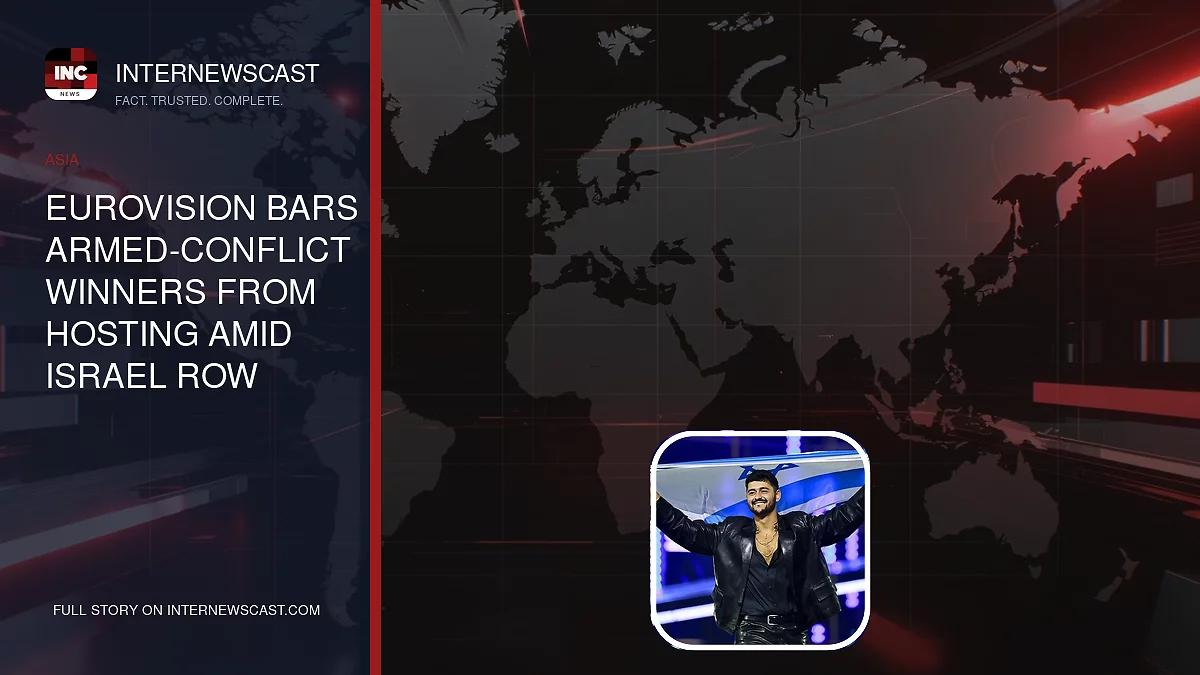
The organisers of the Eurovision Song Contest have announced a huge change to the rules, amid growing backlash over Israel’s involvement. Pictured: Israel’s 2026 entrant, Noam Bettan
Outside the arena, Vienna became the centre of large demonstrations, while more than 1,000 musicians and cultural figures signed open letters calling on Eurovision organisers to exclude Israel from the competition altogether.
Security was significantly tightened ahead of the final following days of unrest in the Austrian capital.
Despite the mounting pressure, Eurovision chiefs stood firm, defending Israel’s inclusion and maintaining that the competition must remain ‘neutral’.
While Israel briefly led during the voting drama, the combined jury scores ultimately saw them slip into second place.
Scenes of jubilation erupted among the Bulgarian delegation as they won and confetti poured from the ceiling, marking a landmark moment in the nation’s Eurovision history.
Across the Austrian capital, pro-Palestine protesters took to the streets waving Palestinian flags and holding signs saying ‘don’t mention Palestine’ and ‘united by genocide’ ahead of the final.
One protester, Viktoria Eibensteiner said: ‘I think it’s very important to show a symbol of Austria being against war crimes, about not offering a stage for Israeli crimes in Palestine, in Lebanon, wherever.
‘We want to take a stance against genocide, against war crimes, and that’s why we’re here today, it’s a celebration that serves to counteract the Eurovision Song Contest and the normalisation of war crimes.’

Israel’s involvement in the contest has come under increased scrutiny in recent years, with many countries boycotting the contest this year. Pictured: Israel’s 2025 entrant, Yuval Raphael
Jamil Sawalmeh, the Country Director for ActionAid Palestine, said: ‘Justice cannot be a song Europe sings for some and silences for others.
‘As Eurovision takes centre stage across Europe today, the humanitarian crisis in Gaza continues, with Palestinians facing bombardment, forced displacement and deepening suffering, while the Israeli Government steps up its assault on Palestinian life and rights in the West Bank.’
The boycotts were a financial blow to Eurovision, which is funded largely by participating broadcasters, and to public broadcasters at a time when many are under financial pressure from government funding cuts and competition from social media.
Long a forum for good-natured and sometimes more pointed national rivalries, Eurovision has found it hard to separate pop and politics in recent years.
Russia was expelled in 2022 after its full-scale invasion of Ukraine.
Tensions rose again after Hamas’ October 7, 2023, attack on Israel, which killed some 1,200 people, and Israel’s subsequent campaign in Gaza that has left more than 70,000 people dead.
The last two Eurovision contests have seen pro-Palestinian protests both outside the venues and inside, forcing organisers to clamp down on political flag-waving.
Several performers and countries have called for the exclusion of Israel, which has competed in Eurovision since 1973, one of a few non-European countries to do so.
The 2024 contest in Malmo, Sweden, and last year’s event in Basel, Switzerland, saw pro-Palestinian protests that called for Israel to be expelled over the conduct of its war against Hamas in Gaza and allegations it ran a rule-breaking marketing campaign to get votes for its contestant after Israel finished second last year.
When organisers declined to kick Israel out, five countries announced in December that they would not participate this year.
The European Broadcasting Union, which runs Eurovision, has toughened voting rules in response to the vote-rigging allegations, halving the number of votes per person to 10 and tightening safeguards against ‘suspicious or coordinated voting activity’.