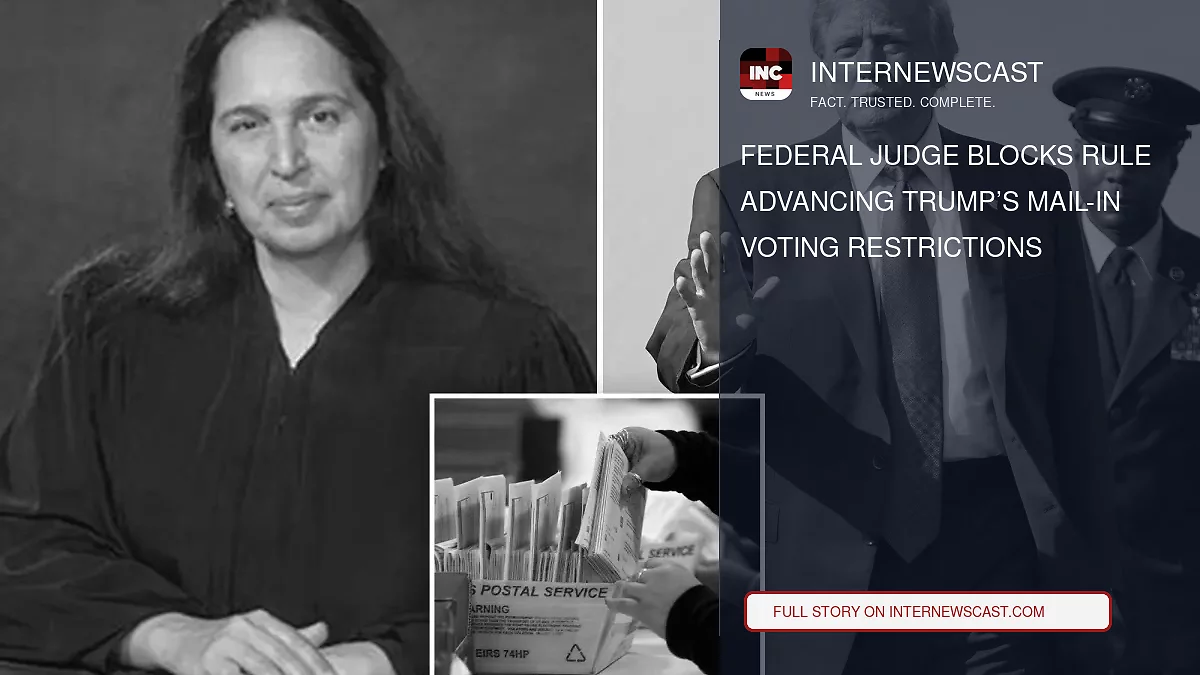
A federal judge on Thursday temporarily stopped the US Postal Service from moving forward with key portions of a new mail-in voting policy adopted at President Donald Trump’s direction, a rule that would have imposed tougher requirements before the November congressional elections.
US District Judge Indira Talwani, sitting in Boston, granted a temporary restraining order sought by Democratic-led states and voting rights organizations. The move came after a US Supreme Court ruling on Monday cleared the way for earlier injunctions against Trump’s mail voting restrictions to be lifted.
The high court’s action triggered an urgent legal push by numerous Democratic attorneys general and advocacy groups, including the League of Women Voters, to revive their challenge and block the Postal Service from enforcing a rule that had been permitted to take effect on Wednesday.
In her Thursday order, Talwani said the policy could keep voters from successfully casting mail ballots unless states first receive Postal Service approval for ballot envelopes and submit voter-specific information through an electronic portal operated by the agency.
Talwani wrote that the Postal Service had not offered evidence of widespread or meaningful mail-in ballot fraud that would justify the new requirements. She also found the rule was likely unlawful and appeared to conflict with the US Constitution, which leaves election administration largely in the hands of the states.
“USPS’s interest in correcting an unsubstantiated problem through likely unconstitutional means is dwarfed by the overwhelming risk of pervasive disenfranchisement of citizens who need access to mail ballots in order to vote,” she wrote.
The temporary restraining order will remain in effect for 14 days as Talwani weighs whether to issue a broader preliminary injunction that would keep the mail-in voting rule blocked for a longer period.
Talwani, who was appointed to the federal bench by Democratic President Barack Obama, is scheduled to take up that question at a September 3 hearing.
“Today’s order presses pause on an unlawful power grab that would sow chaos and confusion for the millions of voters who depend on mail ballots,” Sophia Lin Lakin, a lawyer for the voting rights groups at the American Civil Liberties Union, said in a statement.
The White House and USPS did not immediately respond to requests for comment.
USPS issued the rule to implement an executive order the Republican president signed in March after years of Trump calling for tighter rules on voting by mail and pushing the false claim that his 2020 presidential election defeat to Democrat Joe Biden was the result of widespread voter fraud.
Under the rule, states must supply the USPS with lists of mail ballot recipients, and all outbound and return ballot envelopes must bear unique barcodes.
The USPS, under the rule, may refuse to deliver ballots that do not comply with the new standards or are associated with voters who do not appear on the lists.
All 50 states allow for some form of mail-in voting, with 29 allowing voters to ask to cast ballots that way without providing a reason and eight conducting their elections entirely by mail.
During the 2024 election, the USPS says it processed nearly 100 million ballots, and about 30% of voters nationwide cast ballots by mail, according to the states.
They argue the new federal restrictions risk disenfranchising voters and would unduly burden states in the weeks running up to the election, forcing them to buy new envelopes and equipment, establish new systems and train staff.


