Nearly 25 years after the September 11 attacks, the toll of 9/11-related cancer continues to climb at an alarming pace, with newly released data showing a 1,680% surge in certified cancer cases over the past decade — a rise increasingly marked by rare forms of the disease.
Among World Trade Center survivors, people who lived or worked in lower Manhattan, and those who spent time on or near the debris field known as The Pile, cancer certifications have soared from 3,204 in 2015 to 57,044 this year, according to figures gathered by the World Trade Center Health Program.
“Sadly, we lose roughly two clients a day and see a new cancer certification every 50 minutes,” said attorney Michael Barasch, whose law firm represents thousands of members enrolled in the World Trade Center Health Program.
In a significant shift, the number of cancer cases among survivors who lived, worked or went to school near Ground Zero has now exceeded the total among first responders, including firefighters and police officers, who faced extended exposure in the aftermath of the attacks, the statistics show.
Survivors now account for 28,913 certified cancer cases — a stunning 4,066% increase from the 694 cases recorded in 2015. Responders account for 28,131 cases, according to the latest data.
At the same time, doctors and advocates are seeing more 9/11 survivors and responders diagnosed with uncommon and rare cancers linked to World Trade Center exposure.
One example is thymus gland cancer, which affects a small organ in the upper chest behind the breastbone. The program has recorded 82 such cases, even though thymus tumors make up less than 1% of all cancers.
The data also lists 591 neuroendocrine cancer cases — rare tumors most often found in the pancreas, intestines, lungs or adrenal glands and associated with the digestive system. Among 9/11 survivors, those cases rose 6% between March and June alone.
The Post also previously reported an alarming number of male survivors being stricken with breast cancer after being exposed to the toxic air around Ground Zero. There are now 188 victims of male breast cancer.
There also are 163 victims of brain cancer, an increase of 14 cases, or 9%, in the past quarter.
The cancer surge is attributed partly to the advancing age of the population of Ground Zero responders and survivors — with most now in their late 50s, 60s or early 70s.
Data from the US Centers for Disease Control and Prevention through June of this year show that 67% of the 145,275 current World Trade Center Health Program members are certified for at least one of 69 cancers linked to 9/11 toxins, well above the national rate of around 40% for Americans overall, according to the National Cancer Institute.
Twenty-five years after the 9/11 attacks, there is another terrifying new reality, too: At least 9,425 are now dying from post-9/11-related illnesses, more than triple the 2,977 lives lost Sept. 11, 2001.
“9/11 did not end on 9/11. The cancer clock is ticking 24/7,” Barasch said.
Leslie Lane, now 76, worked in the World Financial Center Building for Merrill Lynch across from the World Trade Center and was in her office when the planes rammed into the towers.
Lane recalled seeing the “dust cloud” while evacuating.
“You could taste the dust. You could taste the fuel, greasy gas,” she told The Post.
She went to another office at 222 Broadway two days later to plan for relocation of Merrill Lynch’s lawyers and returned downtown that November.
Lane was diagnosed with thymus cancer during a check-up in 2020.
“I was lucky. The cancer was caught early,” she said.
She had the tumor removed during surgery at Memorial Sloan Kettering, and it has not recurred.
Lane has no doubt that inhaling contaminants from Ground Zero caused her cancer.
“Thymus cancer is a very rare form of cancer. I don’t drink. I don’t smoke,” she said.
“For months afterward, you could taste the fuel in the air in the back of your throat and mouth. They kept telling us the air was safe. I don’t think it was,” she said.
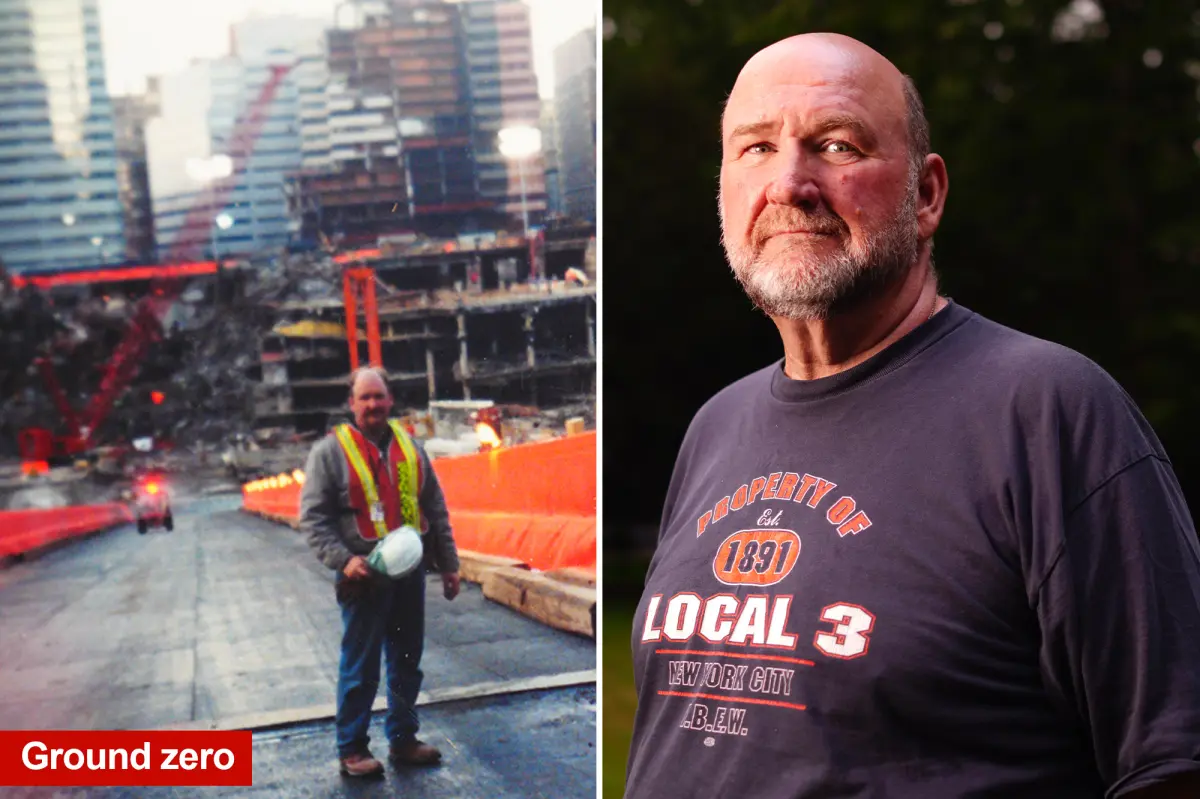
James Ryan, 65, an electrician, helped light up sites at Ground Zero, including in and around the Pile, and rewiring the WTC PATH train sites.
He said he later went for a regular check-up and that blood was found in his urine. He underwent an MRI, and his pancreatic cancer was discovered in an early stage.
He had part of his pancreas removed in 2019.
“I got very lucky,” Ryan said.
Barasch said there’s more work to be done.
He said only about 15% of the civilians who had exposure to the 9/11 toxins have enrolled in the World Trade Center health program.
His firm represents former students who attended high schools and colleges near the World Trade Center who have been stricken with illnesses at a young age. Students from Stuyvesant High School, Borough of Manhattan Community College, PACE University and elementary and middle schools were in the danger zone.
He said it’s best to join the WTC Health Program and get checked out.
“Early detection is the difference between life and death,” Barasch said.