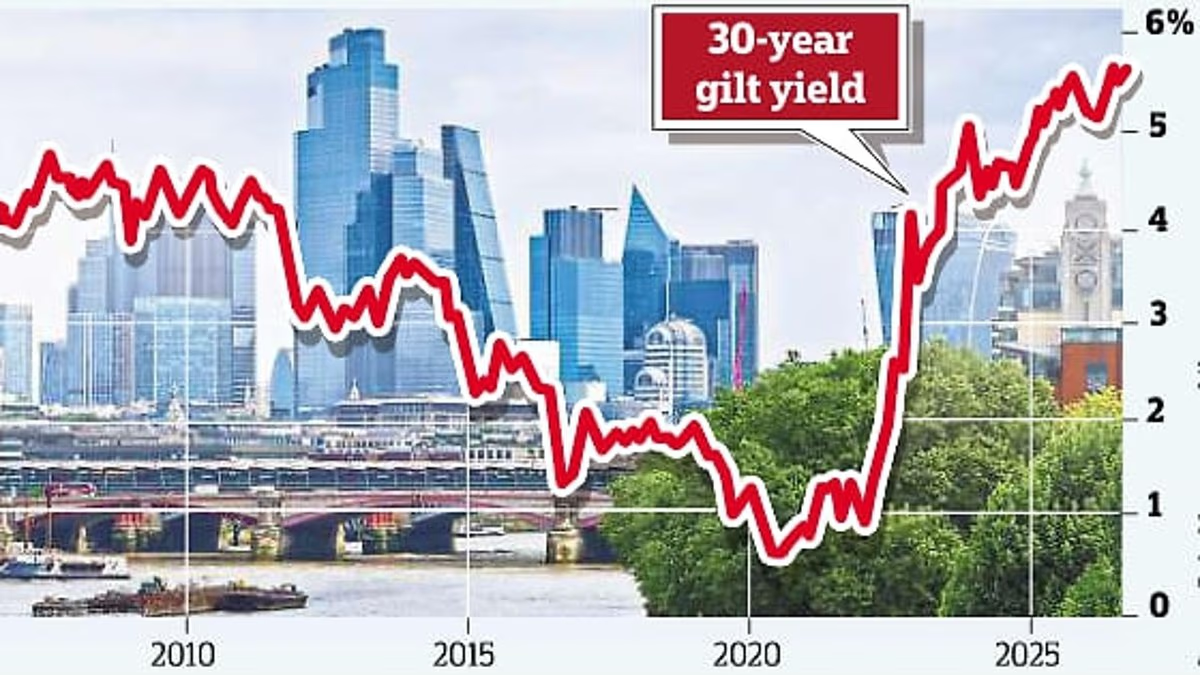

When John Healey returns from the fractious G20 summit of economic powers in North Carolina, one pressing problem will still be waiting at home: Britain’s punishingly expensive bond yields.
If the Chancellor can lower the roughly £135billion annual interest bill on the UK’s £3 trillion national debt, there may be room to finance higher defence spending without resorting to wealth and bank taxes that risk choking off growth.
Government borrowing costs are surging worldwide, with pressure being felt from Japan to France.
Even the United States, long cushioned by the dollar’s powerful status as the world’s reserve currency, is grappling with elevated borrowing costs: 4.79 per cent on ten-year debt and a substantial 5.26 per cent over 30 years.
Yet among wealthy G7 nations, none pays more to borrow than Britain. The ten-year gilt yield is above 5.2 per cent, while the 30-year bond yield climbed as high as 5.9 per cent yesterday.
Those bond costs matter far beyond Westminster. They swallow large slices of tax revenue, feed through into higher mortgage rates and influence the price of commercial borrowing across the economy.
The scale of Britain’s borrowing penalty looks extraordinary when set against other major economies. Japan’s debt-to-national-output ratio stands at 204pc, while France is running a budget deficit of 5.1 per cent of gross domestic product (GDP), compared with Britain’s 3.6 per cent.
Italy, meanwhile, carries a debt-to-GDP ratio of 137 per cent, and America’s vast federal debt has reached $40 trillion.
As former chancellor Rachel Reeves blamed Liz Truss for the ‘moron premium’, four years on it is dead and buried, smothered by tax-raising budgets and revised fiscal rules.
The reality behind UK borrowing costs is complex. Responsibility is down to flawed decisions at the Treasury, the Debt Management Office and the Bank of England.
Almost a quarter of UK debt is index-linked to the discredited Retail Prices Index. In an age of elevated inflation, fuelled by geopolitical strife, Britain’s debt payout to investors is a hostage to fortune.
France, an economy similar in size to Britain, has just 9.1 per cent of indexed debt. The UK is an outlier.
For decades, the country preferred to issue long-term debt and so its debt has an average age of 14 years, around twice that of larger borrowers Japan and France.
The decline of defined benefit pensions and the search by providers for better returns made longer-dated bonds less fashionable.
The Bank of England’s obstinacy on how best to treat its treasure chest of £558billion of gilts, bought in the financial crisis and Covid-19, doesn’t help.
Other central banks choose to hold them until maturity. Governor Andrew Bailey and his posse are selling them back to the market adding to overwrought supply.
Rigidities in Britain’s bond markets, created out of a mistaken probity, need urgent unpicking.
Shein and tarnished goods
In 2024, I was invited to meet with Donald Tang, who was love bombing London.
The executive chairman of cheap, fast fashion outfit Shein, dressed in a captivating boiler suit, was consuming noodles in London’s stylish Peninsula Hotel.
He argued a £50billion float or bigger would ignite the City’s moribund market for initial public offerings.
Potential problems, notably a supply chain with alleged human rights abuses, were brushed aside in a swirl of optimism.
Two years later, having failed to pass muster in New York and London, Shein has made a lukewarm debut in Hong Kong, where investors are less squeamish.
The economics of Shein were transformed for the worse by US and European Union clampdowns on ‘de minimis’ imports, which allow cheap goods to enter free of duties.
Only the UK, among larger economies, is still reviewing the exemption, vaguely hoping to curry favour with Beijing.
Shein’s $26.3billion launch in Hong Kong failed to shoot out the lights. Even so it is still valued more highly than Next at £18.6billion, the British fashion retailer with the most admired online operation.
Bodycote blow to the FTSE
The private equity assault on the FTSE continues with the sale of aerospace supplier Bodycote to New York’s Veritas Capital for £1.85billion.
The Macclesfield-based group was bought out of the remnants of the Slater-Walker empire in 1973.
It was transformed by the likeable entrepreneur Joe Dwek into an innovative engineering company with deep roots in the North West.
Not a great victory for Manchesterism.
DIY INVESTING PLATFORMS

AJ Bell
AJ Bell
Easy investing and ready-made portfolios

Hargreaves Lansdown
Hargreaves Lansdown
Free fund dealing and investment ideas

interactive investor
interactive investor
Flat-fee investing from £4.99 per month

Freetrade
Freetrade
Investing Isa now free on basic plan

Trading 212
Trading 212
Free share dealing and no account fee
Affiliate links: If you take out a product This is Money may earn a commission. These deals are chosen by our editorial team, as we think they are worth highlighting. This does not affect our editorial independence.
Compare the best investing account for you