
Middle-income workers are facing the growing prospect of another tax raid after a sharp sell-off in UK government bonds threatened to leave a £6 billion gap in John Healey’s Budget calculations.
The turbulence in gilt markets pushed Britain’s borrowing costs to their highest level since 1998, intensifying pressure on the Treasury as it seeks funding for increased defence spending and other commitments set out by Andy Burnham.
The jump in debt costs is expected to deepen concerns that already stretched households and firms could be asked to shoulder more of the burden, on top of the £75 billion in tax increases introduced under Mr Healey’s predecessor, Rachel Reeves.
On Wednesday, the Chancellor was cautioned that any large-scale spending push could further unsettle investors and risk accelerating the sell-off in UK bonds.
The warning coincided with a new report from the Resolution Foundation, the think-tank often associated with Labour policy circles, which argued that British taxpayers contribute comparatively less than those in other leading economies — and may have scope to pay more.
“There is a strong case that any benefits of increased defence spending will be broadly shared, so the tax rises needed to fund this should be too, including higher rates on middle earners,” said James Smith, the Resolution Foundation’s chief economist.

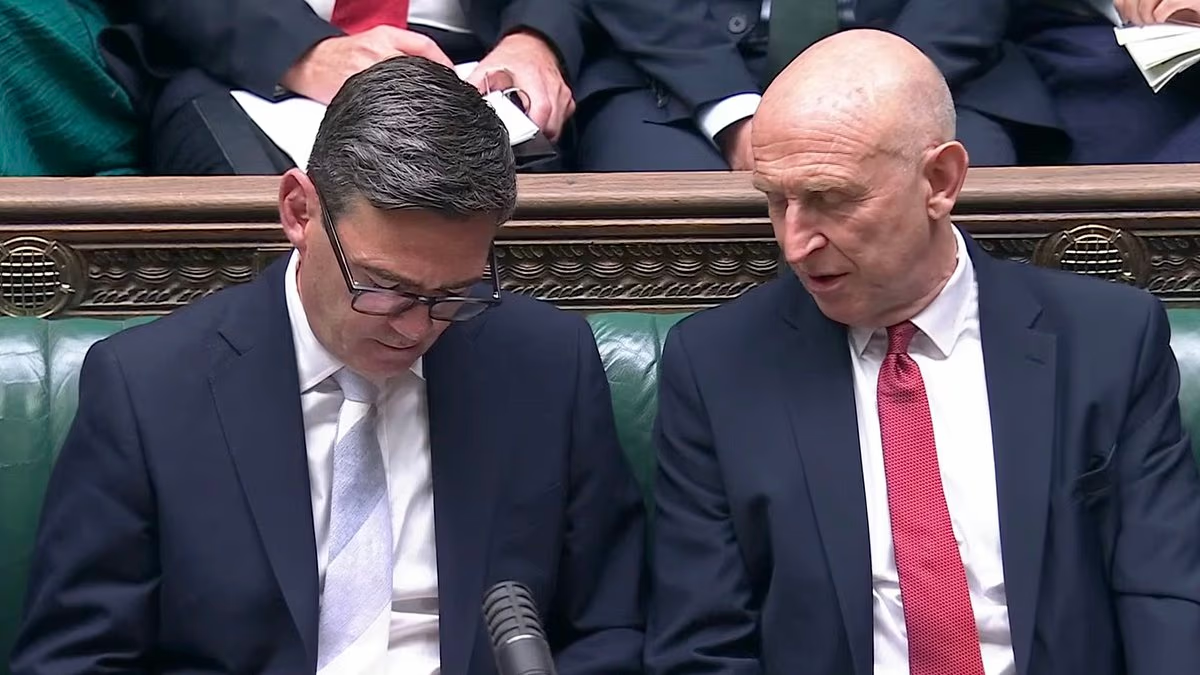
Andy Burnham’s chancellor John Healey is under pressure to identify funding for his plans
The findings are expected to attract close attention inside government, particularly among Labour ministers and officials, many of whom have past links to the Resolution Foundation.
Britain was caught up in a wave of turmoil on global bond markets yesterday, sparked by fears over inflation, interest rates and public debt.
Much of the anxiety has been caused by the Iran war, which shows little sign of being resolved and has pushed oil prices higher – yesterday approaching $93 a barrel.
Bonds are small parcels of government debt. When bond prices fall, their yields rise. It effectively means investors are demanding higher returns against the risk of holding the debt.
Yesterday, yields on benchmark ten-year UK bonds, known as gilts, climbed past 5.25 per cent to hit the highest level since the global financial crisis in 2008. Yields on 30-year gilts spiked to more than 5.9 per cent for the first time since 1998. Yields later edged back from their peaks.
While the increases were part of a global trend, they added to UK borrowing costs which are already higher than those of any other member of the G7 group of major advanced economies.
Simon French, chief economist at City broker Panmure Gordon, said the spike in gilt yields could add £6bn to Britain’s debt interest bill by 2029/30.
The impact of the bond market turmoil could spread beyond public finances, with borrowing costs on financial markets also filtering through to mortgage rates.
But the more immediate headache for Mr Healey will come in his Budget next month. He has already been left with a £5 billion gap to pay for the defence investment plan announced by Sir Keir Starmer.
And Mr Burnham, Sir Keir’s successor, has pledged to implement further costly policies including a council house building spree and an overhaul of social care.
Sanjay Raja, UK economist at Deutsche Bank, said the Budget may prove to be a major test for gilt markets, with additional spending measures of between £10 billion and £50 billion in the pipeline.
‘Market reaction will vastly differ depending in the type of Budget Burnham delivers,’ Mr Raja said.
‘There’s a lot hinging on this from a market standpoint. Getting the bond maths wrong at this juncture, could risk a painful sell off.’
Tory shadow chancellor Andrew Griffith said: ‘Labour’s reckless spending and higher taxes are killing growth. Every time this rate goes up, so do mortgage rates and the burden for the next generation.
‘Andy Burnham and John Healey should rule out more spending and higher taxes.’
However, Labour will face pressure from the Left to spend even more.
The Resolution Foundation’s analysis put the case for higher taxes to do so.
It said that while the level of taxes on UK jobs had risen since 2024, it was still the ninth lowest in a comparison of 33 rich countries, adding that they were also low by historical standards.
‘The analysis strongly suggests that any politician promising a bigger state and lower taxes on middle earners is not being realistic,’ the report said.
‘Given the Government’s intention to increase defence spending, there is a clear case for paying for this through broad-based tax rises that include middle earners paying more.’


