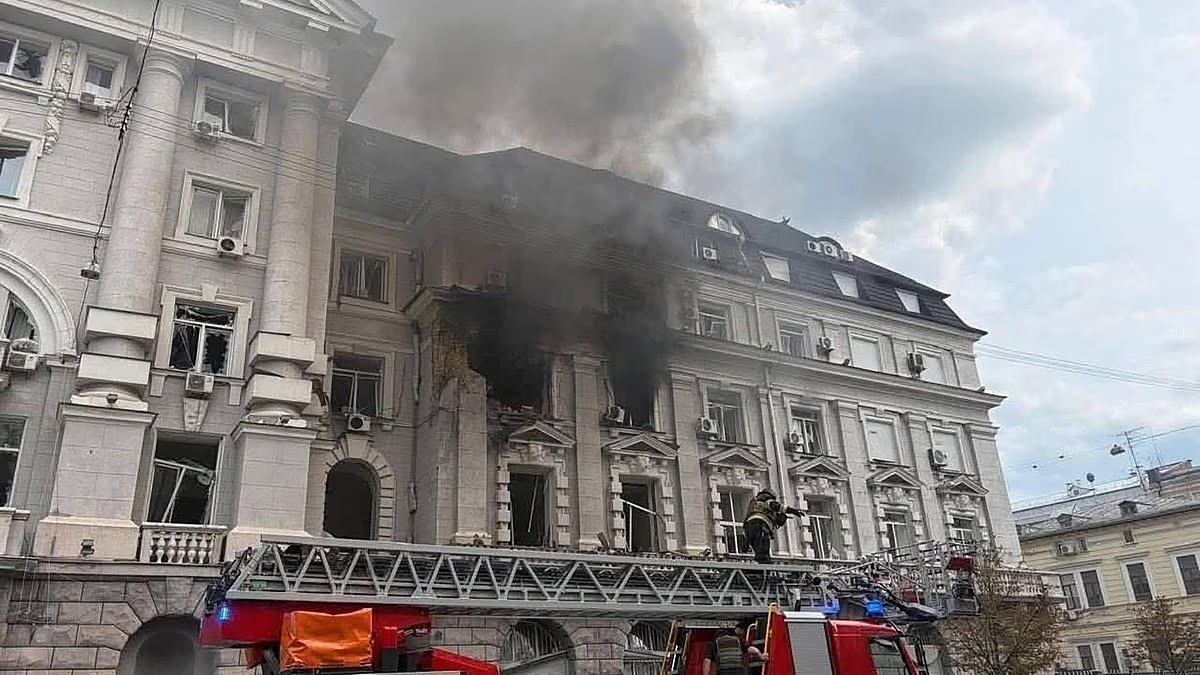
A Russian drone attack has hit the central Kyiv headquarters of Ukraine’s SBU security service, Ukrainian officials said.
President Volodymyr Zelensky said the strike took place on Friday at the SBU’s main building on Volodymyrska Street, a prominent location across from Kyiv’s landmark St Sophia Cathedral.
After speaking with acting SBU chief Oleksandr Poklad, Zelensky said the unmanned aircraft had been deliberately directed at the office used by the head of Ukraine’s Security Service inside the building.
Kyiv’s mayor reported that five people were wounded in the attack, while images from the area showed heavy black smoke rising above the site in the heart of the Ukrainian capital.
Zelensky said rescue and emergency teams were working at the scene and pledged that those injured or affected by the Russian strike would receive the necessary support.
The Ukrainian president also said he had instructed Poklad to draw up a response, describing it as one that should be “significant” and, where possible, “in kind.”
“I instructed Poklad to respond appropriately, significantly, and, if possible, in kind to the Russians for this attack, once everything is prepared,” Zelensky said.
He added that Ukraine’s armed forces would back the planned response, ending his message with: “Glory to Ukraine!”

A Russian drone has struck the headquarters of Ukraine’s SBU security service in central Kyiv, with officials saying the attack directly targeted the office of its chief

President Volodymyr Zelensky said the drone hit the SBU’s central building on Volodymyrska Street, opposite the city’s historic St Sophia Cathedral, on Friday
The strike may have been Russian revenge for alleged SBU involvement in assassination attempts targeting senior Russian military and security officials.
Most recently, Maj Gen Nikolai Varpakhovich, 56, commander of Russia’s 22nd Heavy Bomber Aviation Division, Putin’s nuclear strike force, was shot in the face and abdomen at his home in the Saratov region on Thursday.
He was transferred to Moscow as doctors fought to save his life.
Kyiv has endured more than a week of sustained attacks, with strikes hitting buildings across the city centre as well as warehouses and factories in the suburbs, including a Coca-Cola plant.
Officials said there were no injuries when the factory, near the town of Brovary, east of the capital, was struck.
‘Today, the Russians have hit a Coca-Cola plant with their drone. Coca-Cola is such an enemy that they set it on fire with their Shaheds,’ Zelensky said in his nightly video address, referring to Iranian-designed drones.
‘It’s a clear Russian signal to America. The Russians cannot be unaware that this is an American facility.’
Reuters Television footage showed firefighting crews arriving at the scene and smoke rising above the plant and over nearby fields.
Andy Hunder, president of the American Chamber of Commerce in Ukraine, said the plant’s staff were uninjured.
‘The company is working with the relevant authorities to assess the situation,’ Hunder told reporters. ‘Ensuring the safety and well-being of people remains top priority.’
A university in central Kyiv was also hit earlier this week, although 160 students were already sheltering when the drone struck.
At least 53 people have been killed and 134 injured across Kyiv and the wider region since the near-continuous attacks began last month.
But the strike on the SBU headquarters marks a major escalation and comes as Kyiv struggles to protect key sites amid critical shortages of interceptor missiles.
The SBU building lies in the historic heart of Kyiv, directly opposite the UNESCO-listed Saint Sophia Cathedral and close to two other major landmarks, the Golden Gate and the National Opera.
The attack came just two days after Vladimir Putin issued a fresh threat against Britain, refusing to rule out targeting UK military factories after London agreed to provide Ukraine with classified blueprints for long-range missiles.
During an interview with Russian state media RT, the Kremlin dictator was asked: ‘Could British military industrial facilities located on British territory become military targets?’
Putin replied with a smirk: ‘That’s a secret, a military secret.’
He made clear any ‘British military facilities’ inside Ukraine were ‘absolutely’ a Russian target.
The Russian leader was speaking at a nighttime press conference in Bishkek, capital of Kyrgyzstan, after attending the Shanghai Co-operation Organisation (SCO) summit.
His taunt was the latest increasingly brazen threat from Moscow to target British military and defence companies after the UK increased its support for Ukraine.
Russian foreign ministry spokesman Maria Zakharova warned last week that ‘any British military installations and equipment in Ukraine and beyond its borders’ could be attacked in retaliation for Ukrainian strikes on Russia using British weapons.
Meanwhile, fears over Russia’s use of hybrid warfare against Britain and its European allies have continued to mount.
On Wednesday, Germany was struck by a second sabotage attempt on a major electricity grid, it has emerged.
The incident renewed fears that Russia is deliberately targeting Germany through a hybrid campaign aimed at sabotaging its critical infrastructure, as it came on the same day that a power plant was targeted with ‘home-made explosive rockets.’
It also came on the same day that Berlin formally accused Russia of being behind a failed drone attack at a major German airport last month.
Police said they were investigating an act of premeditated vandalism on the technical infrastructure of a power substation near the western city of Bergheim on Tuesday evening.
A police spokesperson declined to specify the extent of the damage but said the region’s power supply was not affected, while electricity grid operator Amprion said it was likely that external interference caused the incident.
Also on Tuesday, a key installation near the Janschwalde coal-fired power plant in Brandenburg was repeatedly targeted with rockets, while emergency services discovered and defused additional devices.
Brandenburg’s Interior Minister Jan Redmann later called the incident an ‘act of sabotage’.