
A proposal to convert a Grade II-listed former pub into a mosque looks likely to be refused, after council officers said the scheme would inflict “substantial harm” on an important local heritage asset.
The Norwich Muslim Centre had lodged plans to refurbish The Gatehouse, a protected “asset of community value” dating back to 1934.
As part of the application, the group sought permission to change the use of an extension on the site from a community centre to a place of worship — a move that prompted hundreds of objections from residents.
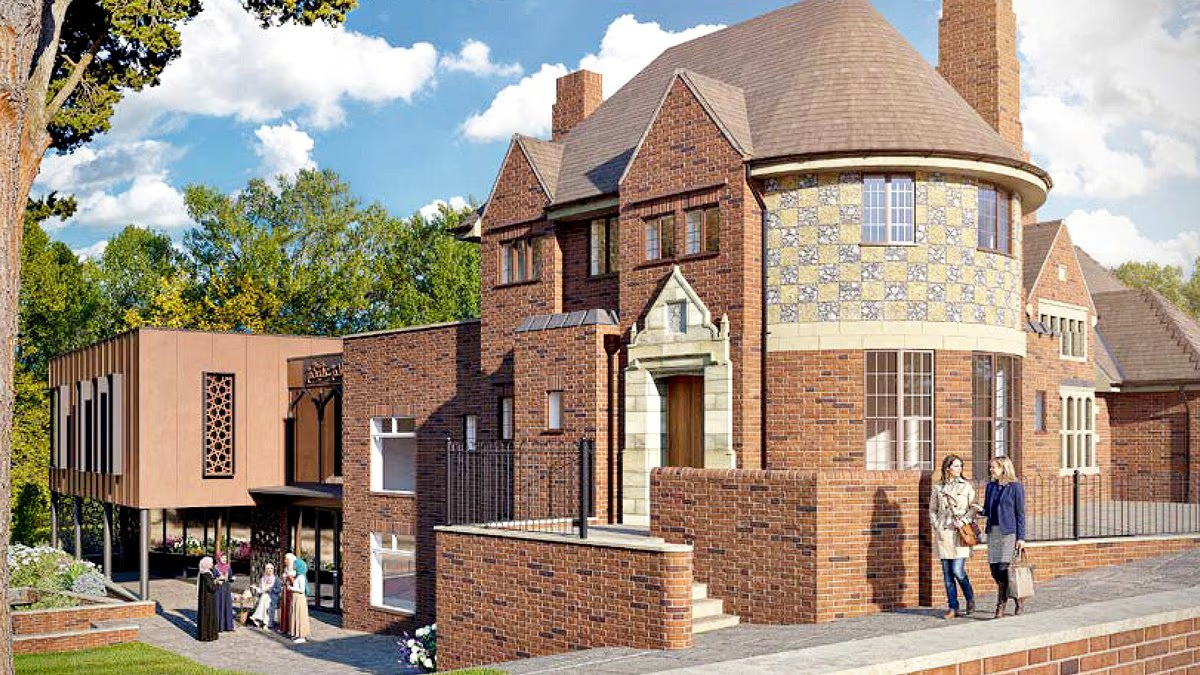
Design documents for the rear extension of the former pub show a sizeable copper-coloured structure featuring screens and Arabic lettering.
The building, known for its blend of Arts and Crafts and Tudor-style architecture, has stood closed for the past three years following the death of its landlord.
Opposition to the Norwich mosque conversion plan intensified last month when leaflets were circulated locally asking residents: “Should this pub be converted into a mosque?”
Sirajul Islam, a trustee of the Norwich Muslim Centre, pushed back against the criticism, saying he had gone door to door in the area to speak with neighbours and better understand their concerns.
“So far, I have come across only three people who told me that they used to visit the pub on a regular basis when it was open and operating as a pub,” he said.

Plans have been submitted to turn the Grade II-listed Gatehouse in Norwich into a mosque. CGI of the proposed building is seen here

Proposals show a large copper-coloured extension decorated with screens and Arabic lettering which would be built onto the rear of the pub

The Gatehouse (pictured), a mixture of Arts and Crafts and Tudor styles, closed three years ago following the death of its landlord
‘This did make me wonder where all those objections and concerns are coming from.
‘We really do appreciate the concerns being raised, and we are fully committed to working with the wider community.’
Now, Norwich City Council’s Conservation and Design team have submitted a report criticising the proposals presented by the local Muslim association.
It also urged the council to refuse the application, stating it sees no ‘convincing evidence or justification’ for the building’s use to be changed.
A public house has been on the site since at least 1866, with the original destroyed by a fire at some point in the early 20th century.
The current building, which has been empty since the death of its former landlord in 2023, was built in 1934 and survived two attacks during the Second World War.
The report also describes the ‘inter-war improved’ public house as a ‘superb example’ of medieval Kent and East Anglian architecture.
It added that the most ‘significant intervention’ of the plans would be the construction of a rear extension which would accommodate prayer halls for both men and women.
It said the ‘scale and massing’, along with its ‘width’ and ‘length’ combined with its height would mean it would be ‘far greater in size’ than the current building.
‘So [it] would be entirely disproportionate and not in any way subservient to the existing building,’ the report stated.

The Grade II-listed Gatehouse in Norwich, Norfolk, was built in the 1930s. An historic photo of the building is seen here

A sign to the pub is seen here. Before it closed, regulars could drink in the Gatehouse’s oak-panelled bars beside a log fire
Join the discussion
Should historic pubs be preserved for their heritage or transformed to serve new community needs?
While noting the proposals would cause ‘substantial harm’ to the site, it added the design was ‘a highly modern addition’ it was not ‘to an historic building’.
‘The proposals do not enhance the existing building and create a great impact upon the significance of the Grade II listed Gatehouse and its setting.
‘The construction of the new prayer hall block offers a degree of harm to the significance of the heritage asset and its setting,’ it read. ‘This is judged to be substantial harm.’
The Norwich Muslim Centre has filed two connected planning applications to the local authority.
So far, one application received 347 objections and 201 supporting letters, while the other received 194 objections and 213 supporting.
In its conclusion, the report said it would be difficult to argue the site could not be used as a pub, as it was closed ‘only three years ago’ due to the landlord’s ‘ill health’.
It also maintained the property could be reused in its ‘current form, or with modest and sympathetic refurbishment’.
The report also described the construction of the extension as ‘inappropriate for the heritage asset in question through its design, scale and massing’.
It added that while there was ‘some degree of public benefit’ for the building to be used again, there was a question if the prayer block was ‘entirely necessary’ to do so.
It also questioned ‘whether the building in its existing form, or a sympathetically altered form could not retain either its use as a public house or another appropriate use’.
The application awaits a decision from Norwich City Council.