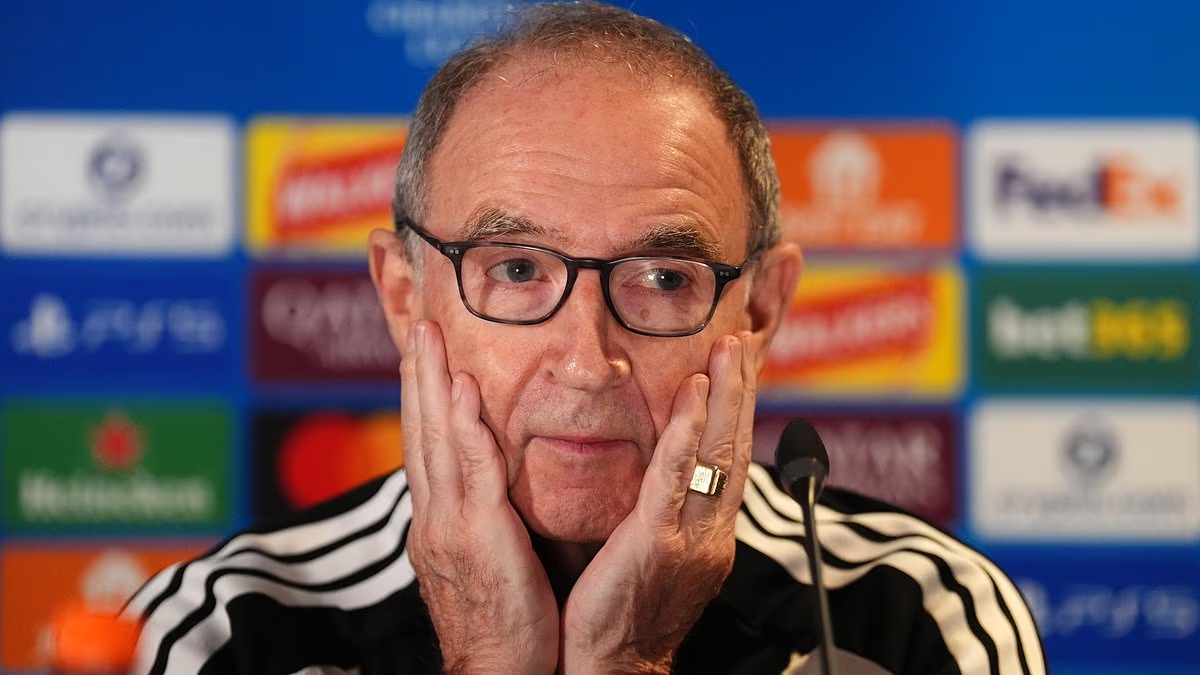

Martin O’Neill increasingly sounds like a man who struggles to stop the truth from tumbling out, even when convention suggests he might be wiser to keep it to himself.
Only last weekend, he wandered into delicate territory by effectively telling Rangers what they could do with the 300 tickets offered to Celtic for the Premier Sports Cup quarter-final at Ibrox. He then appeared to joke — at least, one assumes it was a joke — about sending just a single ticket back the other way for the derby at Parkhead a week later.
And after naming his UEFA squad following the chaotic, last-minute lurches of the transfer window, O’Neill was at it again. This time, he conceded that the Europa League does not carry the same weight as domestic prizes, while also making it clear that the late arrivals signed before Wednesday night’s deadline were not really recruited with that competition in mind.
The discomfort caused by those comments is unlikely to be felt around the lunch table. The real winces will surely come around the boardroom table at Celtic Park.
After all, Celtic have just put four-game European packages on sale to season-ticket holders at £140 each. Selling those tickets becomes a rather harder task when the manager is openly signalling that visits from Ferencvaros, Celta Vigo, Besiktas and Marseille are not exactly at the top of the club’s list of priorities.

Martin O’Neill has acknowledged that the Europa League is not as important as winning the Premiership
Yet there will be plenty who recognise that O’Neill has merely voiced an awkward reality about the Scottish champions. Europe isn’t treated as a serious measure of Celtic’s ambitions. It has not been for close to 20 years. As long as the squad can stagger across the line in the league — as it very much did last season — failure and frustration on the continental stage are quietly absorbed.
And if that leaves Celtic looking like a punchline, or worse, an afterthought, to a broader football audience, then so be it.
Former Sunderland executive director Charlie Methven went viral during the week for stating on his Business of Sport podcast that a ‘dysfunctional’ board at Parkhead have ‘built an entire business model out of failure’.
And why did he go viral? Because he’s got a good argument. Celtic make money whether they land the £40million windfall group-stage football in the Champions League brings or not. They’re sitting on fortunes in the bank.
Yet, you look at the composition of their squad at the end of the transfer window and you can’t help but feel it could have been made a whole lot better and stronger with just a little more adventure and foresight.
The team is crying out for a strong, defensively minded midfielder. Gvidas Gineitis of Torino was the guy identified to fill that role. Yet, whatever the reason for the late collapse in negotiations, the fact remains that Celtic didn’t get him.
A 19-year-old in Joel van den Berg did arrive in a £3million deal, but he has barely any first-team experience from his time at PSV Eindhoven and hasn’t made the cut for the Europa League squad. The suggestion exists, from unattributable sources, that he will be the eventual replacement for Arne Engels, but available metrics don’t seem to suggest he is the same type of player.

Swiss right-back Jordan Lotomba is one of ten new faces, four of whom were loan signings
As for the other five guys brought in at the end of the window, it looks more filler than killer. The jury’s out on Oliver Sorensen, in on a temporary basis from Parma, but at least boasting Serie A experience at the age of 24.
Apart from that, another goalie well into his thirties has arrived on a loan deal from England, two kids from Chelsea are in on loans and a right-back in Jordan Lotomba, who was into his final year at Feyenoord after making just eight starts in the Eredivisie last term, has signed for 12 months.
Sorry, but it just doesn’t speak to long-term squadbuilding. It just leaves the feeling, ten new signings or not, that another window has passed with the same old lack of ambition overriding everything in the end.
It all started so well, too. The £30million spent on recruiting Camilo Duran, Kasper Hogh, Haissem Hassan and Mika Baur pointed towards a new approach of quality over quantity. Those final days of market-moving, though, just signalled a return to the norm.
There will be those who applaud the caution of the board, of course. Who approve of the policy of keeping eye-popping amounts of money in reserve for rainy days. The Champions League has gone, they’ll say, so why spend fortunes and rack up a larger wage bill to create a squad that still might not do much in a less lucrative secondary competition?
Well, among other things, there’s the small point of trying to construct a set-up that might look like it’s ready, for a change, for the Champions League qualifiers when they come round next season.
Six straight failures at that stage of the competition – at the hands of the likes of Kairat, Cluj, LASK and Ferencvaros – is a disgrace. Eight exits in ten is ludicrous. How much money have those disasters cost in total? Where might Celtic be had they prioritised getting players of the right quality in for these preliminary fixtures?

Celtic concede a fourth goal to LASK on a night of Champions League humiliation in Austria
Instead, they find themselves falling apart in humiliating circumstances in Linz a couple of weeks ago with the likes of Anthony Ralston and Dane Murray on the park. That’s before we even get to asking just how futureproofed and forward-thinking a plan can ever be when there’s a 74-year-old man on a one-year contract, with an option for one year more, in the dugout.
In the end-up, despite their early spending, Celtic left the transfer window miles in profit thanks to the departures of Arne Engels, Daizen Maeda, Reo Hatate, Luis Palma, Maik Nawrocki and Johnny Kenny. Using the rough figures available, it looks like transfers in totalled just over £30million while transfers out raked in a little under £50million.
Squad size needs to be factored in as well. Around 20 players who were part of the first-team set-up last season are out of the building. Ten have come in, so how can this summer be termed as anything other than an act of downsizing?
Celtic did have a number of established, international-class targets. Why didn’t they persevere with them – with a view to building a team that won’t need torn apart next summer – even though the Champions League slid off the horizon?
Niko Sigur, who went to the World Cup with Canada, eventually left Hajduk Split for Toulouse, a side with no European involvement and lying third bottom of Ligue 1 in France, for an estimated £3.5million. Ermin Mahmic, in North America over the summer with Bosnia, left Slovan Liberec in a £4.3million deal for Corum FK in Turkey, also third bottom of their domestic competition.
Are Celtic such an unattractive destination that they can no longer compete with clubs such as these? Surely not.

Sam Johnstone has arrived on loan to provide competition for Viljami Sinisalo in goal
Yet, O’Neill’s squad has ended up being padded out with inexperience and loans and still looks vulnerable in certain areas such as left-back, where there is currently no fit first-choice with Kieran Tierney injured, central midfield and even central defence.
It’s strange to think that major shareholder Dermot Desmond argued in a now-infamous 2020 interview that ‘Europe is so important as a yardstick of our football progression’. Six years on, it’s the words of his son Ross during the farce of last year’s abandoned AGM – rattling on about the ‘enormous change in the financial landscape’ – that linger.
That represented an unmistakable waving of the white flag when it comes to UEFA competition and that’s what everyone at that club now exists under.
O’Neill maybe shouldn’t have said what he said about domestic affairs now being the main event, but, in the wake of a once-promising window that ended with an all-too-familiar sense of anti-climax, there’s no question it reflects the sad reality of a club that once broke the mould in Europe settling for its current role as pondlife.