
The cost of issuing new UK government debt has climbed to its highest level in almost 30 years, adding to the pressure facing Andy Burnham and John Healey ahead of a difficult Autumn Budget and creating a potential £6billion debt-interest burden.
The Prime Minister and Chancellor are preparing for their first Budget on October 28, but their task has become even more challenging as turmoil in the bond markets pushes the average interest rate on newly issued gilts—UK government bonds—close to three-decade highs.
At the same time, weak confidence in the state of the UK’s finances has driven yields on benchmark gilts traded on the secondary market to levels not recorded since 1998.
Investors are demanding higher returns to buy UK debt amid persistent inflation, elevated borrowing, political uncertainty and, most recently, concerns about how the Iran war could affect household living costs.
Expectations that the Bank of England could be forced to raise interest rates have added to the pressure. Renewed forecasts of higher rates in the United States have also pushed bond yields upwards.
The Debt Management Office (DMO) sells gilts across a range of maturities, from short-term bonds lasting less than five years to long-term debt extending beyond 30 years, with interest rates varying according to the borrowing period.
The yield on 30-year gilts rose to 5.87 per cent today, its highest level since 1998. The 10-year gilt yield, a key measure of the rate paid by the Treasury to borrow, also edged up to 5.15 per cent. It has exceeded that level only briefly on three occasions since 1998.
Simon French, chief UK economist at Panmure Liberum, said: ‘This morning the 20-year Gilt – one of the market-derived assumptions used for the OBR forecast – is 70 basis points above where it was assumed to going to be at the Spring Forecast, at 5.8pc.
‘Applied across the curve that is a £6billion increase in debt interest by 2029/30 – or put another way, five times the annual funding gap in the defence investment plan.’

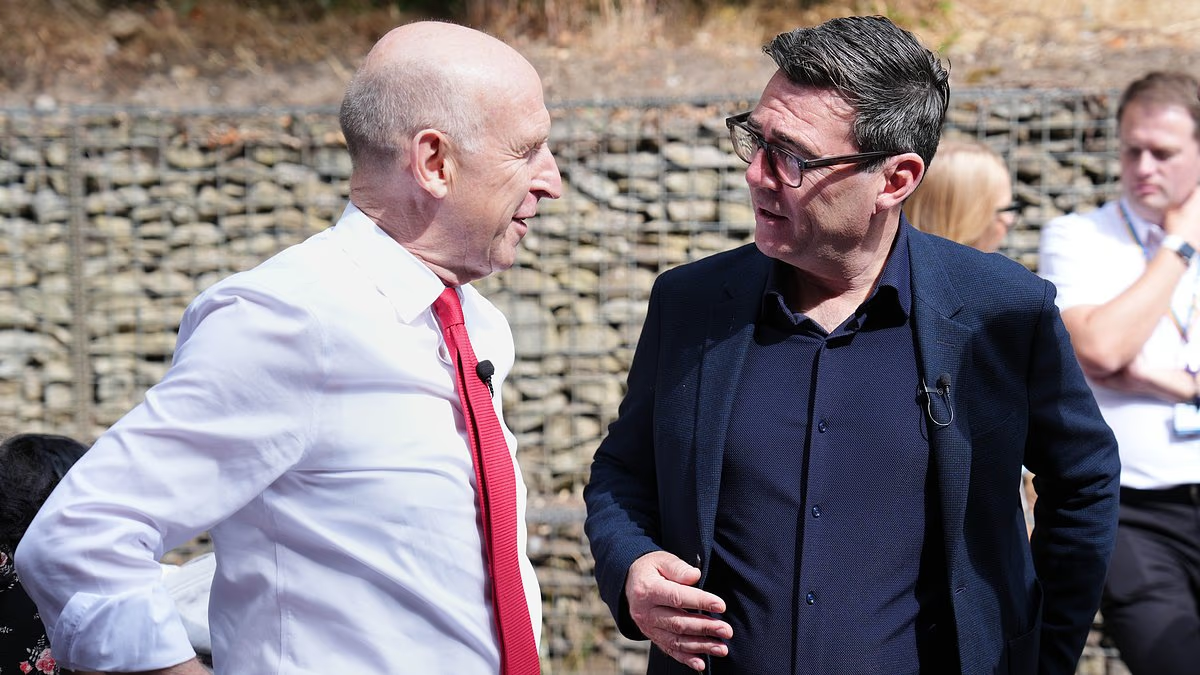
Chancellor John Healey and Prime Minister Andy Burnham face difficult decisions in the Budget
Asked about rising bond yields, the Prime Minister’s official spokesman said: ‘We don’t comment on markets. More generally, I would just say that fiscal discipline is the bedrock of economic stability and national security.
‘The Chancellor and the Prime Minister are in lockstep that the Government will meet the fiscal rules with a buffer against uncertainty and we’re cutting the deficit faster than any other G7 economy to the lowest level in six years.’
An analysis of DMO figures by The Times found that the average yield on UK gilts of different maturities sold to investors this year is approaching levels last seen in 1998.
The scale of the UK’s borrowing programme is adding to the upward pressure on interest rates.
An annual report published by the DMO in late August showed that the UK had planned £303.7billion in gilt sales during the last financial year.
This was double the amount in 2016 and the second highest level on record. The DMO said it was exceeded only by its need to finance the government response to the Covid-19 pandemic in 2020 to 2021.
In 2025 to 2026 the UK spent around £109billion on debt interest, according to a House of Commons report, equivalent to about 3.6 per cent of GDP and 8 per cent of total public spending. This is near the highest level in 50 years.
The Prime Minister and Chancellor will lay out their economic plan for Britain against a backdrop of rising government borrowing and mounting inflationary pressure.

The rate the UK must pay investors to buy debt has risen sharply (red line) at the same time as the amount borrowed each year (grey bars) has climbed and was only outstripped in Covid
Mr Healey attended his first G20 summit, in the US state of North Carolina, yesterday and called on his international counterparts to co-operate on tackling energy prices and the cost of living.
He said: ‘Britain faces these global pressures from a position of relative strength, the fastest growth in the G7 advanced nations in the first half of this year, the deficit being cut faster than in any other G7 country.
‘But no country can face these pressures alone. And these shocks are being felt worldwide. They’ve been felt in people’s pockets, in their weekly shops, filling up their cars.’
Figures published by the Office for National Statistics (ONS) last week showed a surprise jump in government borrowing in July to £1.8billion. This was £700million more than a year ago, with the ONS reporting the government had spent £2billion more on welfare than a year ago.
The Office for Budget Responsibility (OBR) had forecast a £500million surplus in July, which is usually a bumper month for tax receipts thanks to self-assessment payments. This meant government borrowing was £2.3billion higher than forecast.
Borrowing of £56.7billion over the financial year so far is running ahead of the OBR’s forecast of £54.4billion.
Mr Healey has pledged to meet the fiscal rules set by his predecessor Rachel Reeves but Mr Burnham has splashed out on a blitz of measures to ease the cost-of-living crisis since he arrived in Number 10 over summer.
This leaves the Chancellor with a headache as he seeks to balance welfare costs and the need to raise defence spending, with keeping a lid on borrowing.
Figures released today revealed UK shop price inflation was at the highest level for two years last month.
The British Retail Consortium (BRC)-NIQ figures showed shop prices are 1.5 per cent higher than a year ago, a significant jump on the rise of 0.9 per cent reported in July. The increase represents the sharpest rise since February 2024.
Helen Dickinson, chief executive of the BRC, said: ‘The impact of higher energy, input and commodity costs is beginning to filter through into prices, particularly for ambient foods which are typically imported and processed.
‘In non-food, electrical prices rose amid the ongoing AI boom, which is forcing up the price of memory chips and storage.’
Investing Show