
European Commission President Ursula von der Leyen on Wednesday proposed creating a pathway for Canada to become the European Union’s first associate member—an unusually bold offer as US President Donald Trump’s tariffs draw Ottawa closer to Europe.
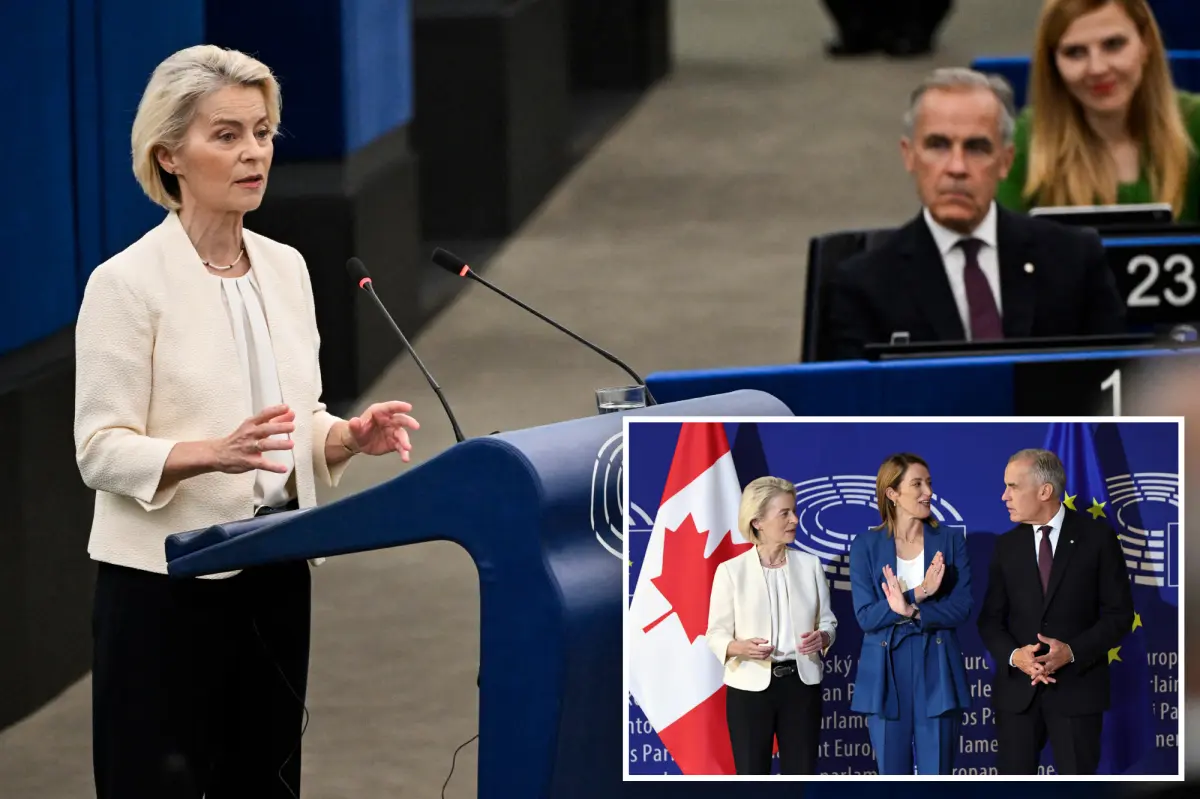
“I would like to work with you on opening the door for Canada being the first associate member of the EU,” von der Leyen told Canadian Prime Minister Mark Carney during her annual State of the European Union address.
European lawmakers gave Carney a standing ovation. The Canadian prime minister is scheduled to address the European Parliament on Thursday.
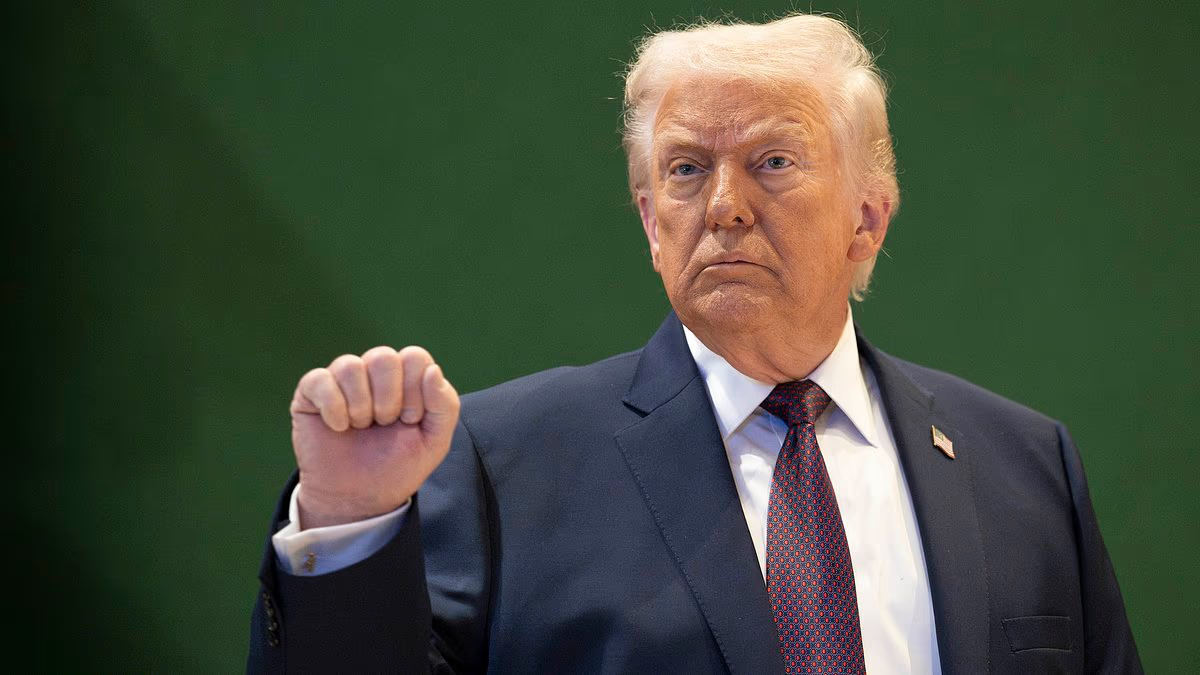
Trump’s tariffs, along with his repeated suggestion that Canada could become the 51st US state, have encouraged Ottawa to pursue stronger economic and security ties with Europe.
About 70% of Canada’s exports are sent to the United States. As Ottawa works to reduce that dependence, Carney has called for a “unique alliance” with the EU.
Von der Leyen said Canada and the EU would expand on their existing free trade agreement, known as CETA, through a wider “Alliance for the Future” designed to establish “a common prosperity and economic security space.”
She described the closer partnership as an initiative grounded not only in commerce but also in shared democratic principles.
“Above all, dear Mark, Europe and Canada believe in democracy,” von der Leyen told Carney, who was seated in the front row to her left.
“We believe that power does not belong to the strongest, the richest or the loudest, but to all of us. That democracies have the freedom to choose with whom to work.”
The proposed partnership would span advanced manufacturing, technology, defense production, the Arctic, energy, critical minerals, batteries, artificial intelligence, quantum computing, cybersecurity and broader economic security.
“This is a partnership not against anyone else, but for our common strength,” she said. “In short, we want to bring the relationship with Canada to the highest level possible.”
Canada became the first non-European country to join the EU’s $173-billion SAFE defense program this year, allowing Canadian companies to participate in joint procurement projects.
Carney said Tuesday that economic integration, once regarded primarily as a strength, is increasingly “being used as a weapon by certain countries.”
Canada has responded to US tariffs with retaliatory measures and rejected trade terms that Carney says would undermine the country’s sovereignty.
The EU has pursued a different approach with Washington, reaching a trade agreement that capped US tariffs on most EU exports at 15%, while Europe removed tariffs on US industrial goods.
That contrast has loomed over Carney’s push for closer European ties.
In a closely watched speech at the World Economic Forum in Davos in January, he urged middle powers to work together to increase their leverage in an era of great-power rivalry.
“When we only negotiate bilaterally with a hegemon, we negotiate from weakness. We accept what is offered,” Carney said.
“This is not sovereignty,” he said. “It is the performance of sovereignty while accepting subordination.”
Carney’s Davos speech on middle powers in January drew a personal rebuke from Trump, and von der Leyen’s overture to America’s neighbor could raise the temperature again.
In an emailed statement Wednesday, Iratxe García Pérez, president of the Socialists & Democrats group in the European Parliament, praised Carney for “great courage confronting Donald Trump” and said allies were needed to defend “sovereignty, solidarity and international law.”