
In autumn 2007, Gordon Brown appeared close to calling a snap general election.
Campaign literature had already been printed, while around 100 helicopter slots were booked at Battersea’s heliport to send senior ministers to distant marginal constituencies.
Hundreds of activists had also been instructed to prepare for deployment within 24 hours from Labour’s dedicated election hub.
Yet the expected mobilisation never happened. Knowing Brown’s plan could lead to an almost certain defeat, George Osborne and David Cameron mounted a last-ditch holding operation. During his conference speech, Osborne promised that, once Chancellor, he would increase the Inheritance Tax threshold to £1million. ‘Only millionaires will pay inheritance tax’, he declared.
The announcement struck a chord immediately. A poll carried out in the days that followed showed a marked improvement in the Conservatives’ ratings across marginal seats. Within days, Brown had reluctantly ordered the election preparations to be abandoned. His hesitation sent his personal poll rating into a decline from which he never recovered.
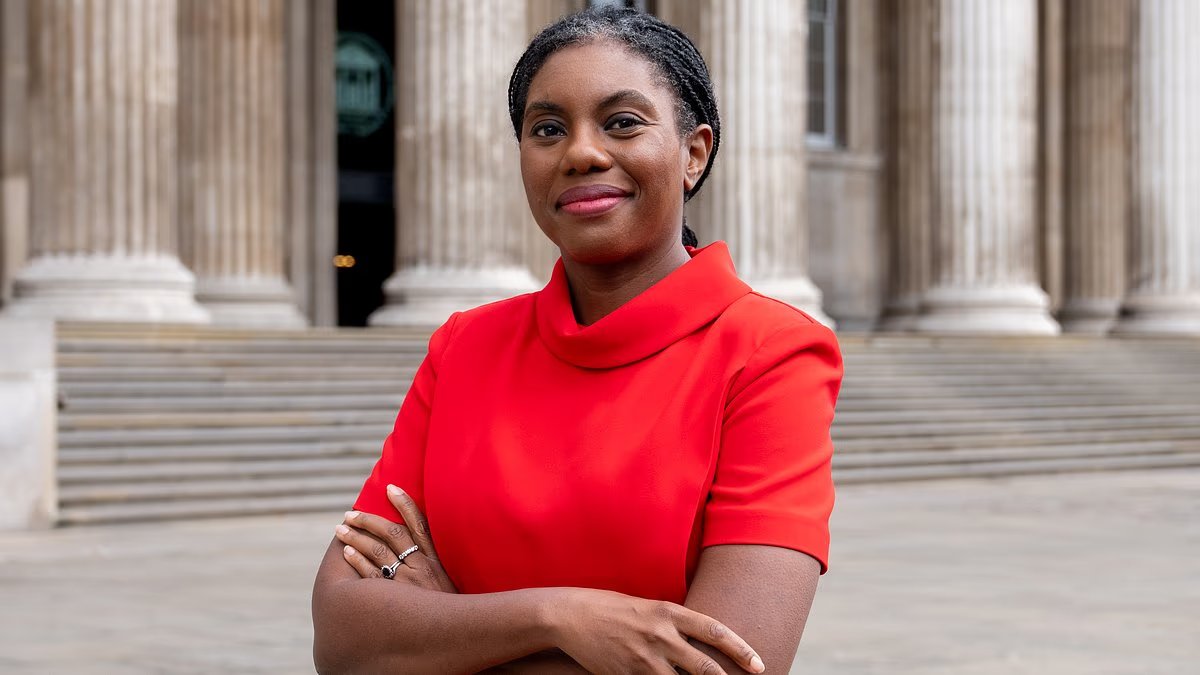
With the next Tory party conference approaching, Kemi Badenoch now has the chance to make a similarly historic—and potentially transformative—political announcement.
At the weekend, my colleague Gabriel Millard-Clothier revealed exclusively in The Mail on Sunday that the Tory leader was considering abolishing Inheritance Tax altogether.
Officially, Badenoch would say only: ‘I’ve asked my team to explore fiscally responsible ways to address this burden.’ Privately, however, her aides indicated that the idea was being taken seriously. ‘When she announced the abolition of stamp duty in last year’s speech, it was the moment her personal approval rating began to turn,’ one ally told me. ‘We think a big policy announcement like this could potentially have the same impact for the party as a whole. It’s a way of communicating, “OK, the traditional, solid, tax-cutting Tory party really is back”.’
That is why Kemi Badenoch should bring the review to a conclusion, instruct her team to return with a fully developed plan and ensure it is ready for her conference speech next month.

At the weekend, Gabriel Millard-Clothier revealed exclusively in The Mail on Sunday that Tory leader Kemi Badenoch was considering abolishing Inheritance Tax altogether
British politics currently has a policy vacuum at its centre. Andy Burnham began his premiership by saying that the country would have to wait until ‘later this year’ to hear his ten-year plan.
Like the Chief in the Asterix comics, who worries that the sky could fall tomorrow but takes comfort from the fact that tomorrow never arrives, ‘later this year’ is becoming an increasingly flexible deadline.
Badenoch has a valuable opportunity to occupy that Burnham-shaped void with a policy that is bold, radical and populist. It would also allow her to draw a clear distinction between herself and a Prime Minister who appears increasingly determined to embrace his party’s socialist traditions.
More importantly, it would help her establish a clear identity in the face of the political challenge emerging on her Right.
This week’s political debate has been dominated by Reform’s acceptance of a combined £72million donation from two British crypto billionaires who recently lived abroad. Yet even more revealing was Reform’s bone-headed response to Badenoch’s proposal on Inheritance Tax.
One would expect a party that aspired to replace the Conservatives as the main opposition to an old-school, tax-and-spend Labour government would have recognised and embraced a policy that sought to reduce the tax burden on hard-working families. Instead, the party’s treasury spokesman Robert Jenrick made the incomprehensible statement that he believed the plan was ‘morally wrong’. It was, he said, ‘a tax cut predominantly for the well-off’.
Had Jenrick simply dismissed the proposal as something that did not align with Reform’s current fiscal priorities, that would have been one thing. But to claim there is something inherently immoral in people simply aspiring to pass on more of their wealth to their children was a staggering assertion. And one that is likely to cost him and his party dear.
Whether a policy pledge by Badenoch along these lines will have the same transformative effect on Tory fortunes as George Osborne’s momentous announcement almost two decades ago, is open to question. But now is not the time for timidity.
Because despite the denials, the plan taking shape inside Downing Street is clear. Burnham is preparing to call a snap election in the spring of next year. And, based on the current trajectory of the polls, he will almost certainly win it.
Reform’s collapse in support is accelerating. This time last year the party stood at 31 per cent in the polls, 11 points ahead of Labour and 14 points ahead of the Tories. Now they are two points behind Labour, a slender 4 points ahead of the Conservatives, and trending downwards. In just over a year, they have lost a third of their support, all at a time when Keir Starmer’s premiership was imploding.
Meanwhile, Nigel Farage’s personal approval ratings have become radioactive. According to the most recent poll, 24 per cent of people have a favourable opinion of Reform’s leader, while a staggering 69 per cent view him unfavourably. This represents the worst level of antipathy towards Farage since records began.
Join the discussion
Would scrapping Inheritance Tax restore trust in the Tories or deepen divisions over fairness?

Burnham is preparing to call a snap election in the spring of next year. And, based on the current trajectory of the polls, he will almost certainly win it, writes Dan Hodges
On these numbers, the idea of Reform securing a majority at the next election is for the birds. And that’s before you factor in the impact of tactical voting, the likely further erosion of support to Rupert Lowe’s insurgent hard-Right Restore party and the plethora of ongoing investigations into Reform’s increasingly murky finances.
The stark political reality is this: There is only one thing that will stop Burnham from calling a snap election and securing a five-year term in No 10. And that is a recovery for the Tory party along the lines we saw in 2007.
That would not require them to leapfrog Labour immediately.
Even after Osborne’s dramatic announcement, Brown still led in the polls for a time. But the shift in support in battleground seats that the policy precipitated was enough to make him think again.
That’s what the Tories need now. Not a miraculous resurgence. But a policy statement that will capture the attention and imagination of the British people. And that will demonstrate there is a party of the Right that provides them with a genuine and serious alternative to the Burnham government, not just an opportunity to register a protest.
Because Burnham remembers well the moment Brown hesitated – and lost. A member of that administration, he was subsequently asked what he thought about that decision. ‘Momentum is a curious thing in politics,’ he reflected. ‘Thousands of us who’ve worked around these jobs could sit in a room and try to work out how to get momentum and how not to lose momentum, but the truth is it hinges on the most unexpected little moments in politics.’
It will take something significant to force Andy Burnham to abandon his own plan for a snap election. Kemi Badenoch is the only person who could still do it. But she will have to be swift, and she will have to be bold.