If you regularly find yourself torn over even the simplest choices, scientists may have uncovered an unexpected explanation.
New research suggests the human brain may effectively be two ancient nervous systems joined into a single organ—a finding that could improve scientists’ ability to study devastating motor neurone diseases.
Researchers at Stanford University in the United States say the brain is built from two distinct developmental systems that evolved millions of years ago.
The hindbrain controls the automatic processes essential for survival, including breathing, sleep and heartbeat regulation. By contrast, the forebrain and midbrain support advanced abilities such as language, consciousness and abstract thought.
The scientists believe these regions may once have existed as separate systems in evolutionary history, much like the two nervous systems found in jellyfish, before becoming integrated into the human brain.
Although the two sections developed independently, the study shows that they now operate together with remarkable efficiency.

Rather than being a single, unified organ, scientists from Stanford Medicine say the human brain consists of two ancient nervous systems cleverly packaged together.

The more primitive hindbrain controls automatic functions such as breathing, sleep, heartbeat and hunger. The forebrain and midbrain, meanwhile, are responsible for higher-level thinking.
‘We’ve shown for the first time that the front of the brain arises from a totally different progenitor cell than the back of the brain,’ said Dr Kyle Loh, an author of the study.
The forebrain is involved in thought and voluntary movement, while the midbrain helps process vision, hearing and motor activity. The hindbrain manages vital bodily functions as well as motor coordination.
Until now, researchers have found it difficult to produce human hindbrain neurons in the laboratory. That obstacle has restricted studies of brainstem conditions, including spinal muscular atrophy and ALS, or amyotrophic lateral sclerosis.
The Stanford team set out to determine why hindbrain cells are considerably harder to create than cells from the forebrain.
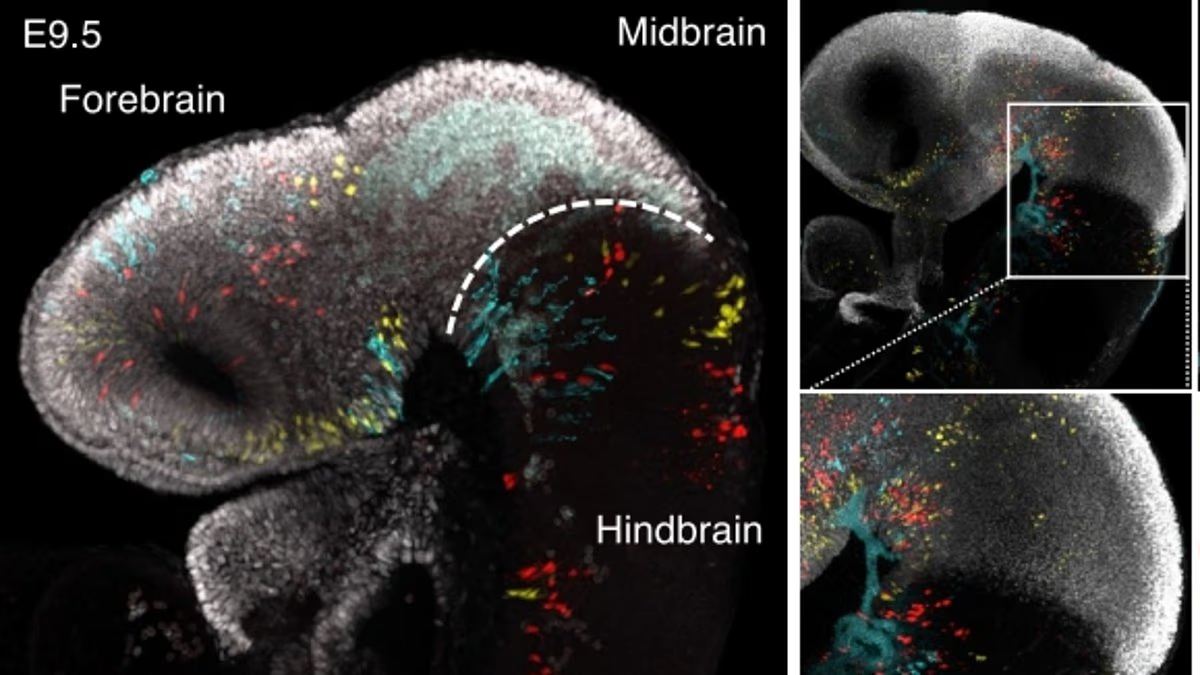
To trace the brain’s development, the researchers examined mouse embryos at the earliest stages of formation.
Their analysis showed that the hindbrain develops along an entirely separate pathway from the brain’s other major regions.
Cells developing in the forebrain and midbrain activate a gene known as Otx2, whereas cells forming in the hindbrain activate a different gene, Gbx2.
‘Our discovery means that we can now grow neurons from the back of the brain, the hindbrain, in a petri dish and study their functions,’ Dr Loh confirmed.

The same two-origin pattern has also been identified in chickens, zebrafish and acorn worms—small ocean-floor animals that share a distant common ancestor with humans.
The researchers also found that the brain’s regions use fundamentally different methods of packaging their DNA.
Dr Rayyan Jokhai, a co-author of the study, said: ‘Previous attempts to make hindbrain neurons likely tried to coax forebrain and midbrain progenitors into hindbrain cells, which our study shows is not possible.’
Armed with this new understanding, the team succeeded in creating functional hindbrain motor neurons in the laboratory for the first time—potentially opening new avenues for research into motor neurone disorders.
This could open the door to research on several debilitating diseases, including spinal muscular atrophy and ALS.
‘Now we have a model to better understand these devastating diseases, and work toward regenerative therapies for them,’ Dr Jokhai said of their study, published in Nature Neuroscience. ‘This is a very exciting new frontier in brain research.’
To test their hypothesis, the researchers also looked back more than 550million years to track evolution.
They found the same two-origin brain pattern in chickens, zebrafish and even acorn worms – tiny creatures living on the ocean floor that share a distant common ancestor with humans.
Dr Loh added: ‘Our research suggests that evolution took two existing neural systems and pushed them together spatially.
‘Having the brain as one organ would probably be more efficient, but we rely on this primordial way to make the brain as two separate pieces.’