
Paracetamol is the UK’s most widely used over-the-counter medicine, taken by millions of people every day.
For many, it is the first remedy reached for when a cold strikes or a persistent headache refuses to ease.
Yet the potentially fatal dangers of taking too much remain unknown to many users.
Last year, one student’s accidental overdose nearly cost him his life and left him facing the long process of learning to walk and speak again.
Riley Lubas, 20, had only recently started a creative media degree at the University of Bath when he developed what he believed was the notorious “freshers’ flu”.
As thousands of students do each year, he visited a local pharmacy and bought cold and flu medication alongside 500mg paracetamol tablets.
What Riley did not know was that the cold and flu tablets already contained 250mg of paracetamol. Within days, the seemingly minor oversight had sent him into organ failure.
Paracetamol overdoses are sadly common in the UK, accounting for about 100,000 visits to A&E departments each year.

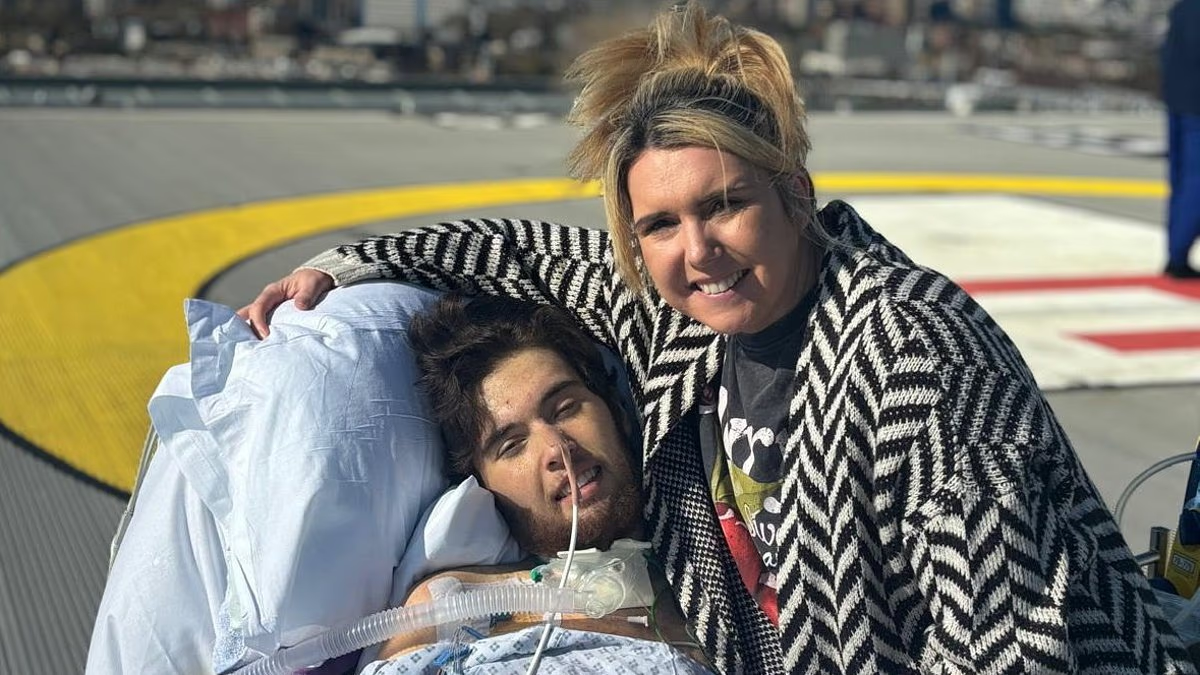
Riley Lubas, 20, nearly died after accidentally taking too much paracetamol

The overdose caused organ failure and forced Riley to relearn how to walk and talk
Studies indicate that roughly one in four people has taken more than the adult maximum of eight 500mg tablets a day—a mistake that can have fatal consequences.
Between 150 and 250 people die in the UK each year after taking an overdose.
An excessive dose causes a toxic by-product known as N-acetyl-p-benzoquinone imine, or NAPQI, to accumulate in the liver.
The body can usually neutralise small quantities of NAPQI. In larger amounts, however, it can overwhelm the liver and trigger devastating organ damage.
The early signs of an overdose can resemble a cold—the same illness many people are trying to treat with paracetamol—and may include nausea, vomiting and stomach pain.
In the most serious cases, the damage can progress to liver failure.
Riley, a bartender from Newport, Wales, said he had no idea he was taking an unsafe amount of the medicine last March.
For four or five days, he took two tablets of each medication every four hours. His total intake rose to about 9,000mg—more than double the recommended 4,000mg limit.
“It wasn’t until my stomach started hurting and I couldn’t keep food down that my flatmates suggested I call 111,” Riley said.
That decision ultimately saved his life.
After being told to go to the Royal United Hospital’s emergency department, medics ran tests and discovered problems with his liver.
Soon afterwards he was admitted to a ward. Worried about their son, Riley’s step-father Chris, 40, and mother Kate, 39, rushed to the scene.
‘I think the doctors were concerned it was hepatitis at first (inflammation or swelling of the liver),’ said Chris. ‘It got to the end of the day, so we went home after visiting hours closed.’
But the ordeal was only just beginning for the Lubas family.
‘Hours later, at half one in the morning, I got a call from the ICU staff at the hospital saying we had to get there immediately,’ Chris said.
‘All they could say at the time was they were doing everything they could.’

Chris and Kate feared they were going to lose their son due to the distressing ordeal
When they arrived back at the hospital in the early hours, doctors delivered devastating news: his liver was heading towards failure, which can prove fatal within days.
As medics fought to save him, Chris and Kate could only watch as Riley slipped into a state of delirium and hallucination – a sign of severe liver damage.
Doctors then transferred him to specialists at King’s College Hospital in London, where the situation became critical.
‘By 6pm that night, he was sedated and on life support and dialysis in multiple organ failure,’ Chris says.
Up to 80 per cent of people who suffer multiple organ failure – when more than two organs shut down – do not survive, studies show.
The staff at King’s College Hospital began asking Riley’s family about his medicine intake.
The family then realised he had been unwell for a couple of weeks and contacted a friend at university, who found packets of paracetamol and cold and flu medication in his room.
Riley was immediately placed at the top of the UK’s liver transplant list because doctors suspected an overdose.
However, damage to his heart meant he couldn’t safely undergo the transplant for two full days, during which time he remained under constant monitoring.

Riley thought he had been struck down by freshers flu but accidentally overdosed on the painkillers
Medics told Chris and Kate the damage to Riley’s liver was ‘as good as irreversible’ – leaving them on the brink of losing their son.
But against all the odds, Riley’s liver slowly began to improve.
Doctors credited Riley’s youth and underlying good health for his recovery, and he was able to come off dialysis and life support after a week.
‘I think the doctors were more surprised than us,’ Chris continued. ‘There’s no exact answer for why it happened this way, but they think that his health and age would have supported the liver’s recovery.
‘But just seeing him up and alive again was unbelievable.’
The recovery, though, was gruelling.
Having undergone a tracheostomy – a surgical procedure to help air reach the lungs – combined with the toll organ failure had taken on his body, Riley had to learn to walk and speak again.
‘That was really hard,’ said Chris. ‘He physically couldn’t move once he’d come out of sedation.
‘And they had to get him used to being able to breathe without the tracheostomy again. It was like he was suffocating when he was trying to breathe.’
After weeks of recovery, Riley was transferred to a hospital back in Newport, where he initially battled severe swelling and muscle loss after being confined to a hospital bed.
A turning point came when he was finally able to breathe independently again – a huge boost to his confidence before he began intensive physiotherapy, re-learning to walk with the help of mobility aids.
After several weeks in intensive care, followed by a further stint on a rehabilitation ward, he was finally discharged home.
Over the following year, he attended regular follow-up appointments – including heart, liver and blood tests – until doctors eventually confirmed he had made a full recovery.
Now, a year-and-a-half on, Riley is back to normal life.
Chris and Kate, meanwhile, have just completed a 50km (31 miles) hike across the Gower Peninsula in south-west Wales to raise money for King’s College ICU.
The family are now calling for greater awareness of paracetamol overdose – and urging young people in particular to understand the risks.
‘It’s just scary because it’s so accessible, it’s so cheap, and it’s seen as a safe drug to take,’ says Chris.
‘I think the biggest issue is that when you’re unwell – whether you’re older, younger or at university – it can be difficult to keep track of how often you’re taking medication.’