
It was the ultimate big-game adventure: so exhilarating, glamorous and improbable that Hollywood stars, aristocrats and some of the world’s wealthiest families abandoned their usual pursuits and travelled north to try their luck.
Yet the prize they were pursuing was not a tiger or an elephant, and the setting was far removed from Africa’s sweeping plains or the jungles of Madhya Pradesh.
Instead, they headed into waters off Scarborough, Yorkshire, in search of the Eastern Atlantic bluefin tuna.
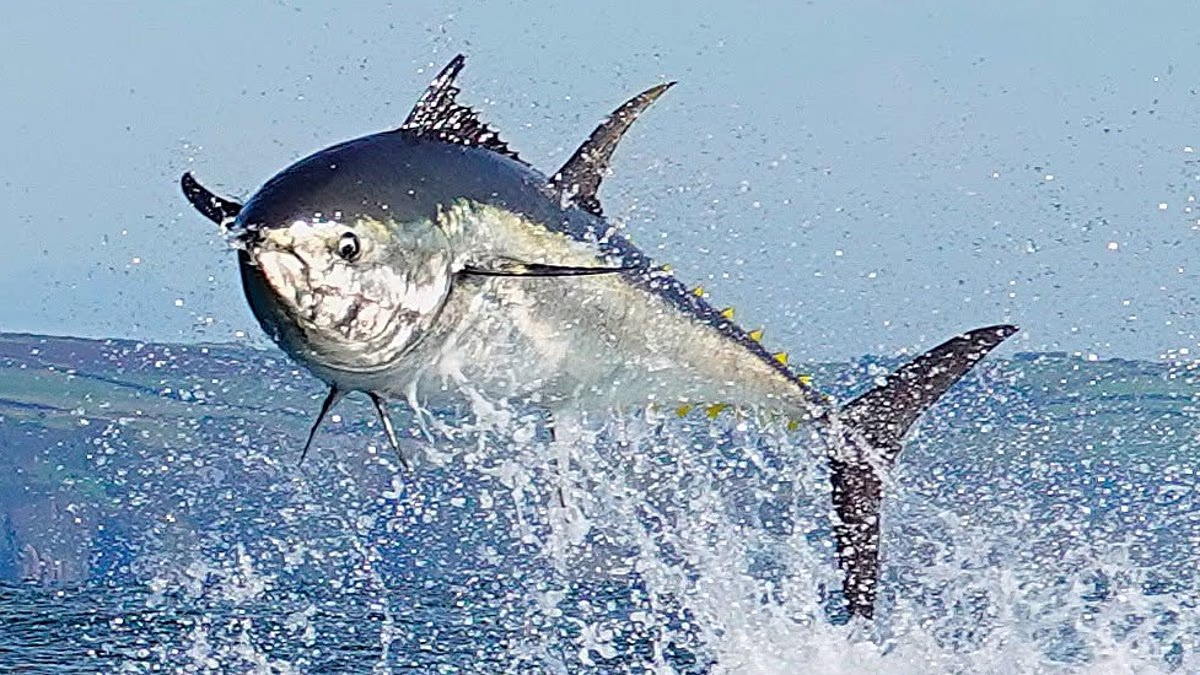
Warm-blooded and the largest member of the tuna family, the bluefin is among the ocean’s most remarkable predators. Sleek, powerful and astonishingly muscular, the biggest can reach 10ft in length and weigh more than 800lb.
Shimmering like quicksilver and capable of extraordinary speed, the fish followed enormous herring shoals into the North Sea. In the 1930s, members of the Scarborough Tunny Club would set out in small fishing boats, joined by figures including John Wayne, Errol Flynn, David Niven, Lord Astor and the celebrated hunter Lady Vera Delves Broughton.
Once a tuna took the bait, the struggle could continue for hours as anglers battled to land a fish and claim a place in the record books.

The bluefin tuna is the largest of the tuna family and one of the ocean’s most magnificent predators
In 1932, inventor and inveterate traveller Lorenzo Mitchell-Henry landed an 851lb giant, a record that remains unbroken. But as the decade drew to a close and the privileged young men of the era went off to fight the Second World War, the boats fell into disrepair and the fishing tackle was abandoned.
Industrial fishing then brought a new threat. Herring stocks were driven dangerously low, while demand for bluefin tuna surged around the world. Fish once dismissed as suitable only for cats or fertiliser had suddenly become highly prized.
The reason soon became clear: bluefin was delicious, particularly when served in delicate slices of sushi or sashimi. The finest fish could command extraordinary prices at Tokyo’s Tsukiji market.
By the early 1990s, bluefin tuna had vanished from British waters. A decade and a half later, in 2007, worldwide tuna populations were nearing collapse. The once-common fish had been pushed perilously close to extinction.
That year, the International Commission for the Conservation of Atlantic Tunas, or ICCAT, introduced a 15-year recovery programme, supported by stringent international fishing controls.
The measures, combined with warming seas that brought more sardines and herring into the tuna’s feeding grounds, helped Eastern Atlantic populations recover in British waters.

A 740lbs bluefin tuna was caught off the coast of in Whitby, for the first time in six decades
The turnaround was dramatic. By 2021, bluefin tuna had been removed from the International Union for Conservation of Nature Red List, while sightings increased along England’s south-west coast.
Last month, the species made an especially striking return when a 740lb bluefin was caught off Whitby for the first time in 60 years. The magnificent fish is back in the North Sea—and, provided conservation rules remain in place, it may now have a secure future there.
“Seeing a shoal in action really is the most unbelievable sight,” says Mitch Tonks, the Dartmouth-based chef, restaurateur and fish expert who owns The Seahorse restaurant. “The water seethes and boils as the tuna drive their prey up to the surface. It just blows your mind.”
Tonks says large numbers began returning to the English Channel around four years ago. The fish have been observed, tagged, released and closely tracked. He has joined several trips and recently landed a 185lb specimen before returning it to the sea.
“We operate on a strictly catch-and-release basis because we don’t have a commercial licence,” he explains. “But it took me 30 minutes to fight and reel it in. As the sunlight catches their skin, you see this incredible range of greens, yellows and blues…”
He stops for a moment, clearly transported by the memory. “They really are the king of fish.”
And with the reappearance of these colossal creatures, a fledgling tuna fishing industry has sprung up.
In 2023, the Department for Environment, Food and Rural Affairs (Defra) issued ten commercial vessels with fishing licences on a trial basis. This year, 30 commercial boats have been allowed a catch a total of four tons each, still a relatively tiny amount. ‘Tuna fishing is incredibly complex,’ explains Tonks, ‘and I don’t think many of the fish are being handled properly. They need to be killed in the right way, preferably by ikejime.’
This is the Japanese method where the fish is despatched with a spike through its brain, so death is instant and painless. It also prevents stress chemicals such as adrenaline, cortisol and lactic acid building up, which can turn the flesh sour and mushy and give it a nasty fishy pong, as well as spoiling quickly.
Tonks adds: ‘Then they need to be bled and chilled quickly on board to stop the internal body heat ruining the meat and to prevent dangerous toxins from forming. A lot of these boats don’t even have ice-making facilities on board.’
He shakes his head. ‘It’s a true art and it will take time to understand these beautiful fish. There are very few doing it well.’
One of those trying to do it right is Edgar Moxom, owner and skipper of Ocean Echoes, based in Weymouth, Dorset. He’s modest and softly spoken, and has been fishing sea bass commercially for 28 years. He received his bluefin tuna commercial licence for the first time this year. The tuna must be caught by rod-and-line and there’s a lot of investment involved.
‘All those specialised rods and reels are very serious bits of kit and costly too,’ he says. ‘You also have to buy all the equipment for chilling them down, plus you have to learn a whole new set of skills.’
He is full of praise for Defra and the Marine Management Organisation (MMO) who have noted the rise in tuna numbers and managed to get increased quotas off ICCAT. Spain and France still get a far higher quota than us. ‘But at least we’ve gone from 15 to 30 permits, which is real progress,’ says Moxom.
Licences are applied for by fishermen and awarded annually, for one year only, and each application goes through a strict process, meaning experience of commercial fishing is essential. But once you pass the criteria, you are entered into a pool and winners are drawn from a hat.
‘This is the problem,’ explains Moxom. ‘I spend a lot of money getting all the kit and there’s every chance I won’t get the permit again next year.’
Price is also an issue. ‘We’re getting less for tuna at the moment at market price than we get for bass. It’s £12 a kilo, compared to £18 at the start of the season.’
Part of the issue lies in a lack of infrastructure and knowledge. ‘There doesn’t seem to be an export market at the moment,’ Moxom goes on, ‘because there is not much confidence in our catch. Tuna grading is a complex, highly technical art and fat content in the fish changes throughout the season.’
Moxom argues that while Defra and the MMO do an ‘excellent’ job in being scrupulous in their regulation and recording of tuna numbers, they need to create a system that sorts the prime fish from the merely mediocre and market them accordingly.
‘In an ideal world, you’d get your licence for five years,’ he says, ‘and build confidence and knowledge, to invest in the long term. But at the moment, this is all so new.’
Because with strict regulations, as well as a change to that annual licence lottery, these incredible creatures, which have come back from the brink of extinction, can not only bring in much needed income for our fishermen.
They can also make sustainably caught English bluefin tuna a byword for some of the very finest fish on Earth.