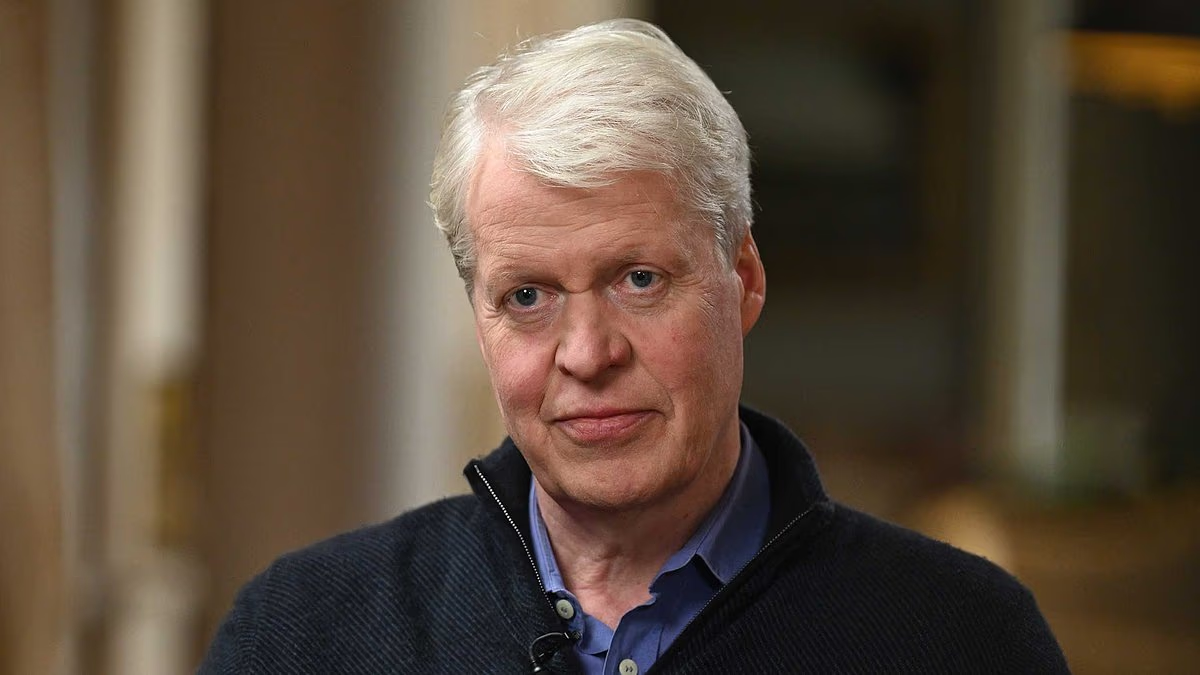

The backlash over Charles Spencer’s revealing memoir about his sister Diana is easy to understand. The King already faces a daunting list of pressures: the continuing controversy surrounding his brother Andrew, Prince Harry and Meghan’s renewed presence in Britain, and concerns about his own health.
Even if Charles Spencer remains understandably bitter toward his former brother-in-law, many will ask whether he might not have chosen to keep those feelings private.
Three decades ago, Charles Windsor was among the most disliked figures in England, while his partner, Camilla Parker Bowles, attracted similar hostility. Time, however, has altered the public mood.
To the surprise of many, Prince Charles emerged from the marital crisis that had damaged the monarchy as a warm, witty and compassionate King. His composure and dignity during illness have earned him considerable affection in numerous quarters.
Mrs Parker Bowles, now Queen Camilla, has also appeared to be a patient and perceptive partner. Everyone has regrets from earlier chapters of life, so shouldn’t the past eventually be left behind? Why, critics ask, should Lord Spencer reopen old wounds with what they describe as a hostile memoir?
That is the argument being advanced by people described as the King’s allies. They have mounted a forceful campaign against Charles Spencer, attacking his own failed marriages and portraying Swan Song as the product of spite, financial pressure and a desire to meet alimony obligations to his third former wife.
Those responses are understandable, but they overlook what seems to me the central issue. Charles Spencer was justified in publishing the book—and justified in bringing it out at this particular moment.
The first reason is simple: the account appears to be rooted in truth. Although the King has expressed anger, he has not directly challenged the substance of Spencer’s memories. I have no doubt that the recollections are genuine.

AN Wilson has met Charles Spencer on several occasions and has stayed at Althorp three times
It is difficult to believe that Spencer fabricated the now-famous telephone conversation, which reportedly ended with the then Prince of Wales saying: “We’ll forget her soon enough.”
Another memory is equally credible. Spencer told me the story years ago, not long after his father died. On the day of John Spencer’s funeral, the young and devastated Earl recalled Prince Charles telling him: “You’re so lucky!” Though the prince was attending the funeral of his father-in-law, he seemed to view the occasion entirely from his own perspective. Spencer had inherited his father’s title, while Charles Windsor remained stuck in the long wait to become King—a position he evidently regarded as deeply unfair.
It is also difficult to know how much of a sense of humour the King possesses. His fondness for the notoriously absurd Goon Show may offer one clue, but he has never seemed to possess the easy comic touch of his ancestor, Prince Bertie, who later became Edward VII. After Queen Victoria’s Diamond Jubilee service at St Paul’s Cathedral, Bertie’s equerry praised the ceremony. “Ah,” Bertie replied, “you have just spent an hour giving thanks to the Eternal Father. But I am cursed with the Eternal Mother.”
Charles Windsor spent much of his life waiting to occupy centre stage. He was eager to become King, yet his mother lived until the age of 96. He had felt neglected by his parents and, after 15 years of adulthood and several unsuitable relationships, was pushed into what was effectively an arranged marriage with Diana Spencer, a bride of just 20.

Prince Charles and Earl Spencer speak beside Nelson Mandela following a banquet in Cape Town
Diana captured the public imagination on an extraordinary scale. After spending three decades in his mother’s shadow, Prince Charles appeared visibly resentful as crowds and media attention turned overwhelmingly toward his young wife.
In a display of extraordinary insensitivity, he told Diana shortly before their wedding that he did not love her, while continuing his relationship with Mrs Parker Bowles—the one person, alongside his sister Anne, whom he regarded as a steady and sensible presence.
Diana’s devastation at her husband’s infidelity was inevitable, and it is equally unsurprising that her brother still carries a deep sense of her suffering.
I would describe Charles Spencer and myself as friendly acquaintances rather than close friends. We have crossed paths several times, I have stayed at Althorp on three occasions, and for a period we were represented by the same agent.
Our first meeting took place in a small but elegant Oxford restaurant. Spencer was an undergraduate dressed in the traditional subfusc—white tie and academic gown worn for final examinations—and Diana had arranged a celebratory lunch for him. Years later, she visited the Evening Standard, where I was working, and we met again over lunch. On both occasions she displayed the same warmth, wit and grace that made her such a compelling public figure. Her personality was so powerful that a husband would have needed exceptional humility not to disappear beside her.
King Charles, by contrast, has long appeared intensely focused on his own concerns. Those familiar with him know about his flashes of defensive anger—a quality dramatically illustrated on the day he acceded to the throne, when a malfunctioning fountain pen appeared to provoke an eruption of frustration.
He was the worst possible husband for her, and she was the worst possible choice of wife for him. He spent the honeymoon sitting on the deck of the Royal Yacht reading twaddle by Laurens Van Der Post while the bored Diana chatted to the crew.
So, the whole thing is a tragedy. A true tragedy, in that probably all those concerned, flawed and imperfect as they were and are – the grannies who dreamed up the marriage, the bride and groom so ill-matched, their flawed, damaged sons – set out with the hope that they would do good.
As it was, this disastrous marriage very nearly brought the monarchy to an end. And its consequences – two traumatised sons, who are still living with the consequences and making the rest of us live with those consequences, could yet finish off the monarchy itself.
So, these things do matter.
Since I first met Spencer he has gone on to be an excellent historian and a first-rate writer. As an historian, he knows that he must set the record straight.
Although it might sound strange, it is more tactful for Spencer to do so now, while the King is still alive, rather than to wait for Charles III to die. Then it would seem like dancing on his grave.
We need to be reminded of how appallingly not only Charles Windsor, but all the Royal Family, behaved towards Diana. That is why the nation turned against all of them. It was not just the Press and the paparazzi who drove her to her desperate end, it was the callousness of the Windsors. I salute Charles Spencer for his bravery in saying all this.
He is a sensitive man who would know full well what the reaction to his book would be. The ‘friends’ of the King and the stuffpots will try to impugn Spencer’s integrity by smearing his character. But the truth is the truth. And, when you think about it – now Diana is, alas, no longer with us – no one else could have told the true story except her brother.
JAN MOIR: I just can’t accept that Prince Charles practically revelled in the death of his former wife
Something profound and elemental emerges from Charles Spencer’s book, Swan Song: Diana, My Sister.
It is not how much he mourns his sister Princess Diana, from whom he was estranged at the time of her death. It is how much he utterly despises King Charles, a hatred that has roared away, a bitter furnace in his soul, for more than 30 years.
In the extracts published by Our News Outlet, Spencer’s undimmed malice burns off the page, a heartless corrosion that is awful to behold. In his version of events, we are encouraged to believe that the then-Prince Charles practically revelled in the death of his former wife.
Indeed, he appeared to be quite pleased that 36-year-old Diana, the beloved mother of his two young sons, met her end in a convenient car crash in Paris.
‘I suspect the prince’s first reaction must have been to think more of how this event might free him to marry the woman he loved, rather than appreciating the loss of one he did not,’ writes Spencer.
He recalls that, unlike others who telephoned to give their condolences in the days and hours after Diana’s death, Charles sounded ‘giddily elated – like a lottery winner’. What a terrible and damning allegation, backed up by precisely nothing, least of all the weight of history.
Yet, according to Spencer, the prince also sounded ‘strangely matter-of-fact, given the enormity of the disaster’.
How could he have been both these things at the same time?

Earl Spencer recalls that, unlike others who telephoned to give their condolences in the days and hours after Diana’s death, Charles sounded ‘giddily elated – like a lottery winner’
By Earl Spencer’s account, while his own grief was profound, the brutish prince seemed to regard the death of Diana with all the detachment of a man who has just witnessed a bug being squashed on a windscreen.
Oh dear, how sad, never mind. That is the mood Charles Spencer ascribes to his former brother-in-law at this tragic moment of global import and personal bereavement in both their lives.
Spencer also writes that Charles said the following to him, delivered in true Bond-villain fashion, perhaps while stroking a cat: ‘Rest assured,’ he hissed, ‘we’ll forget her soon enough!’ Did he really? Not only does it not sound like King Charles, but it is also a remark you could surely put any number of interpretations upon. It is also a remark that could easily be misheard.
Isn’t it far more likely that Charles said ‘they’ll forget her soon enough’ – meaning the public, who were going crazy?
Isn’t it far more likely that Spencer’s own heightened emotional state meant he could have misinterpreted or misunderstood what was coming down the phone line from the royal residences as his own world fell apart?
The Palace responded to this latter allegation by saying: ‘While we do not comment on books as a matter of principle, His Majesty is mindful that the pain of fraternal grief can cloud reason, affect judgment and colour memory in ways others do not recognise, even many years after such a loss.’ Recollections may vary, Mark II.
Some argue that the King should not have commented on Spencer’s words – yet I believe that he had to. The slur is so terrible, the smear so profound, that he simply could not let it lie unchallenged.
In writing these incendiary words, Charles Spencer meant to wound and harm, to thrust a dagger deep into the royal ribs, to cause as much damage as possible, to make a 77-year-old man, not in the best of health, look like a heartless, weak adulterer who simply did not care about the tragic death of his ex-wife.
Spencer’s judgment is thunderous and cruel for many reasons but most of all because it does not acknowledge a speck of humanity within the prince, or that at the worst moment in life, many of us do not behave at our best.

Earl Spencer and Prince Charles at the official opening of a fountain built in memory of Diana, in London’s Hyde Park, in 2004
Ultimately, it all boils down to a choice that seems medieval – which Charles do you believe? Spencer or Windsor, the King or the earl, the husband or the brother, the aggrieved or the grieving. Well, I know who I think is the better man – and it is not Earl Spencer.
Is this a choice Prince Harry must also make? One wonders how he can remain on close terms with his fuming uncle while his father is being so viciously traduced and the monarchy attacked. It seems impossible that he can remain neutral, a gingery Switzerland of calm in this bloody war of attrition.
In later chapters, for example, the earl also recounts his version of the row regarding Prince William and Prince Harry walking behind Diana’s coffin at her funeral procession. Are we back here again? I am afraid so.
This is an issue Harry has bemoaned, too, as further evidence of the moral futility and chronic failings of monarchy.
Look. No doubt it was an ordeal; two young boys in their smart suits and neat hair, trying not to cry in front of the whole world. It still breaks my heart just to think about it.
Yet there is a price to pay for the trappings and advantages of being a member of the Royal Family – and here it was, being marched out in funeral lockstep across a city and a nation in mourning.
Perhaps, with hindsight, they could all look at it another way: that walking behind the coffin was a privilege, it was an honour, it was what was expected of them as heirs to a throne that stretches back more than 1,000 years.
She was their mother, this was their destiny – and in the end, what did it have to do with Charles Spencer? He was an uncle, a man whose views were welcomed – but surely those views could only be secondary to the wishes of the boys’ father?
From that day onwards, all four of these men had to learn how to live without a mother, without a sister and without a first wife.
Some of them, of course, have done so better than others. Spencer and Harry have much in common, for both of them are caught in the amber of three decades of hurt and resentment, unable to move on. Compare this to Prince William, whose burden grows heavier by the day but who never complains. And then there is Charles Spencer, a historian who wants to rewrite history.
Back in 1997, Earl Spencer welcomed his sister’s body back to Althorp in a way he did not welcome her presence in life. When she asked if she could live in the Garden House on the estate in 1992, he said no. Now, she lies in her island grave at Althorp but she does not rest in peace. Her brother has seen to that.
Read more: