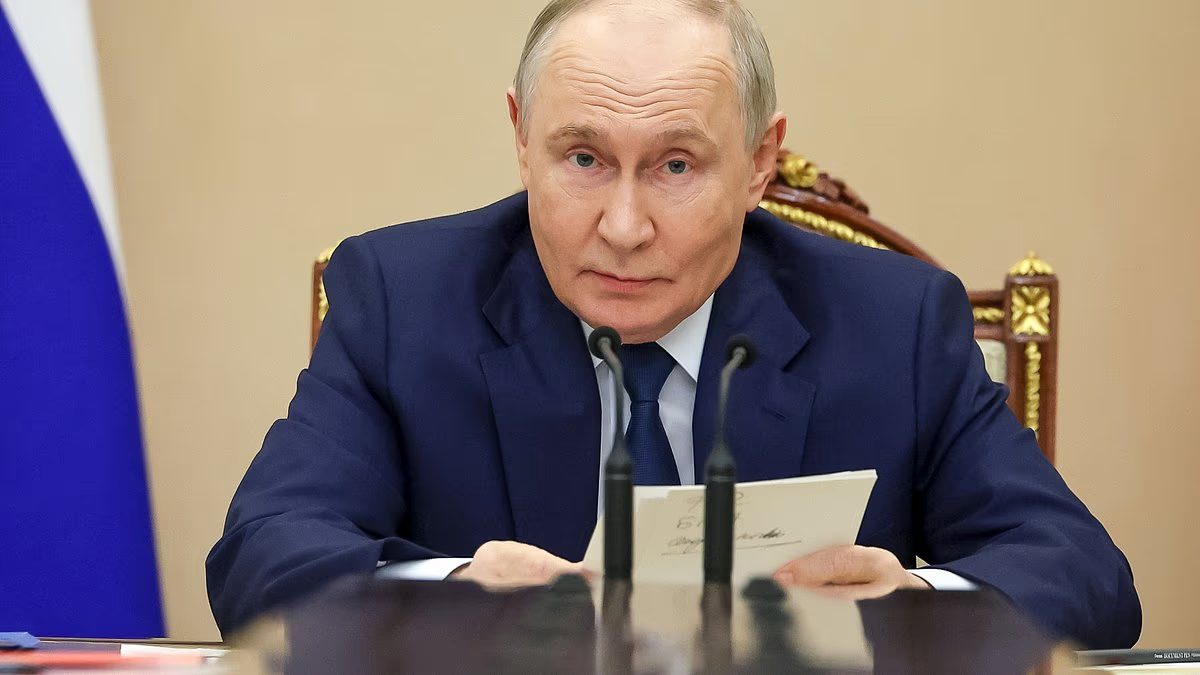
Russian President Vladimir Putin’s United Russia party has secured a record number of seats in the country’s lower house of parliament.
According to preliminary figures released by electoral chief Ella Pamfilova, United Russia won 355 of the 450 seats in the State Duma.
With almost every vote counted following the three-day election, the results show that the president’s party has gained a larger super-majority than its previous record, set in 2016. No parties openly critical of Mr Putin took part in the vote.
The Kremlin has already celebrated the result, saying it demonstrates that Russians remain united behind Mr Putin.
The vote took place after a Moscow court banned Russia’s only liberal and anti-war party, Yabloko, last month.
The case followed a lawsuit brought by the rival Rodina party, which accused Yabloko of publicly supporting an extremist organisation. Rodina cited material published on Yabloko’s website backing the ‘international LGBT movement’, which Russia designated as extremist in 2023.
Russia’s financial monitoring service also alleged that Yabloko had received money through third parties from foreign countries, including Germany and the United States.
Earlier today, the UK joined Australia, Canada, New Zealand and Norway in condemning Russia’s ‘sham elections’ in occupied Ukrainian territory.

Russian President Vladimir Putin’s United Russia party won a record number of seats in the country’s lower house of parliament
A statement published on the Foreign Office’s website said: ‘Holding Russia’s State Duma elections in the temporarily occupied territories of Ukraine, as Russia did in Crimea and Donetsk, Kherson, Luhansk and Zaporizhzhia, is a gross violation of Ukraine’s sovereignty and independence, and the UN Charter.
‘These sham elections are part of a wider system of occupation: the imposition of Russian administration, law, media, education, language and citizenship, backed by coercion and repression. This includes reports of the enforced disappearance, detention, and torture of thousands of Ukrainian citizens.
‘These regions are part of Ukraine and holding sham elections cannot alter the status of these territories under international law. We continue to stand with Ukraine.’
The developments come as the EU works to extend sanctions against Russia over its invasion of Ukraine, after France called for oligarch Alisher Usmanov to be removed from the bloc’s blacklist.
The 27-member bloc last week delayed the deadline for renewing asset freezes and visa bans targeting around 3,000 individuals and entities until midnight on Tuesday.
EU ambassadors were due to resume talks in Brussels on Monday afternoon after failing to reach an agreement during the morning session.
All EU member states must approve the sanctions’ renewal. The measures, which form a central part of the bloc’s response to Russia’s war since 2022, are reviewed every six months.
This latest renewal has been delayed after France joined Slovakia in seeking the removal of Russian-Uzbek billionaire Mr Usmanov from the sanctions list.
Officials in Paris have referred to ‘national security’ concerns but have declined to provide details publicly.
The Financial Times reported that France’s demand was connected to a possible prisoner-release agreement involving French nationals detained in Azerbaijan.
More hawkish EU members, including Poland and the Baltic states, strongly oppose relaxing the sanctions against Mr Usmanov for political reasons.
Meanwhile, diplomats said that Luxembourg is insisting that if Mr Usmanov is taken off the list, it wants to see sanctions lifted on another Russian tycoon, Mikhail Fridman.
A diplomat, speaking on condition of anonymity, said a compromise deal on the table would see Mr Usmanov and Mr Fridman removed, and the rest of the sanctions extended for up to 36 months.
Multiple EU diplomats insisted that despite the standoff over Mr Usmanov, there was widespread agreement that the EU sanctions should not be allowed to lapse.
The blacklist includes key figures such as Russian President Vladimir Putin and Foreign Minister Sergei Lavrov.