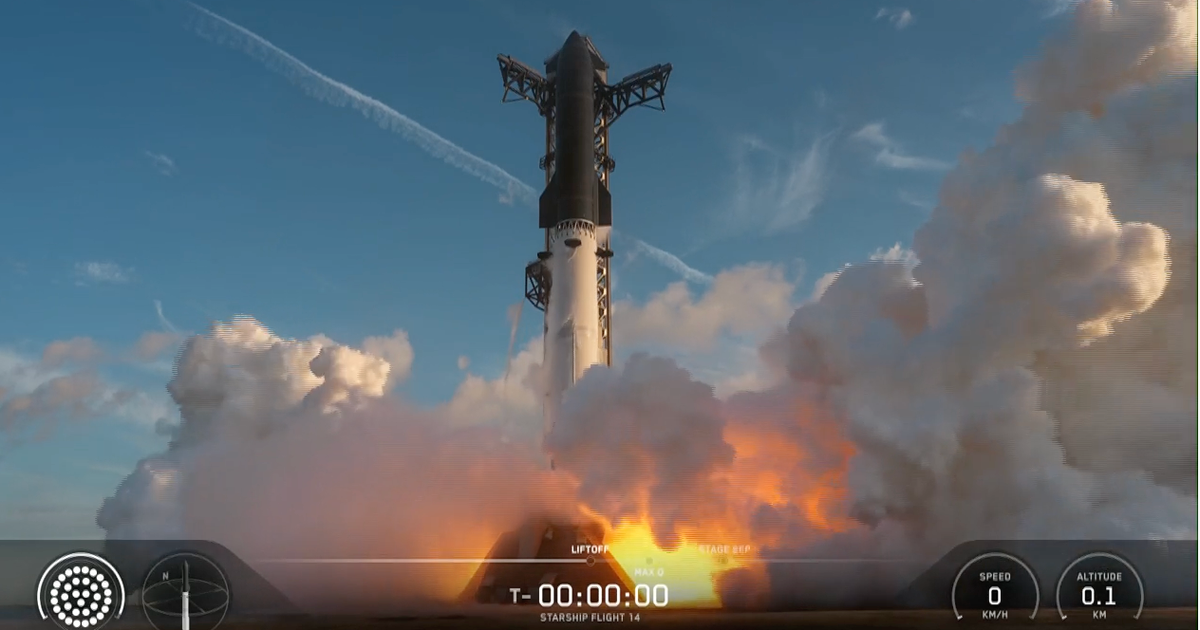

SpaceX launched its Super Heavy-Starship rocket toward orbit Monday, marking a major milestone in the company’s effort to refine the world’s most powerful launch vehicle for commercial operations and future NASA lunar missions.
The Starship upper stage lost one engine during the climb, but after reviewing the situation, flight controllers approved the spacecraft to continue its journey toward orbit.
After 13 suborbital test flights, the mission represents a pivotal moment for SpaceX and NASA. Successfully reaching orbit and returning safely would strengthen confidence that SpaceX can prepare the system in time to support NASA’s planned Artemis moon landing in 2028, which is expected to use a Starship variant.
SpaceX
That lunar mission will depend on a series of Super Heavy-Starship tanker launches to refuel the lander before its trip to the moon. In lunar orbit, the lander would dock with a NASA Orion crew capsule, collect two astronauts and transport them to the surface before bringing them back.
A successful orbital flight would also pave the way for additional tests of autonomous in-space refueling, a capability never demonstrated on the massive scale required for Artemis lunar landings.
SpaceX Starship mission plan
At 8:49 a.m. EDT, all 33 methane-fueled Raptor engines on the Super Heavy booster roared to life, sending the 400-foot rocket away from SpaceX’s Starbase complex along the Texas Gulf Coast.
The first-stage booster produced roughly 16 million pounds of thrust—about twice the power generated by NASA’s Space Launch System moon rocket. As propellant burned away and the vehicle grew lighter, Super Heavy accelerated rapidly through the dense lower atmosphere on a southeasterly path.
About 2 minutes and 20 seconds after liftoff, the booster’s engines were expected to begin shutting down as the six Raptors on the Starship upper stage ignited. The sequence formed part of a “hot staging” maneuver, with the booster separating moments later and beginning its descent.
As Starship continued climbing, the Super Heavy booster was programmed to turn around, reignite its engines and reverse course toward the Texas coast. Thirteen engines would then restart to guide the booster into a controlled vertical splashdown several miles offshore.
During the first hour of the planned six-orbit, 10-hour mission, Starship was expected to release 26 third-generation Starlink satellites. The deployment would mark only the second time the new rocket had been used to place operational spacecraft into orbit, adding to SpaceX’s expanding internet constellation.
SpaceX
On the previous test flight, three engines malfunctioned, preventing a full-duration boost-back burn. Only eight of the 13 engines fired during the landing maneuver, ending in a “hard” splashdown. SpaceX introduced hardware upgrades and software changes ahead of Monday’s attempt to improve the booster’s return.
The booster is ultimately intended to be caught by enormous mechanical arms attached to the launch tower, a maneuver SpaceX has completed four times. For now, however, the company is continuing to use ocean splashdowns while it tests further upgrades. Starship itself is also designed to return to the launch site for a mechanical catch, though that capability has not yet been demonstrated.
The upper stage was expected to reach an orbit about 180 miles above Earth after two engine burns. The first, scheduled to end roughly one minute after the booster’s splashdown, would place Starship on a suborbital path like those used on earlier flights—allowing for a safe splashdown even if control of the vehicle were lost.
If engineers confirmed that the spacecraft was operating normally, an additional 11-second Raptor burn would establish a stable orbit. About 8 1/2 minutes later, a Pez-style dispenser in Starship’s nose was scheduled to release 26 third-generation Starlink satellites, each offering 10 times the capacity of the previous generation.
Once the satellites were deployed, engineers planned to track Starship’s performance through six trips around Earth. The flight would then conclude with a de-orbit burn scheduled for 8 hours and 52 minutes after liftoff.
Like earlier test vehicles, Starship was expected to re-enter the atmosphere belly-first, slowing dramatically inside a fireball of electrically charged plasma. Its fins and flaps would help maintain the correct attitude before three Raptors reignited, flipping the spacecraft upright for a tail-first splashdown off Chile. The mission was designed to last 9 hours and 50 minutes.
Future role in Artemis moon program
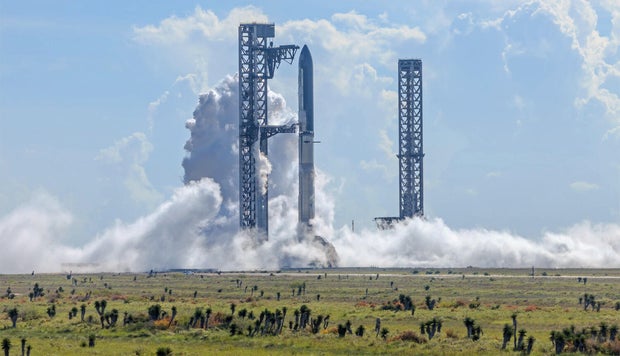
SpaceX now operates two Super Heavy-Starship launch pads at Starbase and has three additional facilities under construction in Florida. Those include a site at historic Launch Complex 39A at Kennedy Space Center and another at the neighboring Cape Canaveral Space Force Station. The company is targeting its first Florida launch for late this year or early next year.
The ambitious flight schedule will require multiple launch pads.
NASA/SpaceX
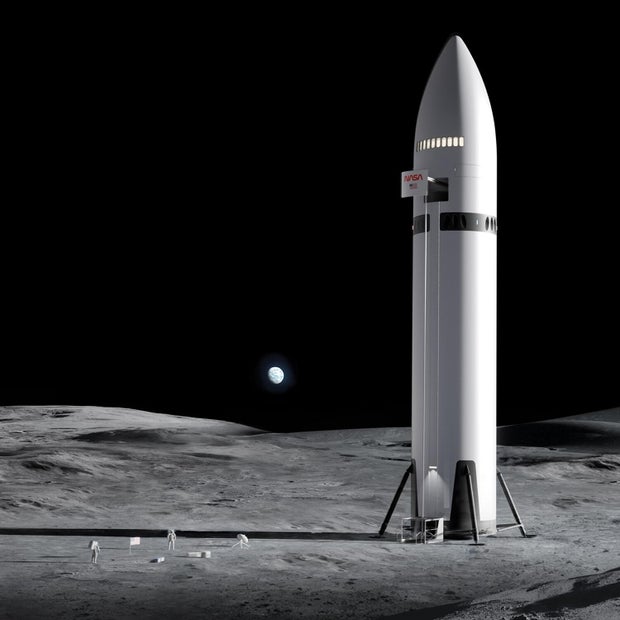
SpaceX is developing a Starship version that will serve as a lander for Artemis astronauts. Before it can travel to the moon, the lander may require as many as 15 Super Heavy-Starship tanker launches to deliver the fuel needed for the mission. It would then wait in lunar orbit for astronauts traveling aboard a Lockheed Martin-built Orion capsule.
The 165-foot lander would carry two crew members to the moon’s south pole, touching down vertically near the region. Once on the surface, the astronauts would use an external elevator to descend from the vehicle and later return to the lander at the end of their exploration.
With the first such landing targeted for 2028, SpaceX must ramp up its Super Heavy-Starship test schedule to get the vehicle certified for human spaceflight and to demonstrate the reliability required to safely launch more than a dozen tankers within days of the lander’s launch.
Many observers with past experience at NASA and elsewhere in the aerospace industry doubt SpaceX can deliver a tested “human landing system” Starship variant by 2028. NASA is hedging its bets, funding development of an alternative lander designed by Blue Origin.
During a test flight in low Earth orbit next year — Artemis III — NASA plans to launch four astronauts in an Orion capsule who will attempt to rendezvous and dock with prototype landers launched separately by SpaceX and Blue Origin.