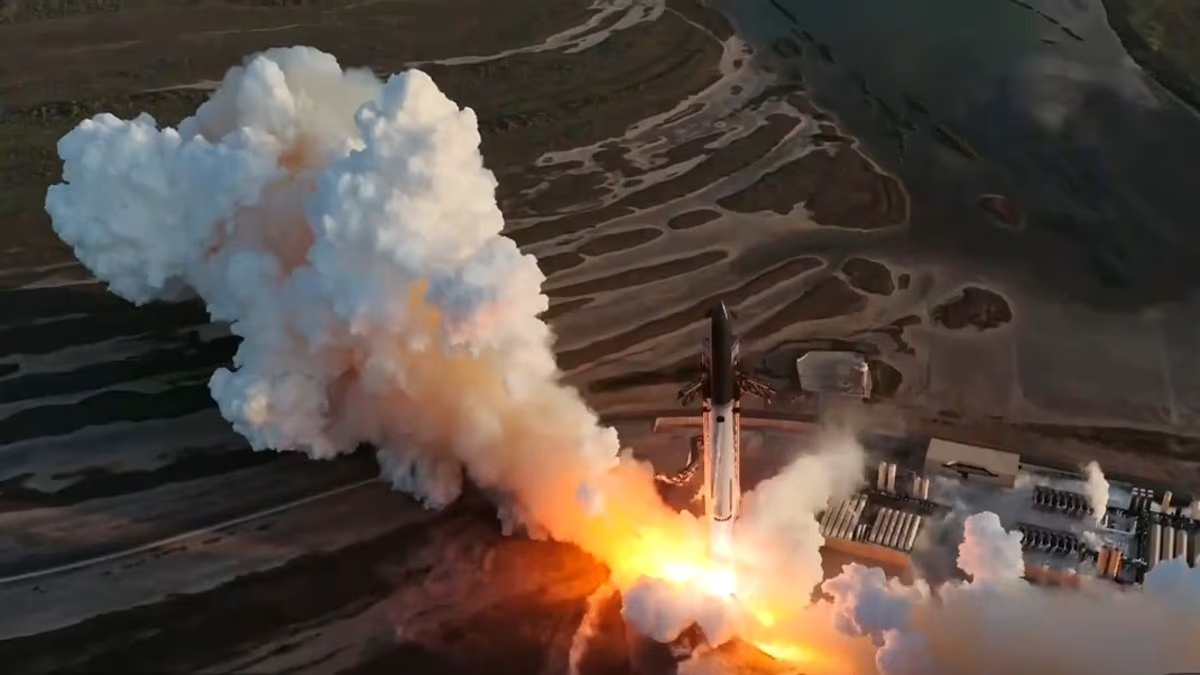

SpaceX’s massive Starship rocket faced a tense moment in flight Monday morning when an engine problem threatened to derail its historic attempt to reach orbit.
The 40-story, uncrewed spacecraft lifted off at approximately 8.46am ET from SpaceX’s Starbase facility on the Gulf Coast near Brownsville, Texas. The vehicle combines a Super Heavy booster with the Starship upper stage.
The mission marked the first effort to place Starship—the most powerful rocket ever built—into orbit. But roughly 15 minutes after launch, one of the spacecraft’s Raptor 3 engines unexpectedly shut down, forcing flight controllers to consider whether the mission could safely continue.
Around 20 minutes after liftoff, mission control approved the attempt to proceed into orbit, prompting cheers at Starbase. Approximately five minutes later, Starship reached its intended orbital path.
The test flight was originally scheduled to keep Starship in space for about 10 hours and complete six orbits of Earth. SpaceX later said the orbital demonstration would conclude seven hours earlier than planned.
The mission is expected to finish with Starship descending into the Pacific Ocean near Chile. SpaceX’s long-term goal is to recover the spacecraft, refurbish it and launch it again.
Monday’s launch came after 13 previous Starship test flights failed to complete an orbital mission. This time, SpaceX is seeking both a trip around Earth and a controlled return to the planet.
A successful flight could increase confidence in a modified Starship design intended to support NASA’s Artemis program and its planned 2028 mission to land astronauts on the Moon.

SpaceX’s Starship blasted off from Starbase in South Texas at 8.46am ET

The test is expected to end with Starship splashing down in the Pacific near Chile, as SpaceX works toward recovering and reusing the spacecraft
Two minutes and 34 seconds into the flight, Starship completed a successful hot-stage maneuver, separating from Super Heavy Booster 21. The booster then performed its landing burn above its planned splashdown zone in the Gulf.
At roughly 9am ET, Starship finished the engine burn that propelled it into space, even after one of its Raptor 3 engines shut down earlier than expected.
The spacecraft adjusted to the failure while SpaceX engineers analyzed the malfunction and determined whether Starship had enough performance margin to continue toward orbit.
After reviewing the situation, flight controllers authorized Starship to carry out the burn required to reach orbit.
About eight and a half minutes after that maneuver, a dispenser at the rocket’s nose opened and began deploying 26 third-generation Starlink satellites. Each satellite is designed to offer 10 times the capacity of its predecessor.
By 9.54am, Starship had successfully released its full Starlink payload.
NASA Administrator Jared Isaacman praised SpaceX following the launch. Writing on X, he said: “Gorgeous launch, getting Ship to orbit and managing every step in a safe, responsible, and especially inspirational way.”

The uncrewed, 40-story Starship vehicle—made up of the Super Heavy booster and upper-stage spacecraft—roared away from its launch pad Monday morning

After two minutes and 34 seconds, Starship completed a hot-stage separation from Super Heavy Booster 21, which carried out a landing burn over its planned Gulf splashdown area

A mid-flight engine shutdown created a tense moment and forced SpaceX controllers to reassess the plan to send Starship into orbit
‘NASA, along with the rest of the interested public, is excited to help where we can and for Starship missions to become routine!’
Starship is orbiting Earth under a flight plan that calls for regular checks of the spacecraft’s condition, allowing controllers to decide whether to let the mission continue or bring it home early.
If a problem arises, SpaceX can fire an engine to take Starship out of orbit ahead of schedule.
The checks are meant to reduce the risk of losing control of the spacecraft and leaving it in orbit, where it could threaten active satellites
Test flight 14, coming three months after SpaceX’s high-profile stock market debut, aims to accelerate development of the largest and most powerful rocket ever designed.

Above is Starship on Sunday, one day before the rocket’s historic orbital launch
After several years of development and testing in Texas, SpaceX began flying Starship in its full configuration in 2023 and has since made numerous modifications through the successes and failures of successive tests.
But enormous technical challenges remain before Starship, which Musk wants to make fully reusable, can conduct commercial flights, deploy data centers in orbit or reach the Moon or the Red Planet.
With this new test, SpaceX hopes to usher in an ‘exciting new phase’ of development that will include, among other things, tests of refueling the rocket in orbit.