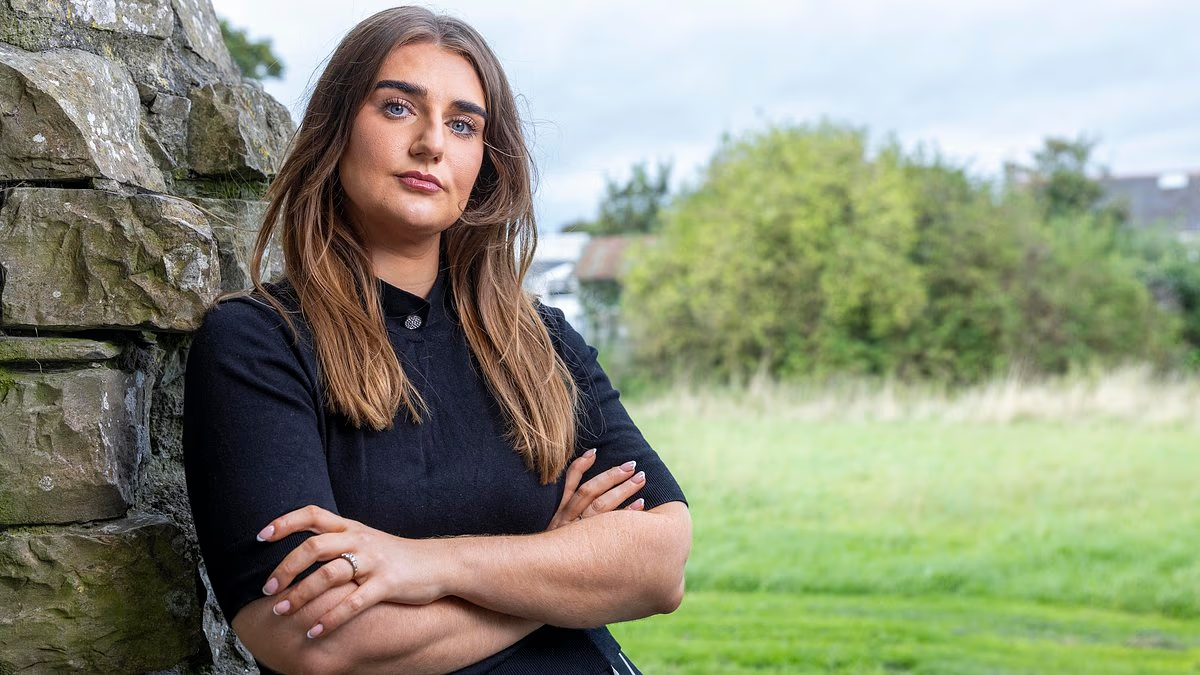

When Sophie Brady appeared on camera for a new documentary examining the crisis affecting Ireland’s special needs assistants, she spoke openly about one of the job’s most troubling realities: the lack of security.
Although she had spent two years working in the same secondary school, the Meath native had no certainty that she would have a job when the new school year began in September.
“I presumed I’d have to re-interview, like I’ve had to do every other year,” says 27-year-old Sophie. “But I thought I’d be in a good position because I’d been doing the role for two years already.”
She was mistaken.
After taking part in Crisis In The Classroom, a Virgin Media documentary presented by Ireland AM’s Eric Roberts and airing on Monday, Sophie applied for her position twice but received no response. She later realised that her school email account had been deactivated.
“I was like, ‘Oh my God, my school email is turned off,’” she says. “I was concerned because I hadn’t heard anything about even an interview date.”

Sophie Brady’s SNA position was not reinstated after the summer break. Picture: Tom Honan
With the start of the school year only days away, Sophie contacted the school herself. She says she was told that an automated email wishing her “best of luck” should have been sent to her.
“I didn’t get an interview,” she says sadly. “I didn’t get to say goodbye to the kids.”
The two other SNAs who had worked with Sophie were later interviewed and returned to their roles. Two more SNAs were also hired when the school opened a new special class.
Sophie says she had never received negative feedback about her work, making the way her employment ended both distressing and deeply upsetting.
“If they knew in June that they weren’t going to employ me again, why not let me know?” she says. “Give me enough notice to say goodbye to the kids and enough time to apply for other positions.
“That was the school I wanted and, in my heart of hearts, that’s the school I thought I’d be going back to.”
The timing is particularly striking. While filming Crisis In The Classroom, Sophie discussed the precarious nature of SNA employment. By the time the programme airs, she will no longer have a job in the role, prompting a stark conclusion.

Sophie appears in Crisis In The Classroom with Eric Roberts
“I don’t want to be an SNA any more because I’ve just been mistreated the whole time that I’ve done it,” she says. “It doesn’t feel worth it.
“Nobody becomes an SNA because they want a slap on the back every ten minutes. I didn’t need anyone to tell me I was doing a good job. But we deserve to be treated with respect. I just can’t deal with every summer not having a position and having to re-interview.”
It is a painful conclusion to a career Sophie says she truly loved.
“I’ve done everything from toileting and lifting children from wheelchairs into hoists to managing their medication,” she says. “I’ve rung ambulances for children who have had epileptic fits and seizures. You’re supporting them through their exams, special centres, regulation and movement between classes.”
Over the previous two years, Sophie says she supported approximately 11 or 12 girls, ranging from first year to Leaving Cert age. In a secondary school, even the seemingly ordinary task of moving between classrooms can feel overwhelming for a child with additional needs.
‘Sometimes they’ve come from a primary school with only 12 or 15 in their class and then there are 120 in the whole year,’ she says. ‘For parents, it helps knowing, “OK, my little Amy has Sophie. She has her SNA. She knows there’s going to be a friendly face there to greet her at nine o’clock.”
‘Kids, particularly with autism, thrive on routine and the same faces all the time.’

Sophie says the lack of a permanent SNA position makes it difficult to plan financially. Picture: Tom Honan
Sophie first arrived at the school as maternity cover in January two years ago. The SNA she was replacing did not return and Sophie stayed on, but says she never had the security of knowing the job was hers permanently.
‘I never signed a thing,’ she says.
It is a precariousness that extends beyond the school gates. Sophie lives with her long-term partner, musician Conor Kavanagh, and says the lack of a permanent position inevitably makes it difficult to plan financially for the future.
‘I could do the best job all year, be my best self, and I still have to re-interview and still have that threat hanging over me every single summer that somebody else is going to swoop in and take the job that I’ve been doing,’ she says. ‘That’s exactly what happened.’
There is another reason Sophie became so invested in being a trusted adult for children. She has previously spoken publicly about suffering sexual abuse during her own childhood at the hands of her cousin David Hamilton, who was convicted and jailed.
Her experience, she says, directly influenced her decision to become an SNA.
‘That is genuinely the reason,’ she says. ‘There are so many women who are in caring professions like SNAs who have a similar kind of past to me. It makes complete sense to want to be the adult that you didn’t have.’
Her childhood also left Sophie acutely aware that a child who appears fine may be anything but.
‘I feel like I’m pretty switched on to it because I know what my masks were,’ she says. ‘I knew how to mask and who to mask around and how to get away with, “Oh Sophie, are you a bit quiet today?” “No, no, I’m fine.” People just believed that and took your word as gospel.’
It is something she says she later recognised in young people at school.
IN CASE YOU MISSED IT: Woke Kansas Pastor in Senate Race Urged Repentance for Beef, Driving
‘There are kids absolutely drowning in anxiety and discomfort, but they’re masking that they’re OK,’ she says. ‘Just don’t call on me, don’t ask me to answer that question. I’m never going to put up my hand, I’m stuck to the chair with anxiety.
‘I can tell by the look on their face. I can tell by their shoulders looking really tight and their fists are clenched and their jaw is tight. There are little things like that I would pick up on.’
For Sophie, one of the privileges of being an SNA was becoming the person a young person trusted enough to approach.
‘I’ve had girls telling me, “I’m struggling with X, Y and Z, but I can’t tell my teacher”,’ she says. ‘To be the trusted adult that they feel comfortable telling that stuff to is such an honour. You can say, “Tell me and I can bring it to someone. We’ll figure out a plan.”’
It’s not the first time Sophie has found herself advocating for people who are not being heard.

Sophie has been an outspoken campaigner for sexual violence survivors. Picture: Tom Honan
Following her own experience of the criminal justice system, she became an outspoken campaigner on the treatment of sexual violence survivors, including the use of complainants’ private counselling records in sexual offence trials.
‘I was literally in the Dáil, I’d say, six times last year trying to get the use of counselling notes banned,’ she says.
She recalls sitting in the public gallery while TDs spoke about survivors’ concerns and says she was angered to see Justice Minister Jim O’Callaghan ‘scrolling’ through his phone during part of the proceedings.
‘We had sent big massive emails, survivors and victims, about what we need and what our expectations are going forward for future victims,’ Sophie says.
‘Because, let’s be real, it’s too late for us, our day in court is done, we’ve gone through all of this. So it’s for future survivors.’
Legislation introduced this year proposes significant changes to the disclosure of counselling and other personal records in sexual offence cases, including removing the existing provision under which a complainant can waive their right to non-disclosure without a court hearing.
For Sophie, however, the frustration is familiar – those directly affected having to fight to make themselves heard. ‘I’ve never known my life without advocacy, I suppose,’ she says.
That advocacy has also brought Sophie a sizeable social media audience. People she has never met regularly contact her to tell her about some of the most traumatic experiences of their lives.
‘I don’t know what it is,’ she says. ‘People tell me their whole life story in my DMs. I think it’s so beautiful that they feel like they can open up to me.’
Far harder has been the abuse Sophie herself has received for speaking publicly. She says some of the most aggressive messages have come from people she describes as being on the far-Right, and that threats have at times become frighteningly specific. ‘People were literally saying that they were going to come to the house and bomb my car,’ she says. ‘It went way too far and it started affecting me and Conor. He was worried about me even going to the gym late at night. I’m genuinely at a point where I’m not comfortable in a lot of ways.’
Being called an ‘attention seeker’ is particularly painful, she says, because it echoes something she heard repeatedly growing up. The cumulative effect means Sophie has begun stepping back from some of the advocacy that has occupied so much of her life.
‘I will never step away from it full-time,’ she says. ‘But I have had to take a little step back.’
This leaves her in an unusual position – in a matter of months, the two roles through which she had channelled so much of her instinct to help other people have changed.
‘I’m not in the school, I’m not advocating for sexual victims. I don’t know what to do,’ she says candidly.
One constant is Conor, her partner for five years, who she has known since primary school.
‘I’m very lucky,’ she says, adding that his support has been invaluable through everything she has experienced.
But suddenly finding herself without a job has inevitably added pressure at a time when the couple are renting and trying to build a future together.
‘We are lucky he has a well-paid job,’ she says. ‘I put that pressure on myself that I need to be working and I need to figure this out and that I’m on a time limit now. It is such a shame because I did love what I was doing.’
It’s difficult not to notice the cruel symmetry of her experience; she went into special needs education partly because she wanted to become the adult she herself had needed as a child, and she became an advocate for sexual violence survivors because she wanted the next person entering the justice system to have an easier experience than she did.
‘I can’t imagine myself doing anything else other than helping people, in whatever capacity that is,’ she says. ‘I have a caregiver within me. I need to feel like I’m helping. This is my purpose.
‘If I feel like this after I’ve only been doing it for four years, and I genuinely loved it, and my passion for it isn’t enough to keep me going, how many SNAs are leaving?
‘How many people have left to retrain as special education teachers or are leaving the country altogether? How many SNAs have we lost?’
It is one of the wider questions raised by Crisis In The Classroom, as Eric Roberts travels around Ireland meeting children, parents, principals and SNAs, and examining whether the system can cope with increasing demand.
Sophie hopes the documentary reaches everybody, not just families who attempt to avail of the SNA system.
‘If you don’t have a neurodiverse child or this isn’t in your world, a lot of people just aren’t aware,’ she says. ‘If this documentary brings light to the regular, average person who doesn’t have any kind of needs in their world, doesn’t have an SNA or hasn’t had dealings with special education, it might just make them go, “oh my god, we need to stand with these parents here”.
‘If we can make it better for the next set of girls or the next set of kids going through school that don’t feel like they have a person, that’s why I exist, I think.’
Crisis In The Classroom airs on Virgin Media One and Virgin Media PLAY on Monday, September 28, at 9pm
CHECK THIS OUT: CCTV Footage Reveals Final Moments in Bali Murder-Suicide