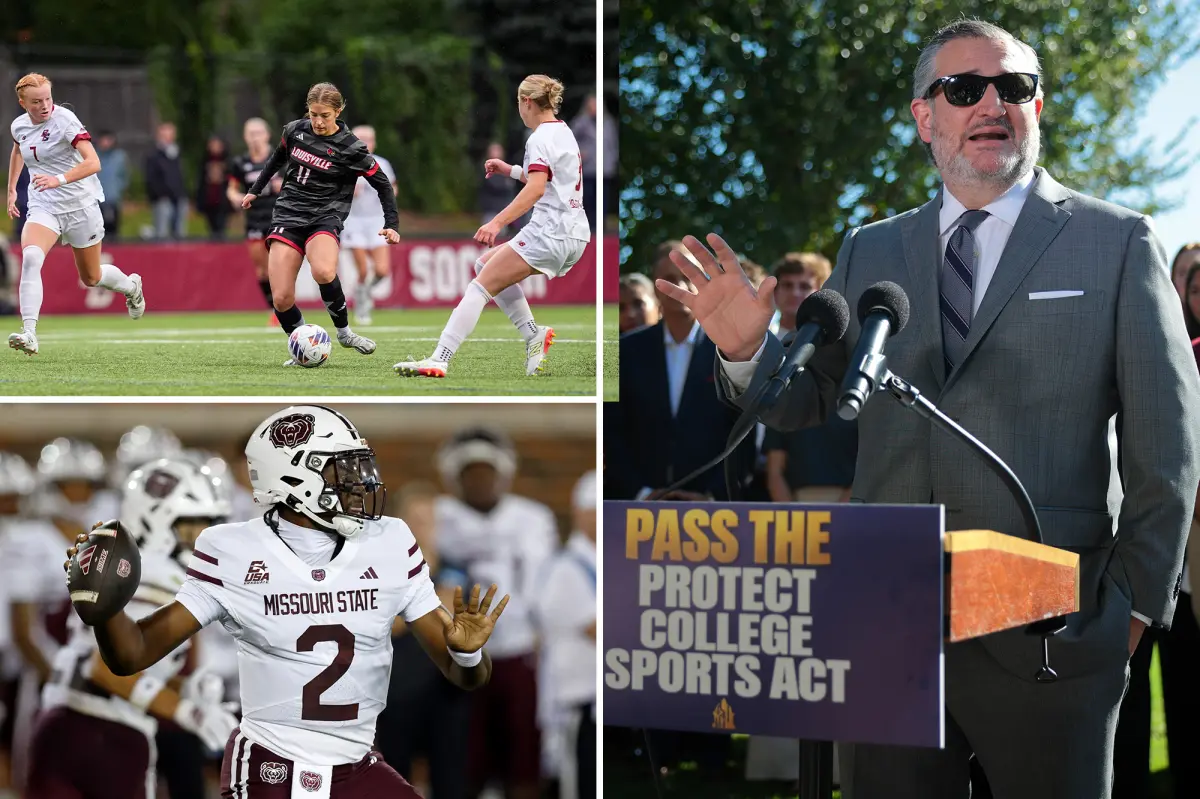

WASHINGTON — The Senate took its most significant step yet toward establishing nationwide rules for college sports on Monday, approving a far-reaching measure governing where and how much intercollegiate athletes can play and earn.
The bipartisan Protect College Sports Act passed 77-22. It would give the National Collegiate Athletic Association (NCAA) and its member institutions a limited antitrust exemption, enabling them to create and enforce eligibility and transfer policies with greater protection from lawsuits.
The legislation would also more than double the amount schools may pay athletes directly. The proposed limit would rise to roughly $49 million per school, compared with the $21.5 million cap established under a 2025 NCAA settlement resolving three federal antitrust cases.
Introduced by Sens. Ted Cruz (R-Texas) and Maria Cantwell (D-Wash.), the bill would allow athletes to transfer once without losing a season of eligibility. It would also apply the NCAA’s five-year eligibility framework, with the clock beginning in the academic year after an athlete turns 19 or enrolls full time in college — whichever occurs first.
“College sports is at a breaking point,” Cruz wrote on X last week, saying the bill would “restore order to a system being torn apart by too few rules and too much litigation. It establishes national standards for transfers, eligibility, tampering, inducements, and revenue sharing while protecting athletes’ right to earn [name, image and likeness] compensation.
“There are hundreds of thousands of college athletes competing today. We should be fighting to protect their scholarships, their roster spots, women’s and Olympic sports, and the institution of college athletics itself,” Cruz added. “College sports is worth saving, for the athletes, for the schools, for the fans, and for America.”
The measure now moves to the House, which is not scheduled to return until after the Nov. 3 midterm elections and could make additional changes. Any amended version approved by the House would have to return to the Senate before being sent to President Trump.
SEE ALSO: Man Sentenced to Prison for Killing Woman Despite Husband’s Fight
Cruz has urged House leaders to bring lawmakers back sooner to consider the Senate legislation. Doing so, however, could also set the stage for an impeachment vote involving Secretary of War Pete Hegseth.
Beyond setting new parameters for athlete compensation, the Protect College Sports Act would limit agents’ fees to 5% of a player’s earnings. It would also prohibit college football coaches from taking another job during the season, a provision prompted by Lane Kiffin’s high-profile move from Ole Miss to LSU before last season’s College Football Playoff.
The bill does not resolve whether college athletes should legally be treated as university employees with collective bargaining rights. Critics contend that it would instead hand more authority to school administrators accused of using players to generate revenue for their institutions.
Ahead of the vote, Sen. Chris Murphy (D-Conn.) challenged the premise behind the legislation. “The legislation that we are going to be voting on tonight is predicated on a simple idea: The idea that college sports is in crisis and that it requires a fairly extraordinary act of legislative intervention to address this crisis,” he said.
“The facts don’t back up that characterization of college sports,” Murphy said.
Murphy warned that the “sweeping bill” could enable colleges to “preserve the system of exploitation” that the Supreme Court ruled illegal in a unanimous 9-0 decision in 2021.
The proposal, Murphy argued, “allows schools to make a whole lot more money … and keep that money for themselves.”
Other critics, including Sen. Tommy Tuberville (R-Ala.), a former college football coach, believe the legislation reaches too far into athlete compensation. Tuberville has argued that Congress should focus instead on creating uniform transfer and eligibility standards.