
People who move from blockbuster weight-loss injections to a daily tablet may be able to continue losing weight rather than regain it, new research suggests.
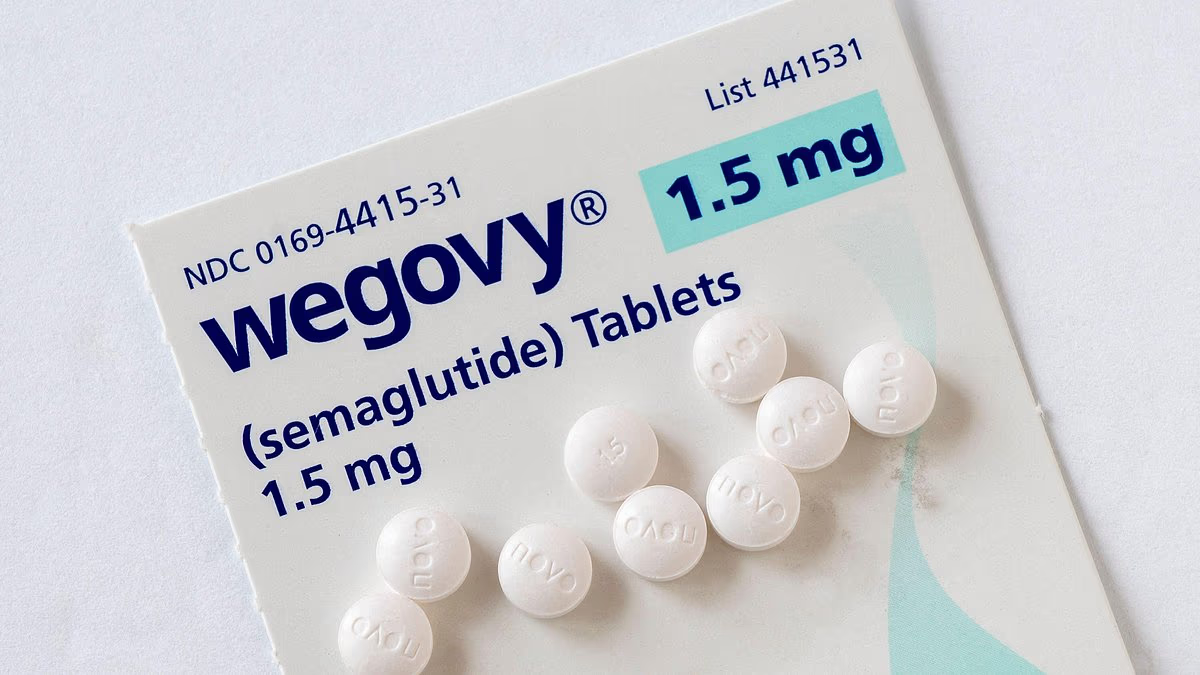
US researchers found that obese adults who switched from injectable treatments to the Wegovy pill lost more weight, shedding more than half a stone over three months.
The medicine is the first and only daily pill of its type approved for use in the UK. Experts say its convenience could encourage patients to remain on treatment for longer because it avoids regular injections.
Scientists at Cornell University reported that more than 40 per cent of people who changed to the tablet lost at least 5 per cent of their body weight during the 12-week study period.
The findings indicate that switching to an oral treatment could restart weight-loss progress when results from injections begin to level off.
Weight loss from the injections is generally most rapid during the opening months of treatment, when users lose about 6 per cent of their body weight in the first three months.
The pace then tends to ease, and many patients reach a weight-loss plateau after six to 12 months on the drugs.
Earlier trial data showed that people taking the pill lost an average of about 17 per cent of their body weight—almost three stone—after just over a year.

UK online pharmacies say their waiting lists for the Wegovy pill have exceeded 100,000 people
By comparison, those using Wegovy injections lost an average of 15 per cent of their body weight.
The latest results come from OCTANE, an observational study involving 194 overweight or obese adults who switched from injectable medicines to Novo Nordisk’s daily Wegovy tablet.
It is one of the first studies to explore how people previously treated with popular weight-loss medicines known as GLP-1 agonists respond after moving to an oral alternative.
Researchers found that almost one in four participants moved out of the obese category within three months of changing to the pill.
The share of participants classified as clinically obese dropped from 87 per cent to 66 per cent, while nearly half lost at least 5 per cent of their body weight.
The study also reported that 87 per cent of participants took the medicine each day.
Separate real-world research suggests that nearly two-thirds of obese patients stop taking weight-loss injections within a year, with side effects such as vomiting, nausea and diarrhoea among the reasons.
“In everyday clinical practice, we see patients who respond well to injectable therapy but who, for personal or practical reasons, want to try an oral option,” Dr Louis Aronne, a co-author of the study, said at the annual meeting of the European Association for the Study of Diabetes in Milan.
“Our findings suggest that a switch to oral medication may be a viable path for the right patient.”
George Godfrey, senior director of medical and regulatory affairs at Wegovy manufacturer Novo Nordisk, called the findings encouraging.
“The data gives us an early look at what happened when people made that choice in the real world.”
‘On average patients lost weight, with most taking their medicine consistently. This shows that switching to the Wegovy pill helped people lose weight while allowing them a new way to align their weight loss therapeutic journey with their lifestyle.’
However, further research is needed to determine whether the pill – which contains semaglutide, the same active ingredient in Wegovy and Ozempic – can offer more sustainable weight loss than jabs.
The pill mimics a hormone in the body called GLP-1 – which triggers the sensation of feeling full.
Wegovy pills have been licensed in the UK for obese adults with a BMI of 30 or above, or those with a BMI between 27 and 30 who have at least one weight-related condition.
Take‑up of the pill is expected to be monumental, with polling suggesting that twice as many patients would be willing to take a weight‑loss tablet as the injections.
It has to be taken with a sip of water on an empty stomach after fasting for at least eight hours. Users must then wait at least half an hour before eating or drinking.
Tens of thousands of people in the UK are thought to have already switched to the pill since it became available privately in July 2026.
But, unlike the injected version, it is not yet available on an NHS prescription.
It is understood that Novo Nordisk plans to meet with the UK Government to discuss rolling it out on the NHS. The price is thought to be the sticking point.