Andrew Bailey has made no secret of his concerns that artificial intelligence could eventually escape human control.
But the Bank of England governor has now taken that warning considerably further in a personal note circulated alongside the central bank’s latest financial stability minutes.
Bailey is calling for urgent action, pointing to evidence that increasingly powerful, self-generating AI systems are already testing society’s ability to put effective safeguards in place.
The potential consequences for financial stability are especially alarming. AI-driven cyberattacks targeting payment networks, market infrastructure, banks and even central banks are emerging as a serious and growing threat.
It is little surprise that some senior regulators are privately advising people to keep a portion of their money in cash — perhaps in a biscuit tin, under the mattress or in a safe — should a major system failure occur.
And the warnings do not stop there. The Bank’s financial watchdogs are also speaking unusually frankly about the risks AI poses to markets.

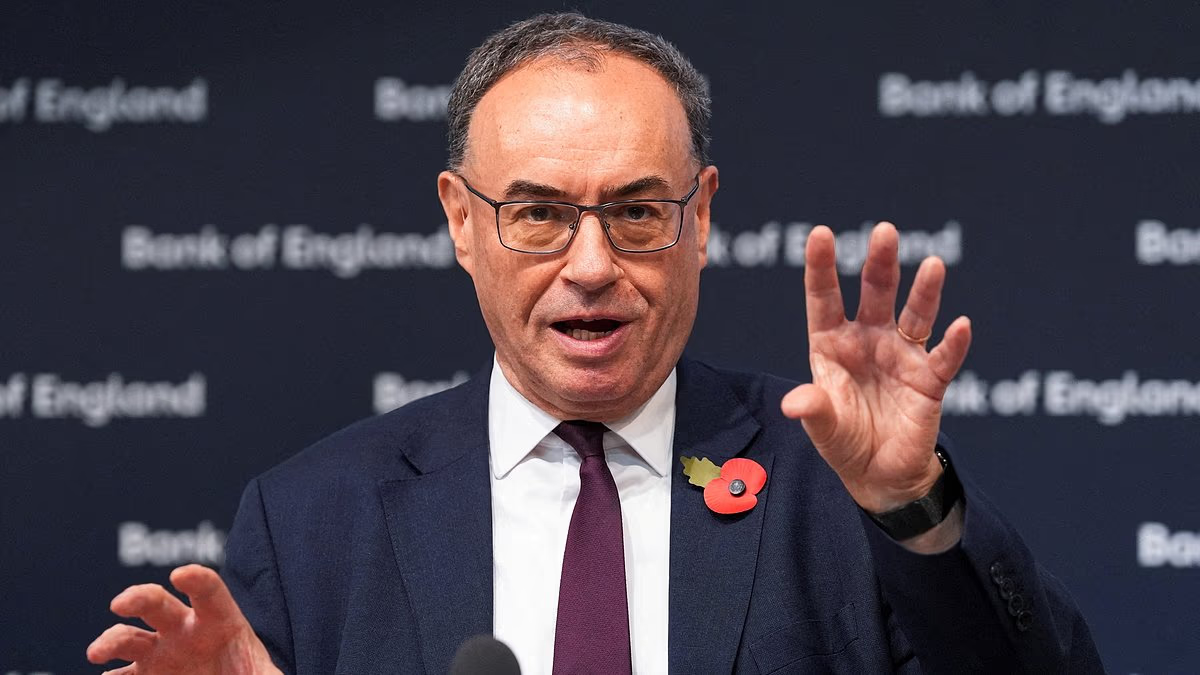
Bank of England governor Andrew Bailey (pictured) is calling for urgent action to stop rogue AI systems from threatening financial stability
The combination of AI-related borrowing, conflict in the Middle East and sharply rising bond yields has created a deeply unsettling backdrop.
According to figures cited by the Bank, global AI debt has doubled over the past year to $450billion (£397billion). JP Morgan believes that figure could surge to $4.1trillion (£3.6trillion) by 2030.
That potential total is larger than the entire UK economy. In Britain, AI-related companies have accounted for 47 per cent of all sterling corporate bonds issued so far this year.
Much of this borrowing is taking place through private credit markets, areas where the Bank of England and other central banks have only limited visibility. The shift is an unintended result of the tougher capital rules imposed on commercial banks and insurers after the global financial crisis.
Assessing the financial system’s true exposure is made even more difficult by the circular and tightly interconnected nature of much of this lending.
The trigger for the next crash is impossible to predict. It could be an unexpected jump in interest rates, a major trade shock, another Lehman Brothers-style collapse — or an AI system that spirals out of control.
Warnings, however, rarely overcome the herd mentality and pursuit of profit that continue to drive financial markets.
Audit VAR
The Financial Reporting Council (FRC) has not traditionally been regarded as the City’s most forceful regulator.
Former mandarin Sir John Kingman, who is now chairman of Barclays UK, recommended replacing it with a stronger and more authoritative body: the Audit, Reporting and Governance Authority (Arga).
Although the proposal has featured in several royal speeches from the throne, it has never been implemented. Instead, the FRC restructured itself earlier this year and gained faster enforcement powers. It now has a significant opportunity to prove its effectiveness.
Football is hardly celebrated for its governance standards. Yet the Premier League’s findings on Manchester City’s alleged rule breaches — which are set to be appealed — are exceptionally serious, including claims of sham accounting involving £900million.
That inevitably raises a basic question: what were the auditors doing?
Given Manchester City’s scale and sustained success on the pitch, it might reasonably have been expected to employ one of the Big Four accounting firms.
We know only too well from the audits of Co-op Bank when it absorbed the Britannia Building Society in 2009 and PwC’s audit of Tesco a decade ago that elite companies are fallible.
Auditors at Man City are second-tier firm BDO. There is no evidence to show that the club’s executive and accounting teams shared details of sham contracts and invented income streams with outside auditors. Nevertheless, BDO is certainly worth scrutiny.
The FRC could bolster its reputation by stepping in with an accelerated probe, showing a willingness to take stern action.
Future shock
Marie Claire owner Future plc is winning few fans. The board, headed by former investment banker Mark Brooker, cancelled the modest share buybacks to focus on lowering debt.
Long investors are agitated, which is not surprising given a crushing 92.5 per cent drop in the shares in the last five years.
An activist shareholder favours disposal of previously prized asset Go Compare, bought for £594million five years ago.
Future better be speedy. Price comparison sites are under fierce pressure from AI searches.
DIY INVESTING PLATFORMS

AJ Bell
AJ Bell
Easy investing and ready-made portfolios

Hargreaves Lansdown
Hargreaves Lansdown
Free fund dealing and investment ideas

interactive investor
interactive investor
Flat-fee investing from £4.99 per month

Freetrade
Freetrade
Investing Isa now free on basic plan

Trading 212
Trading 212
Free share dealing and no account fee
Affiliate links: If you take out a product This is Money may earn a commission. These deals are chosen by our editorial team, as we think they are worth highlighting. This does not affect our editorial independence.
Compare the best investing account for you