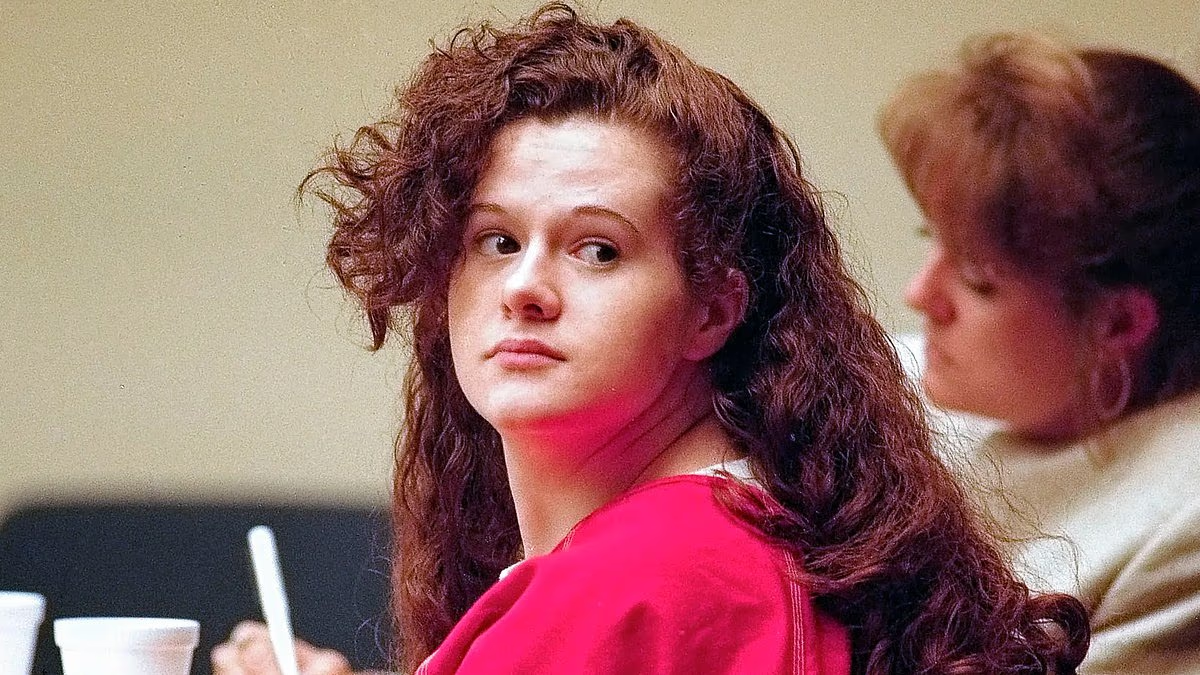

Christa Pike remains hospitalized in critical condition after her failed execution, unconscious and dependent on a ventilator, according to her attorneys. She also suffered severe burns to both arms.
On Friday, Pike’s lawyers filed an emergency motion asking a court to order the Tennessee Department of Correction to preserve all evidence connected to the botched execution.
Pike, 50, was stuck with at least seven needles on Wednesday as medical personnel tried to administer two lethal doses of pentobarbital, according to the filing.
“At one point, Ms. Pike herself offered guidance on where the IV team could attempt access; one needle was bent at a 90-degree angle when it was removed,” the motion stated.
Her attorneys said two sets of syringes containing the lethal drug were administered. Throughout the procedure, Pike could reportedly be heard crying, whimpering and breathing heavily.
At one point, she said, “my arm feels like it’s about to burst open.” Later, she asked, “does this happen like that?”
As of Thursday night, Pike was still critically ill at a Nashville-area hospital, where she was “intubated, on a ventilator, and remains unconscious,” her attorneys said.
Pike had spent 30 years on death row after being convicted of murdering her 1995 Knoxville Jobs Corps classmate, Colleen Slemmer.

Christa Pike remains hospitalized, unconscious and on a ventilator, with severe burns on her arms following her botched execution, according to her lawyers.

Pike was taken to a hospital after receiving two sets of lethal-drug syringes and being heard crying, whimpering and breathing heavily during the procedure.
Her lawyers said both arms were swollen, burned and blistered when she arrived at the hospital. They compared the effects of the drug to bleach or Drano, the chemical used to clear clogged household drains and pipes.
Pike’s attorneys believe problems with the IV lines caused the pentobarbital to enter the surrounding tissue rather than her bloodstream.
“Apparently at no point did any member of the execution team realize that the IV lines were not correctly placed or that the veins had blown and that the pentobarbital was, in whole or in part, entering Ms. Pike’s body,” the lawyers wrote.
Rather than correcting the problem, the attorneys said, officials prepared and administered a second set of pentobarbital syringes.
MORE STORY: Brooklyn Kitten Rescue Itty Bitty City Kitties Bans MAGA Supporters From Adopting
Pike’s lawyers are asking that every piece of evidence from the failed execution be preserved to support accountability and protect her legal rights.
“We are working closely with those closest to Christa to respect her wishes, safeguard her privacy and protect her rights as a patient during this extraordinarily difficult time,” said Luke Ihnen, an attorney with Federal Defender Services of Eastern Tennessee.
“We ask that the public and the media respect that privacy as well.”
The filing also noted that Pike had previously appealed her execution, arguing it would constitute cruel and unusual punishment because of her individual medical and physical characteristics, including thrombocytosis, post-traumatic stress disorder and small veins.

Pike spent 30 years on death row after being convicted of the 1995 murder of her Knoxville Jobs Corps classmate, Colleen Slemmer.

During the procedure, Pike said, “my arm feels like it’s about to burst open,” and later asked, “does this happen like that?”

Her lawyers emphasized that Pike previously filed an appeal claiming her execution would result in cruel and unusual punishment
‘Her concerns were called ‘speculation’; they were laughed off, scoffed at, and dismissed,’ the lawyers wrote.
‘In the words of one media witness: we have a lot of questions, and the Department of Correction has a lot of answers that it needs to provide to the public about what happened here. We agree.’
Pike received the death sentence in 1996 and would have been the first woman to be executed in Tennessee in over 200 years.
Instead, the case marks the second botched execution in Tennessee this year, and Governor Bill Lee halted any additional executions for the year and ordered ‘a comprehensive, third-party review to determine exactly what occurred.’
The state’s execution protocol calls for a secondary set of drug syringes to be administered ‘if the inmate is not deceased’ after the first set. It does not spell out what happens if the subject is alive after the second set.
Tennessee announced in 2024 that it was switching from a three-drug series for lethal injections to the single drug pentobarbital.
This is a breaking news story.