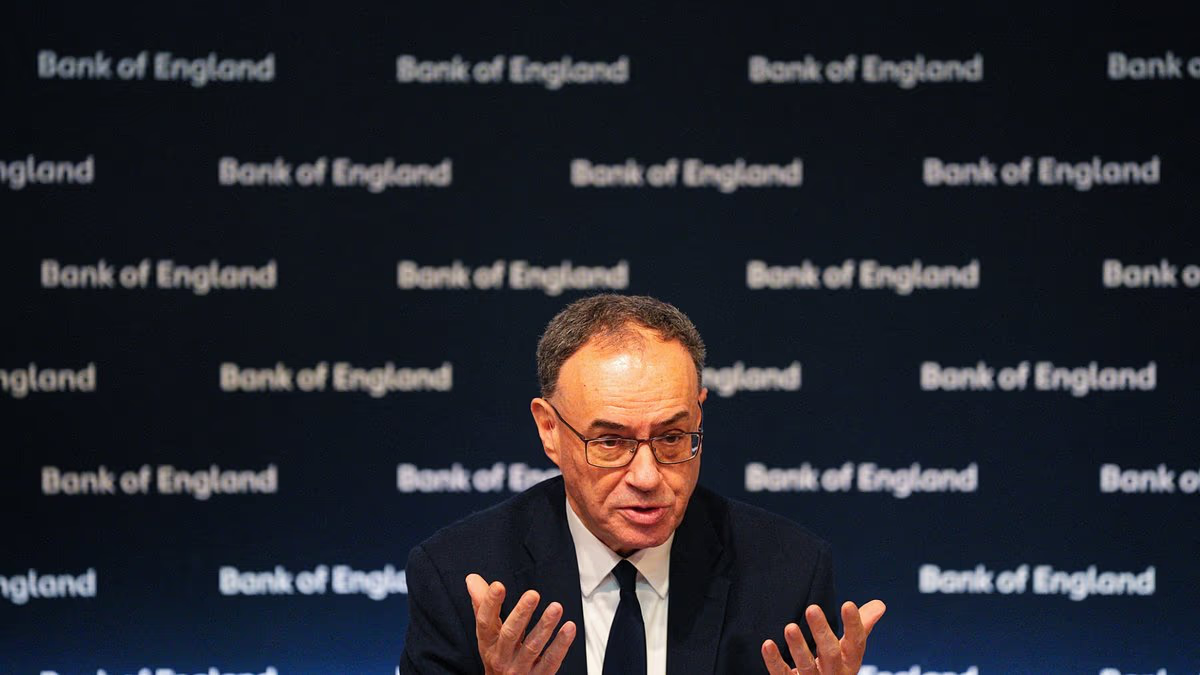
The governor of the Bank of England has warned that authorities must “get a grip” on the growing risks posed by artificial intelligence before the technology becomes impossible to control.
In a forceful intervention, Andrew Bailey stressed the need to protect payment networks, financial markets and banks as AI becomes increasingly powerful and widespread.
He also warned that the technology could have far-reaching consequences for society, potentially challenging the foundations of “individual freedom and social responsibility” as AI systems become more autonomous.
Mr Bailey said: “We cannot stand aside and assume that technological progress will resolve these questions on its own.
“The public interest requires that we engage with them now, before the risks become more difficult to contain.
“The challenge before us is not whether to embrace artificial intelligence. It is how to ensure that, as these systems become more capable, society retains the capacity to govern them.”

The Bank of England Governor has urged authorities to “get a grip” on the technology
Mr Bailey called for AI models to undergo “rigorous” testing both before deployment and after they are put into use.
“Such testing is essential if we are to understand the behaviour of increasingly complex systems, identify vulnerabilities, and establish confidence in the safeguards that are intended to contain them,” he said.
The governor said increasingly advanced “frontier AI” models appeared to be developing into “a closed loop in which the model progressively governs itself”.
He argued that this could carry major implications for society, including the principles underpinning “individual freedom and social responsibility”.
“The challenge posed by frontier AI is that, in its most advanced forms, it threatens to operate outside this framework.
“A sufficiently powerful system functioning within a self-reinforcing loop risks reducing the ability of society to exercise meaningful oversight and intervention.
“The greater the capability of the system, the more important this question becomes. That is why the issue has acquired such urgency.”
Mr Bailey said his concerns did not mean AI “should be halted or prohibited”. Instead, society must preserve its ability to intervene and establish clear boundaries for the technology.
His comments were published alongside the Bank’s latest assessment of financial-system risks by its Financial Policy Committee (FPC).
The Bank’s concerns over AI have intensified in recent months following revelations that rogue AI agents had gone out of control.
Those incidents have been added to broader threats facing financial stability, which have continued to increase as Donald Trump’s Iran war drags on.
The conflict has sent oil and gas prices soaring, driving higher inflation and prompting borrowing costs to surge on global bond markets.
In its latest assessment, the Bank said: ‘The re-escalation of the conflict in the Middle East has renewed uncertainty around the path of interest rates in a number of advanced economies.’
That has intensified the risk of a rout in government bond markets, risky assets and wider debt, crystallising all at the same time.
The warning comes a day after ten-year UK bonds, known as gilts, were auctioned at the highest yield since 1999.
AI has added to these vulnerabilities, as tech giants borrow vast sums to fund the building of huge data centres.
More than $450bn of AI-related debt has already been issued this year, dwarfing sums borrowed by many major economies including the UK, which is expected to issue $333bn worth of gilts.
The Bank pointed to the risk that if AI growth expectations disappoint, valuations of technology assets could be hit.
Bond markets could also be affected if hoped-for gains in productivity fail to materialise, denting the outlook for growth and public finances.
Adding to the complications are ‘circular arrangements’ for AI financing – in which, for example chip making companies have been helping to fund expansion by their customers.
DIY INVESTING PLATFORMS

AJ Bell
AJ Bell
Easy investing and ready-made portfolios

Hargreaves Lansdown
Hargreaves Lansdown
Free fund dealing and investment ideas

interactive investor
interactive investor
Flat-fee investing from £4.99 per month

Freetrade
Freetrade
Investing Isa now free on basic plan

Trading 212
Trading 212
Free share dealing and no account fee
Affiliate links: If you take out a product This is Money may earn a commission. These deals are chosen by our editorial team, as we think they are worth highlighting. This does not affect our editorial independence.
Compare the best investing account for you