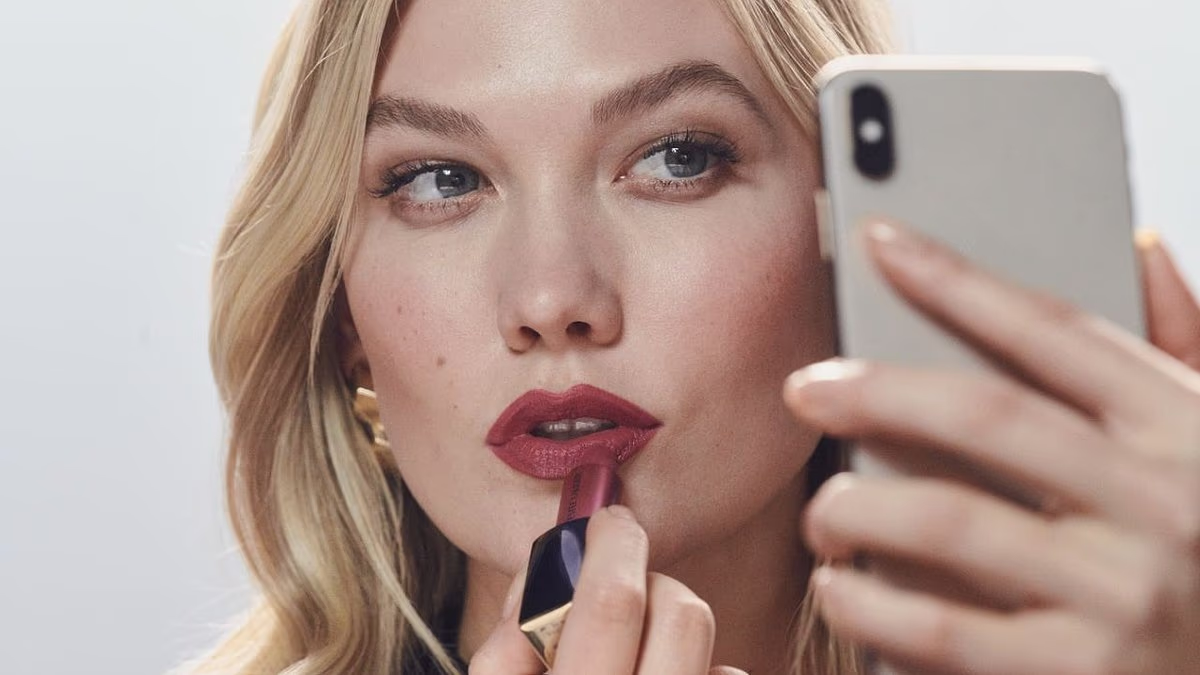
The beauty industry has rarely looked more attractive to investors.
The global market for cosmetics, moisturisers and perfumes is expected to expand by 5 per cent annually, reaching $590billion by 2030.
That raises a timely question: could your portfolio benefit from a beauty makeover?
The sector’s growing appeal was underlined this week when Sephora, the beauty retail arm of French luxury group LVMH, announced plans to open shops in 100 Marks & Spencer stores.
M&S currently holds just 1.3 per cent of the £5.2billion UK beauty market, putting it up against Boots, which commands the largest share.
Analysts believe the partnership could make Marks & Spencer more appealing to Gen Z shoppers, for whom beauty has become a cultural obsession.
Meanwhile, Boots owner Sycamore Partners is reportedly nearing a $9billion sale of the business to Canada’s Weston family.
Unilever is also reshaping its portfolio, preparing to move away from Hellmann’s and other food brands while concentrating on faster-growing names including Dove, Tresemme and premium make-up company Hourglass.

Beauty has become an increasingly appealing investment sector
The renewed focus on beauty is not driven solely by the so-called ‘lipstick effect’, when consumers continue to spend on affordable luxuries during difficult economic periods.
Make-up and skincare are increasingly viewed as everyday essentials rather than occasional treats. Consumers are likely to prioritise them in almost any economic climate, except perhaps during a severe recession, according to David Coombs of Rathbones.
Beauty also benefits from another important advantage. As Coombs puts it: ‘This is a sector that won’t get disrupted by AI.’
That does not mean the industry is ignoring artificial intelligence. Companies are using the technology to improve their chances of appearing at the top of results when consumers ask ChatGPT or another AI service which products work best.
Search interest is being boosted by the ‘skin-ification’ of hair, a trend that encourages consumers to apply as many treatments to their locks as they do to their skin.
Weight-loss drugs are adding to the momentum, with drug-related hair thinning amplifying demand for haircare products. Three beauty stocks are held in my Isa: Estee Lauder, L’Oreal and Elf.
I have followed my own advice in this column by betting on a recovery in a sector where the right combination of ingredients, celebrity backing and marketing can deliver spectacular results.
Last year, Elf acquired model Hailey
Bieber’s Rhode make-up business for $1billion. In the third quarter of this year, Rhode generated $160m, equivalent to one-third of Elf’s sales. Analysts rate Elf a ‘buy’, but which other beauty shares are worth considering?
Unilever
Shares in Unilever, the £97billion FTSE 100 conglomerate, have fallen 8 per cent this year to 4,484p, partly because of concerns about its withdrawal from food.
However, Unilever has deep experience in beauty, notes Madeline Wright, deputy portfolio manager at Finsbury Growth & Income Trust. Dove, which was launched in 1957, is worth around €5bn on its own.
Wright comments: ‘Divestment in foods should enable the leaner Unilever to grow at a faster rate.
‘Unilever’s beauty and wellbeing division grew revenues at 4.3 per cent last year, with half of that coming from volume growth. Revenues from food grew by 2.5 per cent.’
Uncertainty means most analysts consider Unilever a ‘hold’. But brokers Bernstein believe the shares could go to 5,800p – appealing if you want to back companies that should thrive in the age of AI.
L’Oreal
L’Oreal, the €199billion French giant, is one of the companies being aided by the ‘skin-ification’ of hair which has boosted its Kerastase premium range, as chief executive Nicolas Hieronimus told investors.
Coombs likes L’Oreal’s relentless commitment to its luxe and other products which include Aesop, CeraVe, Garnier and Lancome.
More of this merchandise is being bought thanks to L’Oreal’s partnership with ChatGPT maker OpenAI.
Yasemin Senai, analyst at the Guinness European Equity Income fund, says: ‘L’Oreal has decades of scientific research, strong dermatological credentials and a large innovation and marketing engine behind it.
‘This creates a deep pool of credible information – and could make its brands more likely to surface in AI-led recommendations.’
The link with OpenAI is the reason why brokers Berenberg think L’Oreal shares could rise from the current €373 to €447.
Estee Lauder
A bet on this $33billion American company relies on the successful continuation of its Beauty Reimagined turnaround.
Estee Lauder’s fortunes in China are reviving. Its Clinique, Bobbi Brown and other products now feature on TikTok shop, a popular channel for beauty sales.
And there is brisk demand for its more expensive scents such as Le Labo, at £122-plus a bottle.
In May, Estee Lauder failed to merge with Puig, the Spanish group which has a substantial stake in the £1.2billion Charlotte Tilbury line.

Sephora – the beauty retailing arm of French luxury giant LVMH – will be opening shops in 100 Marks & Spencer stores
But, in August, Estee Lauder shares soared when the company reported the end of a run of three straight falls in sales.
At $91, the price is 31 per cent up over six months. Deutsche Bank rates Estee Lauder a ‘buy’ with a target price of $117.
For the moment, Puig seems to be plotting an independent future. But the shares are rated a ‘buy’. After all, its Jean Paul Gaultier perfumes are some of the hottest things on TikTok shop.
Ulta
This $23billion US beauty retailer is Coombs’ other pick because it is making the most of AI – and because it is moving into ‘wellness’, counselling its clientele on vitamins and supplements in its 1,500 suburban strip mall stores.
Coombs observes: ‘Ulta is a trusted brand at a time of scandals over the advice being given by online wellness “experts”.’
It has also gone international with the acquisition of British chain SpaceNK.
Ulta shares have risen by 7 per cent over the past six months to $541. But analysts are now targeting an average target price of $630. It seems as if they are as enthused about the prospects for the company as chief executive Kecia Steelman wants Ulta to be ‘the destination of a lifetime’.
Shiseido
Not so long ago, Shiseido, the 1.3trillion Yen Japanese owner of brands like Nars, was a star of the sector. But it has recently been held back by the ill thought-out purchase of the Drunk Elephant line – and the stellar ascent of the Korean skincare companies.
The shares are up by 43 per cent this year to 3,261 Yen with Shiseido pinning its hopes on new offers such as The Vital Perfection Intensive SculptDefine Serum, advertised by Anne Hathaway.
Analysts suggest the shares are a hold until this unguent works miracles on Shiseido’s bottom line.
If you want to take a chance on the continued clamour for Korean cleansing routines, they are stocked in M&S, and more will be available when Sephora arrives next spring. In the hope of a sales boost from this designed to ‘dump the frump’ at M&S, analysts rate the shares a ‘buy’.