
Donald Trump has offered to assist Vladimir Putin as Russian authorities work to contain what has been described as a suspected outbreak of airborne plague in Siberia.
Asked about the reported disease, the president said: “Well, we’re looking at it very strongly. We just heard about it, and they call it pneumonia.”
Trump added that pneumonia had been easier to treat years ago.
“The microbes and the germs have gotten stronger disproportionately, but we’ll help them,” he said, referring to Russia.
The offer follows the death of Daria Shipilova, 28, an employee at an anti-plague institute in Irkutsk. Russian authorities have said she died from “pneumonia of unknown etiology” rather than plague.
However, local reports say almost 200 people are under medical observation, while at least four hospitals in the region have been closed for a three-week quarantine.
More than 60 of Shipilova’s colleagues are also reportedly being kept in isolation at the institute.
Regional media, citing sources said to be close to security services, reported that Shipilova may have contracted pneumonic plague after a test tube broke inside the laboratory.

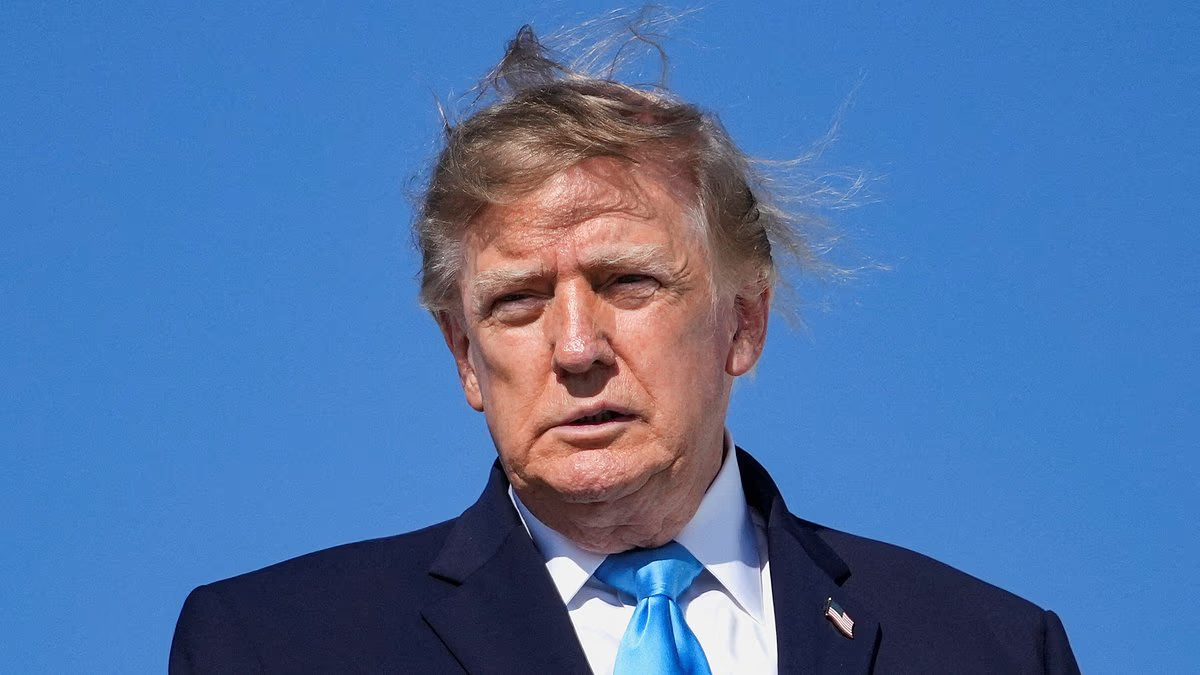
Trump made the comment about microbes and germs while speaking to reporters at the White House on Monday afternoon

Authorities have sought to downplay Shipilova’s death on October 2, while suspicions of an alleged cover-up continue to circulate

Health officials in hazmat suits have been pictured in the Irkutsk region, where a mask mandate has also been introduced

Laboratory worker Daria Shipilova, 28, died in Siberia after reportedly developing pneumonic plague following a broken test tube
Pneumonic plague affects the lungs and can spread between people through respiratory particles. When diagnosed and treated promptly, however, it can be cured with antibiotics.
Shipilova was admitted to a hospital in Shelekhov, near Irkutsk, with severe pneumonia symptoms on September 29. She died the following week.
Russia’s health watchdog said broader testing had found no microorganisms connected to Shipilova’s work and rejected claims that an accident occurred at the institute.
Alexei Tsydenov, head of neighboring Buryatia, initially confirmed that she had died of plague, but days later revised his statement to say it was only “possibly” plague.
Public events in Irkutsk were canceled, and law enforcement reportedly launched a criminal investigation into potential health and safety violations. Despite the growing media attention, regional Governor Igor Kobzev said the situation remained stable.
US Secretary of State Marco Rubio said on Monday that Washington was “watching and monitoring it closely.”
Rubio acknowledged that a suspected outbreak could “quickly spread,” but said there was no immediate reason for concern, noting the absence of direct commercial flights between the United States and Russia.
“There’s very limited travel between the US and Russia, obviously,” Rubio told reporters on Monday before departing for Iceland.

A researcher from Irkutsk Anti-Plague Institute during a field trip
‘But like anything else, something like that gets out and could quickly spread. So we’re watching and monitoring it closely.’
‘I don’t think it’s cause for alarm, but it is cause for focus and a cause to just keep an eye on it. And we’re doing that,’ he added.