
Leading Canadian physicians are warning that the country’s assisted-dying system may be approving some requests too readily, including one involving an older woman whose loss of ability to cook for her family left her feeling she had lost her purpose.
Gary Rodin and Madeline Li, psychiatry professors at the University of Toronto, said concern is growing among healthcare professionals as more Canadians receive approval for medical assistance in dying.
The doctors said they support the availability of legalized medical assistance in dying, but noted that Canadian law does not require clinicians to help patients explore other forms of support before pursuing the procedure.
Writing in an opinion article for The New York Times, Rodin and Li said assisted dying was designed as a dignified final option, generally for people facing terminal illness or another profound medical condition.
However, they argued that in recent years too many patients have been approved without receiving enough time or professional guidance to think carefully about the decision.
“In some cases, patients are being approved who should not be,” the physicians wrote, pointing to reports involving people whose requests were linked to loneliness, poverty or other difficult social circumstances.
Rodin and Li said their own clinical experience had shown them that counseling and practical support can sometimes help patients move beyond a severe mental-health crisis and choose to continue living.
They described the case of a woman in her 70s who was distressed after losing the ability to prepare meals for her family, a role she had long embraced as its matriarch.

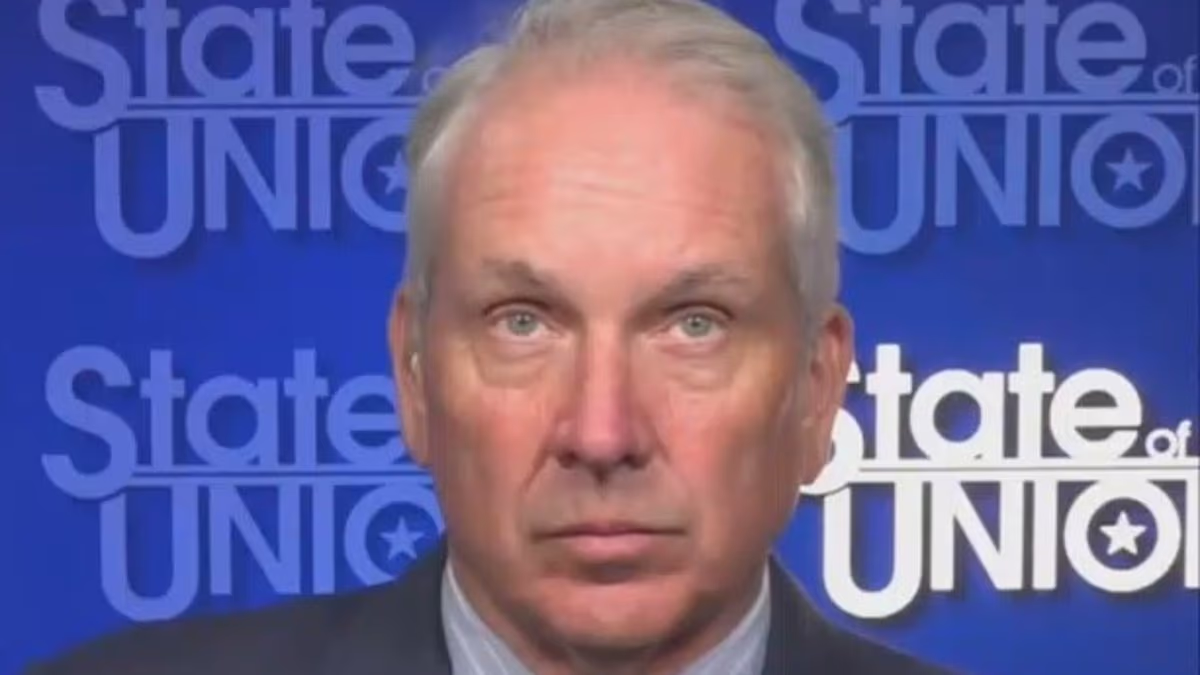
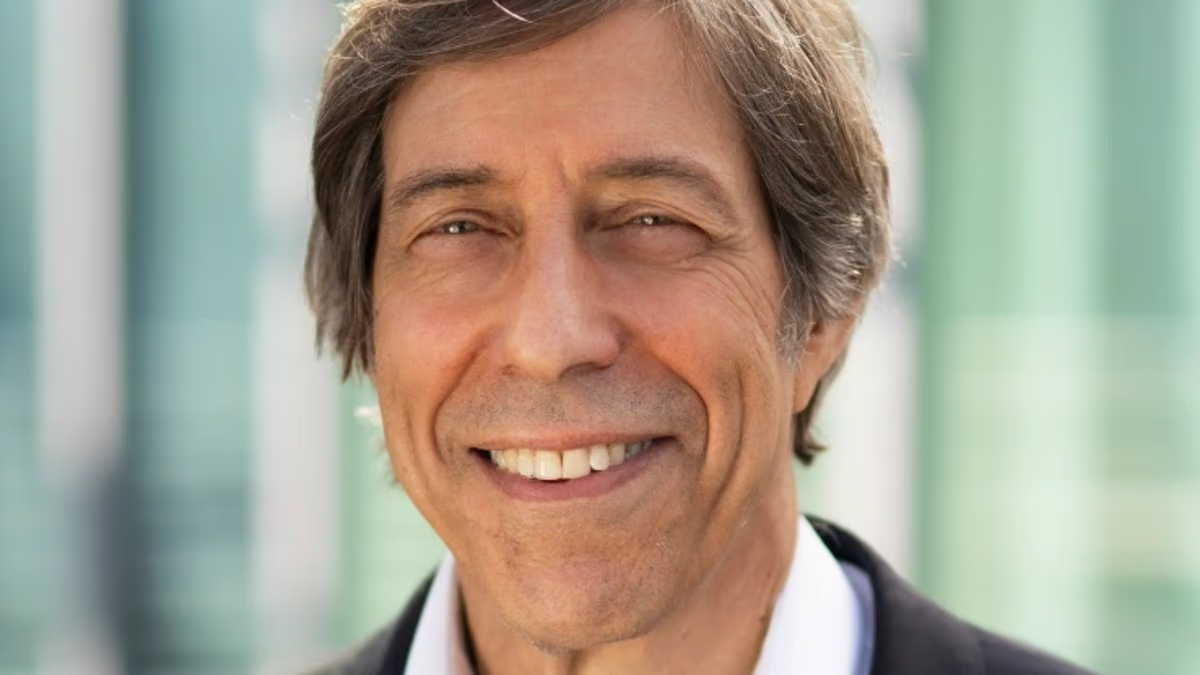
University of Toronto doctors Gary Rodin and Madeline Li have voiced growing concern about the rising number of assisted-dying approvals in Canada

The psychiatry professors, including Rodin, said they support legal medical assistance in dying but warned that Canadian law does not require healthcare providers to direct patients toward alternative forms of help

Rodin and Li said counseling and other support had helped save patients’ lives, including a woman in her 70s who was approved for assisted dying after losing the ability to cook for her family but ultimately decided not to proceed
After receiving approval for assisted dying, the woman told doctors she believed she no longer had value to her family.
“Through counseling, she came to understand that her family valued who she was, not what she did for them,” Rodin and Li wrote.
She chose not to end her life, at least at that point. When Christmas arrived, her family gathered around the table, where she sat proudly as others handled the cooking and serving.
The doctors said the apparent ease with which some requests are approved has created a serious ethical challenge, particularly when patients seek assisted dying because they believe there are no other options available to them.
They traced much of the concern to a 2021 change in Canadian law, when Parliament removed the requirement that a person’s natural death be reasonably foreseeable.
Canada launched its assisted-dying program in 2016 under stricter rules. At the time, approval generally required a “reasonably foreseeable” natural death, such as one caused by terminal cancer.
Patients in that category may request medical assistance in dying through an accelerated process.
Rodin and Li also recounted the case of a patient in his 30s who was admitted to their palliative care unit, where teams focus on managing symptoms and providing comfort to people living with serious or life-limiting illnesses.

Rodin and Li said Canada now has one of the world’s most permissive assisted-dying systems, allowing requests involving almost any form of subjectively intolerable suffering with a medical basis, as well as some medically unexplained physical symptoms


Kristin Logan was diagnosed with stage 4 ovarian cancer in 2023, with her chances of survival slim. Kristin said that she felt pressured into assisted dying by Canadian doctors with the system ‘setting’ her up to die

Rodin and Li said their argument was not against assisted dying and do not think psychiatric evaluations should be ‘a matter of course,’ but believe further counseling and ‘reflective conversations’ should be included in a doctors approval
‘Thanks to the procedure, [he] was able to choose to die before he became even sicker and potentially lost the ability to communicate,’ they said.
‘He said a final goodbye to everyone he loved, including his five-year-old son, and died with his wife beside him and a music therapist singing Leonard Cohen’s “Hallelujah.”‘
However, Rodin and Li said Canada’s system is now ‘one of the most permissive in the world, allowing assisted dying for almost any form of subjectively intolerable suffering that had a medical basis, or even for medically unexplained physical symptoms.’
For patients without life-threatening illnesses, they are required to wait 90 days before they can receive the procedure, according to the doctors.
‘The law, however, does not require clinicians to engage in deeper conversations that explore the complex meaning of the request,’ they said.
‘We’ve seen cases where people request medical aid in dying in the face of a new cancer diagnosis or flare-up of an existing illness and get the procedure within a matter of days.
‘There is no requirement in either track that patients attempt treatment to relieve their suffering. Nor does the law specify adequate safeguards to protect vulnerable individuals whose decision may be affected by social disadvantage.’
The procedure, according to the doctors, now accounts for over five percent of Canada’s deaths.

Assisted-suicide supporters outside the British Columbia Court of Appeal before it overturned a ruling that said Canada’s assisted-suicide ban violated charter rights of gravely ill Canadians

People opposed to assisted-suicide demonstrate outside the British Columbia Court of Appeal

Brigitte Stegemann, seen right, died in July by assisted dying. Her family claim that she didn’t actually want to die as her granddaughter repeatedly told doctors their family opposed the plans, believing the pensioner wasn’t mentally capable of making the decision independently
Rodin and Li said activists had been a driving force in the changing requirements for assisted dying, and theorized that their influence may have caused doctors to reevaluate their role in the system.
‘Many doctors have come to see their primary role to be making sure their patients meet the legal eligibility requirements to qualify for assisted dying,’ they said, noting the need for a patient to be experiencing ‘intolerable suffering’ with the mental capacity to consent to the procedure.
‘The problem is that there has become far more focus on whether patients can get an assisted death and not enough on whether they should.’
The university professors cited one healthcare provider’s description of his role as a ‘conduit’ for a patient’s ‘desires and choices.’
Another provider admitted to having no role in evaluating a patients suffering, stating that the degree to which they felt they were suffering ‘is entirely up to the patient – 100 percent,’ Rodin and Li wrote.
‘While it is critical that patients are able to make decisions about their bodies, doctors have an important role in guiding those decisions,’ they added.
Rodin and Li said their argument was not against assisted dying and do not think psychiatric evaluations should be ‘a matter of course,’ but believe further counseling and ‘reflective conversations’ should be included in a doctors approval.
‘Unfortunately, psychological care of this kind for patients requesting assisted dying is not routinely offered by doctors or other health care providers, nor is it routinely covered by insurance. It should be the standard of care and fully funded,’ they wrote.
‘A society that permits assisted dying should also ask whether it has done enough to help people sustain their sense of dignity and meaning in life.
‘Death must not become the only kind of relief people can imagine.’