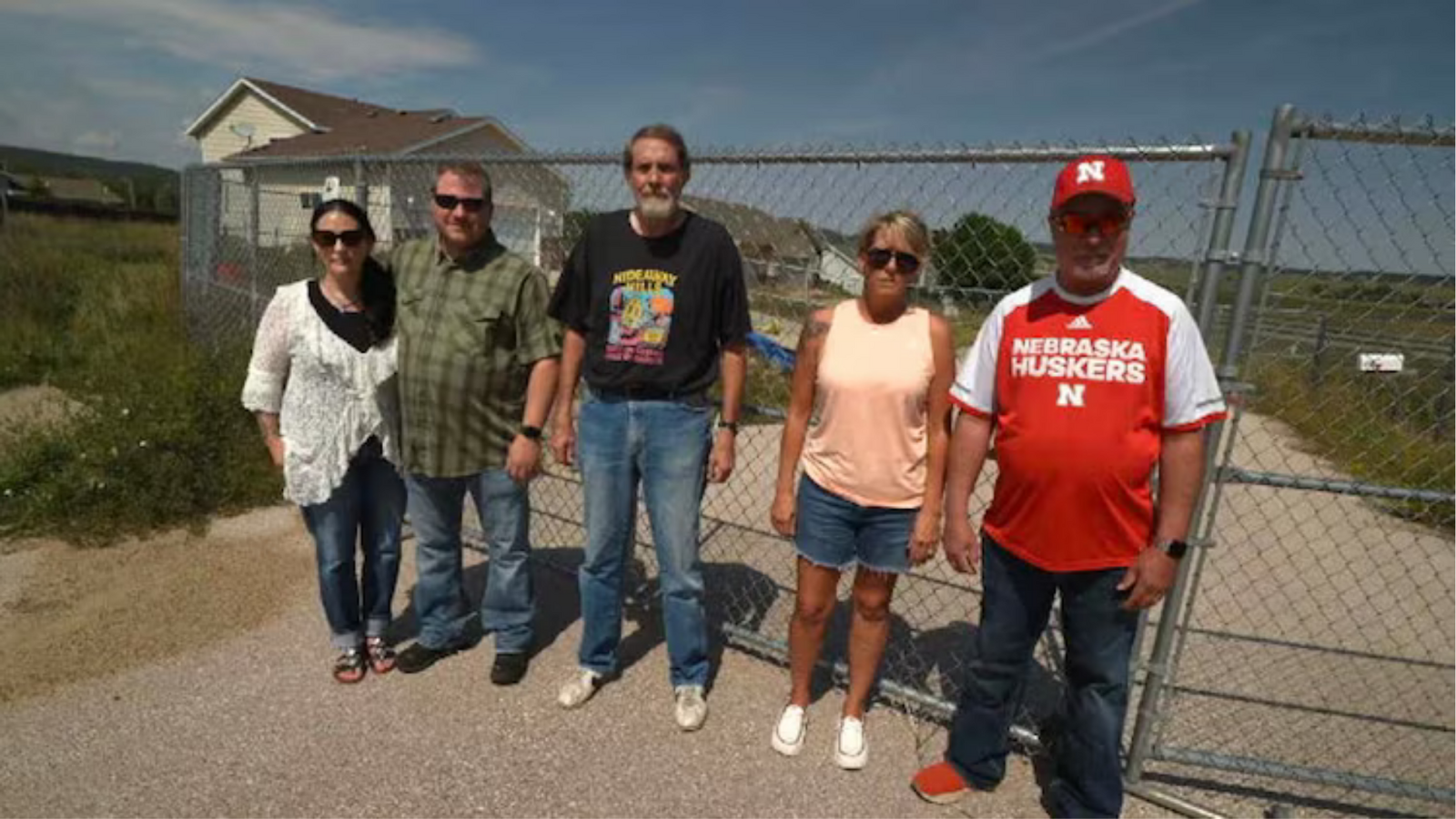
No one in Hideaway Hills imagined that the ground beneath their homes could suddenly give way.
The South Dakota neighborhood, home to more than 150 families in the scenic but rugged Black Hills, had long felt like an idyllic community. Neighbors greeted one another, children played outside and the local school bus driver even kept her bright yellow bus parked at home. Residents described it as the American Dream.
That sense of security vanished six years ago when a sinkhole suddenly opened, exposing an abandoned mine beneath Hideaway Hills and forcing more than a dozen families from their homes.
Now Dalton holds two jobs—one at a neighborhood deli and another at a movie theater—as he struggles to pay for a new home and keep up with expenses.
He was among 13 Hideaway Hills homeowners evacuated in April 2020, after a nearly 30-foot-wide sinkhole opened without warning. When crews descended into the cavity, they found a web of mine shafts dating back roughly a century beneath the development.
Court documents show that the land had once been home to a gypsum mine operated by the state of South Dakota. The property was later sold to private developers in 1994.
“Nobody in this neighborhood knew about the mine shaft,” Dalton said.
An ABC News investigation found that the residents of Hideaway Hills are part of a wider national problem. Across the United States, deteriorating abandoned mines are contributing to dangerous sinkholes beneath neighborhoods, highways and public property.
Over the past two years, an abandoned mine shaft collapsed beneath a New Jersey highway, creating a sinkhole more than 40 feet across. In Pennsylvania, a grandmother was killed when an old coal mine collapsed beneath her as she searched for a missing cat. In California, an abandoned gold mine gave way beneath a family’s living room, killing a 32-year-old man and his dog.
'It was supposed to be the forever home'
Six years after emergency crews went door to door and told families to evacuate, the original Hideaway Hills sinkhole is still open. The owners of all 13 affected homes remain barred from returning.
Homeowners of Hideaway Hills say they feel abandoned by the state.ABC News
“That was our home, and it’s just sitting there,” Allison Ireland told ABC News. “We can’t live in it. It was made for a family, and now it’s empty.”
Ireland and her husband, Brian, raised four children in the house. Even though they cannot live there, the couple continues to make mortgage payments.
David Peck, another homeowner forced out by the collapse, said the property was meant to be his family’s long-term home. “It was where my kids were supposed to grow up, and where my wife and I were supposed to be after the kids were gone,” he said.
“I’m living paycheck to paycheck,” Peck said. “I shouldn’t be at my age. I should be thinking about retirement. It’s all gone. I’ll be working until the day I fall over at the bench.”
Residents who were not ordered to leave told ABC News that the neighborhood’s problems continue, including collapsing driveways, unreliable utilities and water they can no longer safely drink.
Tonya Junker, who drives the local school bus, remains in Hideaway Hills because moving is financially out of reach.
“My husband is supposed to retire next year,” Junker said. “It feels like starting over. And who can afford that?”
'Don't think I'm going to walk away'
Shortly after the sinkhole opened, Kristi Noem, who was governor of South Dakota at the time, held a call with the homeowners and assured them the state wouldn't forget about them.
"Don't think I'm going to walk away and forget about this situation at all," Noem said on the call, a recording of which was obtained by ABC News. Noem did not respond to a request for comment from ABC News.
In Hideaway Hills, six years after emergency crews knocked on doors and ordered families to pack up and leave, the original sinkhole remains unfilled.ABC News
But years later, the homeowners of Hideaway Hills say they feel abandoned by the state.
In May 2020, 150 homeowners filed a class-action lawsuit against the state, the site's developers, and the home builders. The lawsuit alleged that state officials and developers knew the subdivision was built over a former gypsum mine.
Multiple lawsuits against the state of South Dakota, the land's developers, and the realtors who represented the homebuilders were ultimately dismissed, with claims against the developers and realtors barred by the statute of limitations
In the lawsuit against the state, attorneys for South Dakota argued that the state's legal responsibility ended once it filled in the mine and sold the property in 1994, asserting it was protected by sovereign immunity.
Across the country, dangerous sinkholes are opening as aging, abandoned mine infrastructure erodes beneath communities, roads and public lands.ABC News
A lower court ruled against the homeowners and an appeals court agreed with the state and ruled that it is immune from liability claims under the state constitution.
In July, the state's supreme court again ruled in favor of the state, saying the homeowners did not have a valid claim that the government took or damaged property without paying compensation.
In a statement to ABC News, a spokesperson for South Dakota Gov. Larry Rhoden said the outcome of the lawsuit is consistent with the law.
"The residents of Hideaway Hills have endured significant hardship and uncertainty due to their land settling, and the governor is mindful of the challenges they continue to face," the spokesperson said. "The court's decision resolves the legal issues presented in this case. While it is not the outcome the homeowners wanted, it is the outcome that the South Dakota Constitution dictates."
Katie Sirenana, who still lives with her young children just a few doors away from the sinkhole, told ABC News she doesn't sleep because of fear that her home will collapse.
"We were under the impression that our property was OK," Sirenana said. "I wish we would have never bought it, because now we're stuck."