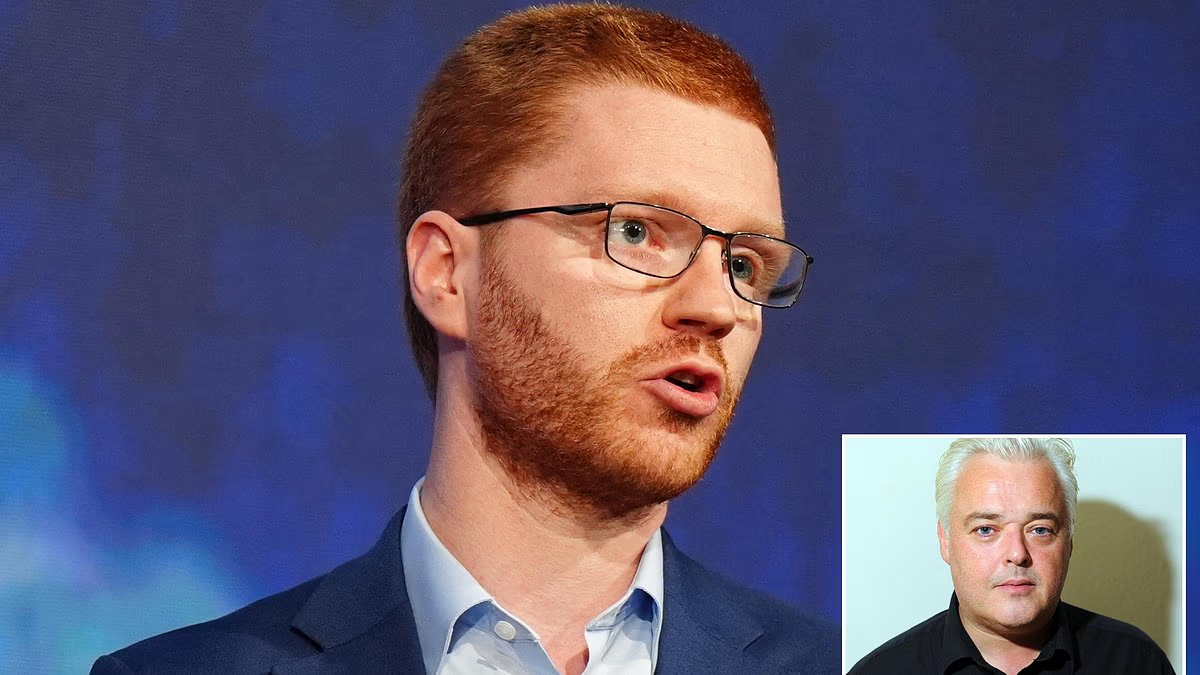

Zack Polanski is an honourable and decent man. At least, that is the impression he appears determined to give—and he would be the first to say so.
The leader of the Green Party of England and Wales is also his own most enthusiastic supporter, judging by the glowing assessment he repeatedly offers of himself.
In speech after speech, Polanski presents himself as a politician of exceptional moral conviction, motivated by a compassion he suggests is lacking in others.
His message is straightforward: if you see yourself as a good and compassionate person, he wants you to believe that he is the politician for you.
Yet the argument advanced here is very different. Polanski is portrayed as a deeply calculating politician, prepared to say whatever he believes will help further his career.
That criticism intensified after his response to the Green Party’s decision at its annual conference last weekend to pass a motion condemning Zionism as racism.

Scottish co-leader Ross Greer echoed the Green Party of England and Wales in condemning Zionism as racism
Polanski did not take part in the vote. Afterwards, despite having spoken about his Jewish heritage, he said he would not accept anyone being excluded from the party “because of the religious or communal body they are part of”.
Critics, however, argued that this was precisely the effect of the motion he failed to oppose.
In a joint statement, the Board of Deputies of British Jews and the Jewish Leadership Council described the motion passed in Brighton as an attack on the Jewish community.
They reserved particular criticism for Polanski, saying: “We reserve particular criticism for Zack Polanski, who neither spoke against the motion nor voted. These are not the actions of a leader, but a bystander.”
The organisations also described the Greens as “an extremist party with a platform of anti-Jewish racism”. The Scottish Greens, now jointly led by MSPs Ross Greer and Gillian Mackay, did not retreat from their support for the position taken by their sister party.
A party spokesman said that “modern-day Zionism” had “resulted directly in a genocide against the Palestinian people”.
The implication, critics contend, is that Jewish people who support the continued existence of Israel are being branded racist because of that belief.
That, in turn, risks creating a hostile environment in which Jews become targets for prejudice from sections of the self-described progressive Left.
Anti-Semitism has risen sharply across the UK in recent years, prompting widespread alarm.
The election of Jeremy Corbyn as Labour leader in 2015 brought renewed attention to anti-Jewish ideas that had circulated on the hard Left for decades, according to critics of his leadership.
Those views were often presented in the language of compassion. Expressing concern for the people of Gaza, critics argued, was sometimes used as cover for hostility towards Jews.
The resulting rhetoric included slurs and anti-Semitic tropes, alongside the insistence that opposition to Zionism could not itself be anti-Semitic.
History suggests that anti-Semitism can be politically useful. Even in more stable periods, however, this ancient hatred has generally remained at the fringes, attracting extremists and conspiracy theorists on both the far Left and far Right.
But at the worst, anti- Semitism becomes acceptable with devastating consequences. These are terrible times for Jews.
Three years ago, today, on October 7, 2023, Palestinian terrorists invaded southern Israel, massacring almost 1,200 people. Young women attending a music festival were gang raped, their bodies mutilated before they were executed; families were hunted down and shot.
Within hours, the response from the political Left was to restate its solidarity with the people of Gaza.
Tens of thousands of demonstrators took to the streets of UK cities, including Glasgow and Edinburgh, calling for the globalisation of the Intifada.
They chanted for the end of Israel – for what else could their demand for Gaza to stretch ‘from the river to the sea’ mean? – and they made life less safe for every Jew.
The old saying has it that in order for evil to flourish, all that need happen is for good men to do nothing. To the ranks of the complicit, we must add the foolish.
Zack Polanski and Ross Greer are political zealots, stricken by certainty. Having decided – in Greer’s case as a teenager – that the rigid set of ideologies to which they adhere represent the one true way, they cannot imagine that those with whom they disagree might be anything other than malign.
These inadequate men, who prevaricate and dissemble on the matter of Israel, are always keen to remind us that they stand with Jews.
But the fact is they also spend a great deal of time standing with people who would gladly see Israel wiped off the face of the Earth. The privileged middle classes have always enjoyed cosplaying as victims.
Having been forced to endure lives free of hardship, struggle and pitiless woe, many feel the need to take on the agonies of others.
Thus, we see – and hear – a lot of confident people with time on their hands marching alongside supporters of the terrorists who, three years ago, committed the worst atrocities in a long history of attacks on the world’s only Jewish state.
Green parties from across the UK are always well represented at these disgraceful displays of solidarity with those who would erase Israel.
Both Zack Polanski and Ross Greer are cynics playing idealists. They pander to the worst excesses of their supporters without a thought for implication or consequence. I wonder whether, this time, they and other senior Green politicians might live to regret their complacency.
Following the vote on the new anti-Zionist policy, Mr Polanski, along with deputy leaders Rachel Millward and Mothin Ali, the party’s five MPs and others issued a statement which was clearly an attempt to see off the charge that their party is now officially, formally and proudly anti-Semitic.
‘As Green Party leaders and MPs,’ they wrote, ‘we will always uphold universal human rights. We will never tolerate any form of discrimination or harassment…’
These people tolerated discrimination and harassment when they stayed silent and allowed their members to debate – in the most despicable terms – whether the desire of Jewish people to live in a homeland free of persecution should be considered racist.
The anti-Semites who support the idea that Zionism is racism will never be satisfied. Their hatred of Jews runs deep and the success of the Green Party motion is just a step along the way.
Zack Polanski is now fully under the control of the anti- Semites within his party ranks and it is difficult to see how that ends well for him.
In making the lie that Zionism is racism into official party policy, the Greens have surely overstepped the line at which decent people must stop supporting them.
These are not good people and their politics is not righteous.