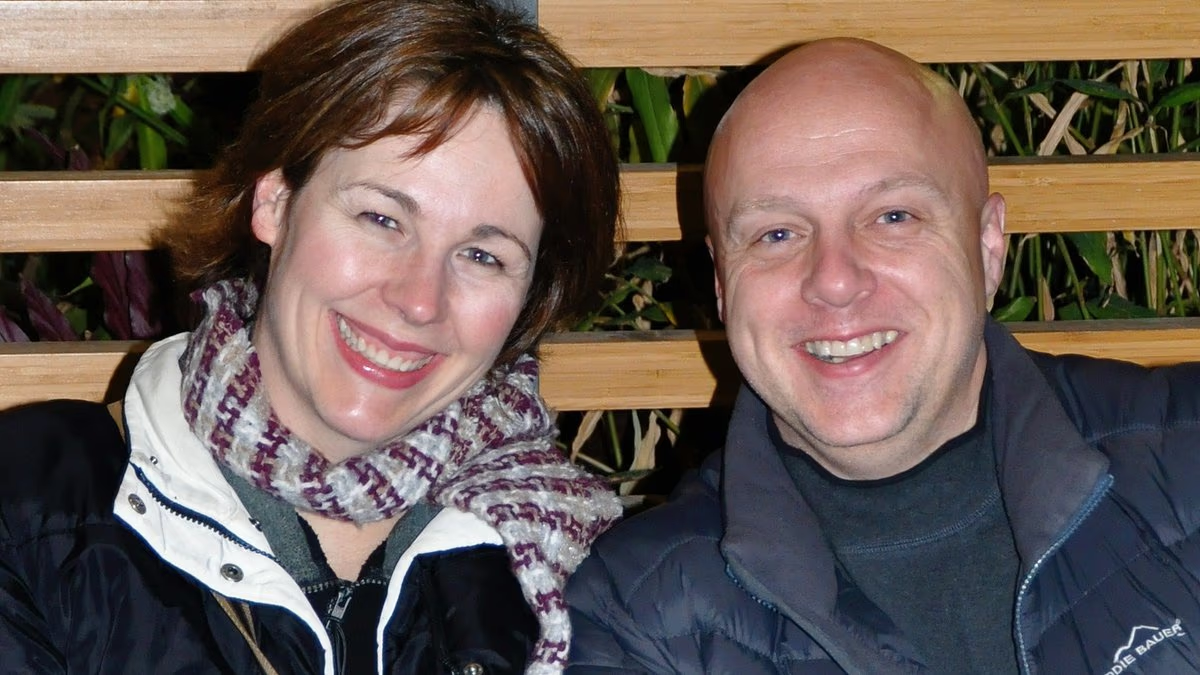

I will never forget the cold November day I held my nine-year-old son’s hand as we led the funeral procession for his father.
I was mourning Sean, the man I had loved and shared my life with for 20 years, until an unexpected heart attack took him at just 47.
But Dash was a little boy who had lost his dad far too soon. Hearing him sob throughout the service made my own pain feel even sharper.
Friends and family had travelled from far and wide to pay their respects. Their kind words about Sean brought a small measure of comfort to my devastated heart.
They remembered him as witty, caring, humble and fiercely loyal — a devoted father whose family meant more to him than anything else.
I remember believing that the outpouring of support might help us survive the dark days that lay ahead.
Then, the day after his funeral, my world fell apart. I found evidence that Sean had had multiple flings during our marriage and had built up more than £30,000 in debt while financing his secret life.
The most devastating revelation was still to come: Sean had also been involved in a five-year affair.

Jessica Waite discovered her late husband had been unfaithful after he died aged 47
The grief and sadness I had carried since his sudden death were suddenly overwhelmed by a powerful wave of anger.
I wanted to shout at Sean, demand an explanation and ask how he could have deceived me. I even felt an overwhelming urge to pack his belongings and throw him out of our home.
Of course, none of that was possible.
How was I supposed to mourn when I no longer knew whether Sean was the man I had believed him to be? The person I loved now felt like a stranger. And what was I meant to do with everything I had learned?
Should I protect his reputation by keeping his secrets? And what, if anything, should I tell Dash about the father he adored?
I soon learned that when someone dies after leading a hidden life, the lies do not die with them. Their deception becomes part of the legacy left behind — a burden I would never wish on anyone.
Sean and I met in 1995, when we were both in our twenties and teaching English in Japan.
He was charismatic, intelligent, funny and exceptionally hard-working. But the moment that truly won me over came after my grandmother died and I needed to travel from Japan to Canada for her funeral. This was long before booking flights online was something you could do in a few clicks.
Sean told me not to worry. I should concentrate on getting to the airport, he said, and leave the arrangements to him.
The journey involved four connecting flights, but at every stage, a ticket arranged by Sean was waiting for me at the check-in desk. That was when I believed I had found someone I could spend the rest of my life with — a man who would always stand by me. I thought I knew exactly who Sean was.
After Japan, we spent some time living in Singapore before moving back to Canada. I continued teaching, while Sean began building a career in technology.
Before long, he’d become hugely successful; he had a Porsche on the driveway and we loved travelling to far-flung places.
Shortly before he died Sean had taken on a high-profile job as CEO of a software company in Colorado. It meant he lived there in an apartment during the week, flying home at weekends.
Did it worry me, him being away from us so much? I worried for his wellbeing, that the strain of a high-pressured job was taking a toll, but I trusted him. We spoke every day and he always told me he loved me. Every night he’d call Dash to read him a bedtime story.
We made the most of the weekends as a family and I just assumed he was devoting all his time in between to work.
Our agreement had been that I’d pause my career to hold the fort at home while he was in a high-salary position. Then, after a few years, we’d be financially secure and he would move back home and take on a lesser role.
But while I adored him, I knew Sean wasn’t perfect.

Sean and Jessica met in 1995 when they were both teaching English in Japan in their early twenties. They married and had a son together
A few years before his death I’d suspected him of getting close to a colleague called Rebekah. They were texting outside work hours and she seemed to be confiding in him about her personal life.
When I confronted him, Sean had vehemently denied anything was going on. He’d mentored a lot of colleagues over the years, so I believed him when he said that was all that was happening here.
After some couples’ counselling, we’d put the blip behind us. Few couples, after all, go through life without any hiccups.
Additionally, he could have a short fuse and in the months before his death his moodiness had become unbearable. I thought it was the stress of his new job. I never suspected it was also the strain of concealing all his lies.
Rather than ruin our precious weekends together by addressing his mood swings, I’d decided to tackle the issue that Christmas, when he’d have two weeks at home.
He died before I had chance.
On November 4, I spoke to him while he was on his way to the airport ahead of flying home. We chatted about our plans for an early family Christmas celebration, as my mother was visiting us.
Shortly after that conversation, I was sitting in a café having lunch with my mum when I got a call from an A&E nurse at a hospital in Houston to tell me my husband was dead. He’d had a heart attack as he waited to board his flight.
In a state of complete shock, I collapsed into Mum’s arms in tears.
How could it be possible? At 47, Sean was still young and fit, and had recently had a full medical exam, including an electrocardiogram to check his heart, after which he was given a perfect bill of health. Months later, I was told that the post-mortem examination revealed the cause of death as cardiac sarcoidosis, a rare autoimmune condition that causes heart problems, and that frequently goes undetected.
My first week as a widow was a blur. Aged just 44, I felt caught in a maelstrom of emotions: utterly devastated myself, heartbroken for Dash that he’d lost his father before even reaching his tenth birthday, unsure how we would ever rebuild our lives without Sean.
The day after the funeral, I finally found the strength to go through the box of Sean’s personal belongings that had been couriered to me by the hospital.
Inside was his briefcase and the clothes he’d been wearing when he died.
After I tearfully laid Sean’s clothes out on the bed, his scent both comforting and painful, I found his wedding ring buried in his shaving kit.
My feminine intuition flickered. Why had he not been wearing it when he died? It was odd.

At 47, Sean was still young and fit, and had had a full medical exam not long before his shock death
It was when I logged onto his iPad that I discovered the truth. His emails and messages revealed multiple infidelities, most of them one-night stands. He’d even been with another woman on the last night of his life. His browsing history also pointed towards a porn addiction.
Unable to process what I was seeing, all the breath left my body.
There was also a credit card among his possessions that I didn’t recognise.
When I accessed the account online, an itemised statement revealed he’d run up over £30,000 of debt, much of it spent on luxury hotels and restaurants where, I realised, he must have been entertaining his various women.
Having given up work to raise our son, being left responsible for this level of debt was terrifying. Would I have to sell our house, robbing Dash of the one bit of stability we had left?
But far more difficult was trying to come to terms with Sean’s betrayal.
People ask: ‘How could you not have known?’
As stupid as this may sound, with his punishing work and travel schedule, I couldn’t imagine Sean having the time or energy to sustain a double life.
But his betrayal ran even deeper than I realised in those first, awful hours going through his messages.
One of the few people I confided in, several weeks after my discovery, was Carmen, a friend who also happened to be a financial adviser. I needed her help to deal with Sean’s debt.
We were sitting together at my kitchen table going through the bills when I said to her, bitterly: ‘The first things I’m paying off are boutique hotels and room service, free-flowing prosecco and breakfasts for two.’
‘Yes,’ said Carmen, ‘poor Rebekah will have to foot her own bills now.’
I froze.
Rebekah, the former colleague I’d once feared Sean was getting too close to? What did she mean?
Carmen was mortified. Married to Sean’s friend, Scott, she had assumed I must know about Sean’s five-year affair with Rebekah. She had found out after Rebekah kept calling Scott in tears following Sean’s death.
But I hadn’t known. I had trusted Sean when he told me there was nothing between them.
Now, my world had shattered all over again. His repeated betrayals had obliterated anything that had ever been good between us, made a mockery of his daily pledges of love. All my memories were contaminated.
Without Sean there to take out my anger on, I sought revenge on Rebekah.
A couple of days later, I called her husband to tell him about the affair. He hadn’t known and thanked me for telling him. Eventually, they divorced.
Then I sent her text messages calling her ‘a life-destroying coward’, and saying I hoped her children would see her for exactly what she was.

Writing my book, The Widow’s Guide to Dead Bastards, was perhaps the most cathartic part of the whole process
I wanted her to acknowledge my existence, to admit what she had done. Yet she never did. Her only response was to threaten to sue me for harassment.
The hardest part was trying to remain a functioning, loving parent to my son, and preserving his good memories of his father for his sake.
Emotionally exhausted, unable to eat or sleep, I tried to keep the days as normal as possible for Dash. Then, when he was tucked up in bed, I’d pace the floor or watch the video of Sean’s funeral service on repeat, trying to remember the love I’d felt for him that day.
At the time, my grief had felt unbearable, but now I wished I could go back to that uncomplicated sadness.
After my original burst of fury came the realisation that none of my questions – why had he done this, had he still loved me? – would ever be answered. I couldn’t confront Sean and there would never be any apologies or remorse – or, it felt, closure for me.
Taking revenge on Rebekah had done nothing to cure my anger. I could feel my rage becoming corrosive.
Eventually, I had to ask myself whether I was prepared to feel this way forever. If not, I needed to work through all my complex feelings in order to find a sliver of peace.
A local group for widowed parents and their children helped a bit, as did talking therapy.
Grieving a loss that involves betrayal is complicated, and I liken counselling to setting a broken bone; it doesn’t take the pain away, but it puts things in place so that eventually they’ll heal.
When a friend told me about Camp Widow the summer after Sean died, I pictured a circle of black-veiled women sobbing around a camp fire.
In fact, it was a conference in a hotel with various events and workshops, such as ‘Writing through grief’.
I thought I would be the only one with complicated feelings, but it turned out other widows were carrying burdens such as addiction, estrangement and domestic violence alongside their grief.
One wonderful woman whose husband died on 9/11 hosted a session on finding love after loss, which, to my surprise, began with recommendations for discreet online shops selling vibrators. Step two was how to write a profile for online dating.
It served me well. A day after the first anniversary of Sean’s death, I arranged to meet a man called William in a café.
We’d been chatting on a dating website and it was surprising and terrifying in equal measure to discover we enjoyed each other’s company.

Eleven years on from his death, I don’t think forgiveness equates to letting him off the hook. It’s more about securing my own peace
Adamant I wasn’t going to fall for the first man who came along, it was a slow burn. But ten years later, we’re still together.
Gradually, I told Sean’s family and close friends his secrets. It was very painful to say these things out loud, knowing this double loss – of Sean himself and of the man we’d thought he was – would hurt them too.
Therapy helped me separate Sean’s lies from the good times we’d had together – not least sharing a son – so that, with time, I was still able to look back at our life with some fondness. While I had felt such a fool for not seeing what was going on, ultimately I accepted that the shame was Sean’s for abusing my trust, not mine for trusting him.
Dash is now 20 and thriving at university. Rather than one big conversation about his dad’s lies there were many little opportunities over the years to gently disclose small parts of what Sean had done.
With the benefit of hindsight, I think that Sean’s abrupt changes in mood and short fuse in his final months may have pointed towards undiagnosed bipolar disorder, a condition his mother also suffered from, which would also account for his promiscuity and overspending.
I positioned it to Dash that his dad had a mood sickness that caused him to make poor choices.
Writing my book, The Widow’s Guide to Dead Bastards, was perhaps the most cathartic part of the whole process.
Just before it was published, nine years after Sean’s death, I gave it to Dash to read. By then, he’d come to understand Sean as both a much loved father and a complicated, imperfect human being.
Had Sean been alive when I found out about his double life, I’d certainly have divorced him. For a long time, I envied other betrayed women who did get divorced because they had their chance to yell and scream and let their cheating husbands know exactly how they felt. Shouting at the walls, as I did, isn’t the same.
People expect betrayed wives to go nuclear in normal circumstances, but when you find out a spouse has cheated after they died you’re supposed to just quietly soldier on. People are instinctively uncomfortable about speaking ill of the dead.
At times I wished I’d never discovered the truth. That way, I could have grieved the uncomplicated memory of a good man.
But seeking to understand Sean made me wonder if a relationship can evolve even after one spouse dies.
When I remember him now, I feel like I know the whole Sean, even the shameful parts he thought I couldn’t love. I’m certain he would be sorry for the pain he caused.
Eleven years on from his death, I don’t think forgiveness equates to letting him off the hook. It’s more about securing my own peace. Through writing my book I’ve learned that a surprising number of people find themselves in similar circumstances to mine; we all deserve to move forward and to find happiness again.
The Widow’s Guide to Dead Bastards: A Memoir by Jessica Waite (Simon & Schuster, £10.99).
Rebekah’s name has been changed.
As told to Sadie Nicholas


