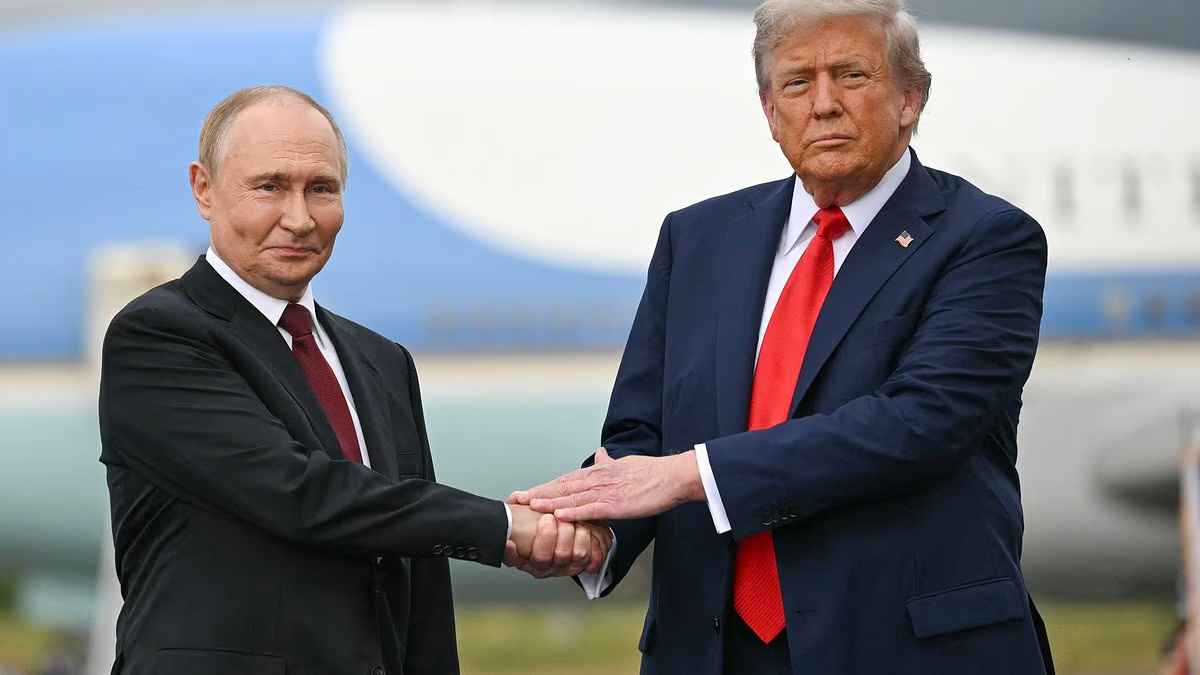

Donald Trump said today that Vladimir Putin has agreed to send hundreds of thousands of tons of diesel to the United States, a move he suggested could help lower fuel costs before Americans vote in November.
“I have just concluded a highly successful discussion with President Vladimir Putin, of Russia, wherein it was agreed that Russia will immediately supply over 300,000 tons of diesel fuel to the American and global marketplace,” Trump wrote on Truth Social.
He said a further 500,000 tons would be released in November, followed by 1 million tons “immediately thereafter.”
Trump added that, depending on the condition of Russia’s diesel refineries—which have been heavily damaged by Ukrainian drone strikes—the country would provide another 3 million tons “within a short period of time.”
At the same time, the Treasury Department said it was temporarily easing sanctions on Russia through April 7 to enable the diesel shipments. The United States and its allies have imposed sweeping sanctions on Moscow since Russia invaded Ukraine.
Ukrainian President Volodymyr Zelensky condemned the agreement as a “gift to Putin.” A Ukrainian official told Axios that Kyiv had been taken by surprise by the announcement.
“Gifts to Putin will not bring peace or any benefit to the civilized world. Russia will ‘repay’” the diesel with more “terror and treachery,” Zelensky said.
“Allowing Russia to sell petroleum products is an investment in a war that must be ended, not prolonged.”

Donald Trump greets Vladimir Putin on the tarmac after both leaders arrived at Joint Base Elmendorf-Richardson in Anchorage, Alaska, on August 15
The initial 300,000 tons would amount to about 2.2 million barrels—less than two hours of global diesel consumption, according to calculations based on International Energy Agency data.
The 500,000 tons scheduled for November would equal roughly 125,000 barrels a day, or about one-eighth of the approximately 1 million barrels of diesel Russia exported daily before Ukraine’s refinery campaign.
Trump said the arrangement, combined with what he described as America’s “total control of the Strait of Hormuz,” would reduce diesel prices worldwide.
American diesel prices have climbed to record levels amid the overlapping wars in Iran and Ukraine. The national average is now $6.28 a gallon, according to AAA—more than $2.60 above the $3.68 average recorded a year earlier.
DISCOVER MORE: Overwatch Eskay Before And After Photos: Is She Trans?
US diesel futures dropped about 4.5 percent to $4.66 a gallon on Friday. Brent crude, the global benchmark, was trading near $104 a barrel, down approximately 0.3 percent.
Diesel fuels the trucks and trains that transport goods across the country, as well as much of America’s agricultural machinery, making higher prices a burden for households.
The cost of living has become a central issue for voters ahead of the November 3 midterm elections. In a Reuters/Ipsos poll conducted in late August, 47 percent of registered voters identified it as the most important factor in their decision.
The agreement followed reports that Trump had urged Zelensky to halt attacks on Russian oil refineries, arguing that the strikes were contributing to higher diesel prices.

Rescuers work at an apartment building damaged by a Russian airstrike in Zaporizhzhia, Ukraine, on Friday

Smoke rises during an airstrike reportedly carried out by the Saudi-led coalition over the Houthi-controlled Yemeni capital, Sanaa, on Friday
A source told Axios that Trump repeatedly raised the refinery strikes with Zelensky during a September 20 call and referred to diesel several times.
The call came the same day Ukraine unleashed its largest drone attack on Moscow since the war began, with the city’s mayor saying 450 drones were shot down and the capital’s main oil refinery hit.
Ukraine has become increasingly adept at hitting the parts of refineries that take longest to fix, such as the units that turn heavy oil into diesel and jet fuel, which rely on equipment Russia cannot easily replace, analysts say.
Global oil prices were already pushed back above $100 a barrel last month after Iranian-backed militias in Iraq were blamed for a drone attack that shut Saudi Arabia’s East-West pipeline.
Tehran’s Houthi proxies in Yemen have also seized an island in the Bab el-Mandeb Strait at the mouth of the Red Sea, a vital route after Hormuz was disrupted.
Trump has blamed the diesel spike on Ukraine, rather than his own war with Iran, telling reporters at his golf resort in Ireland on September 13: ‘This isn’t done by the Middle East, this is done by what’s happening with Russia and Ukraine.’