
On July 10, 2019, then-Prince Charles formally opened a £75 million pilot-training facility a few miles south of Gatwick Airport.
After trying out one of its advanced flight simulators, Charles joined former aviation minister Baroness Vere on a makeshift stage to unveil a commemorative plaque. During the ceremony, he joked that flying in his younger days relied on “the seat of your pants and dead reckoning”.
The six simulators at Acron Aviation, one of Britain’s biggest pilot-training providers, have since played a central role in preparing commercial pilots from around the world.
Two of the machines now stand prominently at the entrance to the company’s imposing UK headquarters near Crawley, West Sussex.
The academy’s online material says aspiring aviators can progress from “little or no flying experience to a fully qualified airline pilot” in roughly 70 weeks. A place can reportedly be secured with a deposit of about £3,000, though the full course carries a price tag of approximately £94,500.
Its Gatwick-based “London Training Centre” promotes student-style accommodation, high-end restaurants and breakout areas, while highlighting its proximity to the capital. International trainees are encouraged to visit attractions including Big Ben, the Tower of London and Buckingham Palace.
What the company is less willing to discuss today, however, is the story of one former overseas trainee.
Around a year before Charles attended the centre’s official opening—when it was operated by L3Harris Commercial Aviation, before being acquired by Acron Aviation last year—Hamam al-Hammami is understood to have joined the academy.

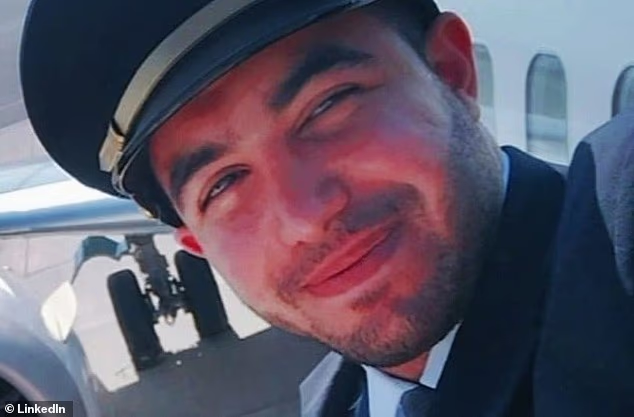
Hamam al-Hammami, the co-pilot suspected of attempting to hijack a flight from Dubai to Israel
Al-Hammami was in his early twenties at the time. He had spent his teenage years in Syria and was born to an Omani father and Syrian mother. After successfully gaining a place at the L3Harris Airline Academy, he appeared to be embarking on a career flying passengers for commercial airlines across the globe.
That trajectory changed last week, when al-Hammami, serving as co-pilot on a budget flight from Dubai to Israel, was suspected of trying to seize control of the aircraft and crash it into Ben Gurion Airport or a high-rise building in Tel Aviv—an alleged attack described as being “akin to 9/11”.
According to claims made by investigators, he used a crash axe stored in the cockpit to assault the pilot, Smit Machchhar, roughly two and a half hours after take-off.
Israeli authorities described the incident as an attempted jihadist terror attack, alleging that al-Hammami had undergone Islamist radical indoctrination before trying to take sole control of the plane.
Despite suffering serious injuries, Machchhar reportedly managed to open the cockpit door and raise the alarm. Passengers then intervened and overpowered the alleged attacker.
The aircraft plunged 17,000 feet in about 30 seconds before being brought out of its dive by a sewage-truck driver. He later told Our News Outlet that knowledge picked up from watching aviation documentaries helped him carry out the life-saving manoeuvre.
Two off-duty pilots who happened to be travelling on the flight subsequently landed it in Saudi Arabia, where al-Hammami was arrested.
During questioning in the UAE, he reportedly provided prosecutors with a “detailed confession”, setting out his alleged motives. Investigators say he told them he wanted to commit the attack “as revenge for Gaza” and intended to “die a martyr”.
UAE Attorney General Hamad Saif al Shamsi said al-Hammami had increased his exposure to material supporting terrorism and had also been taking boxing lessons with a private coach in the period leading up to the alleged hijacking.
Deleted social media posts have also reportedly surfaced, portraying him as an angry young man who promoted conservative Islamic views, described women as “rotten meat” and spread hateful material.
The revelations have prompted difficult questions about whether an apparently ambitious and capable young man was a jihadist who remained hidden in plain sight. Al-Hammami had studied not only in Britain, including through a distance-learning course at a university in Buckinghamshire, but also in Australia and New Zealand—raising questions over whether warning signs were missed and whether he could have been stopped earlier.
Worryingly, he would later go on to describe his five years spent studying in the West as the ‘golden years’ of his religious commitment.
In fact, when explaining how he prepared for the attempted hijacking, al-Hammami revealed he had watched radical terror videos and read extremist literature while studying engineering at The Royal Melbourne Institute of Technology in 2017.
He also made the disturbing confession that, while in Melbourne, he became involved with an Islamist preacher called Samir Mohtadi, who has referred to Zionists as ‘bloodsuckers’.
Was al-Hammami spurred on to take radical action by a toxic combination of radical Islam and the so-called ‘manosphere’?
The latter refers to a relatively recent online phenomenon dominated by the likes of Andrew Tate, the so-called ‘king of toxic masculinity’, who is currently facing charges of rape and sex trafficking in Britain.
Back at Acron’s HQ, some eight years after it is understood al-Hammami began his studies in Britain, it is clear the aspiring pilot would have had access to all the conventional attractions of suburbia.

The then Prince Charles opened the £75million pilot training centre near Gatwick in 2019
Opposite the office is a retail complex housing branches of Sainsbury’s and Greggs and there are a McDonald’s and Starbucks nearby.
Local workers flit about drinking coffees and dog walkers meander the streets in the nearby Three Bridges neighbourhood.
When al-Hammami began training at the L3Harris Airline Academy, as it was then known, in around 2018, there were also bases at Bedfordshire’s Cranfield Airport, Bournemouth and Southampton.
While there is no suggestion of any wrongdoing by Acron, the company declined to say where al-Hammami was based. Approached by Our News Outlet this week, one guard at its impressive premises said: ‘I’m not saying no one remembers him, I’m just saying there is no one here that can help you.’
Asked about the due diligence it performed on al-Hammami, a spokesman for the company said: ‘Our thoughts are with everyone affected by this incident. As this is an ongoing investigation, we are unable to provide further comment.’
But his commitment to pursuing a career in aviation has since been linked to his desire to carry out a 9/11-style attack, the UAE attorney general revealed.
To piece together what led this seemingly aspirational young man to allegedly attempt to pull off such an atrocity, the first place to look in our digital age is social media.
While his account on Twitter (now X) under the name @pilothamam has been deleted, many posts remain archived on the internet.
An Omani national, al-Hammami spent time in the UAE as a child before moving to Syria in 2011, the year the nation was engulfed by the Arab Spring.
He spent four years in the country as it was beset by civil war and later wrote on X that he was ‘raised on religion, morals and virtue’.
By 2015, al-Hammami was in Australia on a student visa, where he is said to have studied engineering at RMIT University in Melbourne for two years – but failed to complete his studies and left without a degree.

Captain Smit Machchhar piloted the flight and was attacked during the attempted hijacking
Reports suggest that, during this time, al-Hammami visited radical mosques and frequented extremist websites and the Australian authorities are currently conducting a multi-agency probe into his time in the country.
It was at this point that he seemingly turned his attentions to completing professional pilot training.
We now know that, between November of that year and May 2019, al-Hammami obtained a six-month student visa to undertake flight training with a ‘UK-based company no longer operating in New Zealand.’
We understand this to be Britain’s L3Harris Airline Academy, which was working with a flying school in the city of Hamilton at the time, and police in New Zealand are also conducting enquiries into the time he spent there.
By 2020, al-Hammami is understood to have returned to the Omani capital of Muscat, where he embarked on a distance learning course in aviation run by Buckinghamshire New University in High Wycombe.
The Foreign Office regularly vets students from overseas studying ‘sensitive’ subject areas, such as aviation or aeronautical engineering, under the Academic Technology Approval Scheme (ATAS), introduced in 2007, amid concerns that people with improper motives were targeting British universities. However, this does not affect students studying remotely from outside of the UK.
A spokesman for the university says his course ‘focused on the business, management and operational aspects of the aviation industry’.
He adds: ‘It was delivered entirely online, pilot training formed no part of the course, and there was no requirement for students to attend the university in person in the UK. Assessment was completed through coursework and other online assessments.’
Be that as it may, it was during his time studying with the British university that he began to feel more comfortable espousing his views online.
Among more than 3,000 posts on what was then known as Twitter, al-Hammani did enthuse about flying, describing it in one post as ‘not a routine job’ with ‘unforgettable moments… like your first solo flight and your first landing with passengers.’

Israeli prime minister Benjamin Netanyahu greets grandfather Yaniv Hayon, one of the heroes of the flight who took on the hijacker
In another, he said: ‘The best thing about flying is that you don’t follow a specific routine. Every day you work with a different captain and cabin crew, and every day you fly to a new destination, which makes the job very enjoyable and never boring.’
But by 2021, however, al-Hammami was espousing a strict interpretation of Islam. He said he was looking for an arranged marriage and the woman in question must wear a face-covering niqab and agree not to work outside the home.
In 2022, he said he had ‘never touched a girl in my life’, adding that ‘God has protected us from temptations. I would not chase after cheap, rotten flesh.’
Describing his thoughts towards women, he once wrote: ‘Her only obligation is to lift her legs.’ And in another sign of his familiarity with the lexicon of the manosphere, he used words such as ‘alpha’ to describe strong men.
Perhaps surprisingly for someone enjoying a career in the airline industry, he also railed against mixed-gender workplaces, saying they had a corrupting effect on women.
‘How many respectable, religious girls have been ruined in mixed-gender work environments and manipulated?’ he asked. His Twitter account also included references to women being ‘stomped on’ and given a ‘pre-emptive slap’.
Little wonder, then, that reports suggest al-Hammami was barred from flying by Oman’s national carrier, Oman Air, over concerns about his increasingly ‘extremist’ views.
Following a stint working for Royal Air Maroc, the Moroccan national flag carrier where it is believed he did not gain permission to fly, al-Hammami was eventually hired as a pilot by UAE-based budget airline flydubai. And it was this role that gave him access to the flight to Tel Aviv on September 30.
Georgian dentist Shota Musaev, 47, was among the passengers on board. He told Our News Outlet that the aircraft banked sharply before a woman shouted: ‘Knife, knife!’
He was one of four men who rushed into the cockpit. ‘The first man, who was closest to the cockpit, rushed inside and saw that one pilot was covered in blood while the other was still stabbing him violently,’ he says.
‘He grabbed the attacker by the neck and dragged him out. We brought him down and pinned him to the floor. They also brought out the badly wounded pilot, and that was when I got involved. We tied the terrorist up, binding his hands and feet.
‘The pilot was losing a tremendous amount of blood. His arm was badly slashed, as was his neck, and he had a very deep wound at the back of his head. Everything in the cockpit was covered in blood, but he was conscious.’
He said the attacker, believed to be al-Hammami, begged passengers to ‘kill me’.
Grandfather Yaniv Hayon, from Israel, was another of the heroes who took on the hijacker. He had been celebrating his wedding anniversary with his wife in Vietnam and was returning home via Dubai.
Mr Hayon says that when he reached the cockpit the hijacker was ‘on his knees’ over the aircraft’s controls while the bloodied captain was injured on the floor.
Of the hijacker, he said: ‘I grabbed him by the throat. It was instinct. I pushed him out towards the exit and started shouting for people to come and help because he was resisting very strongly.’
After the pilot had been subdued, Mr Hayon says he ‘leaned over the pilot’s seat with my arms forward and pulled the controls back towards me because the aircraft was pointing downwards. I pulled back on the controls. It was only for a few seconds.’
He later helped tend to the injured captain and told him: ‘Nobody is going to die today.’
Nine hours after the attack, in a post which may have been pre-prepared and timed, an online social media account in al-Hammami’s name praised Ayman al-Zawahiri, al-Qaeda’s former leader.
Questions continue to swirl about the security lapses that enabled al-Hammami to fly the Tel Aviv route in the first place.
Israeli aviation rules are intended to prohibit pilots from countries which do not have formal diplomatic relations with the country, such as Oman, from operating flights.
But perhaps more pertinently for Britain, why did al-Hammami believe the West sparked his ‘golden years’ of religious commitment? And should he have been welcomed here in the first place?
Additional reporting Natalie Lisbona