
Each year, invasive aspergillosis affects around 4,000 people in Britain. The serious fungal infection is caused by Aspergillus mould, which can be found in compost heaps, decaying leaves and even household items such as pillows and duvets.
Without treatment, the disease is almost always fatal. Even among patients who receive therapy, between one-third and one-half die within weeks. The infection is often diagnosed late and typically strikes people with weakened immune systems, leaving their bodies less able to work with antifungal medicines. In some cases, the Aspergillus mould is resistant to treatment altogether.
That is why patients and doctors are welcoming the prospect of a new antifungal drug, the result of decades of research.
Yet concerns are growing that agricultural fungicides could be creating ‘superfungi’ capable of resisting medical treatment, potentially making new drugs ineffective before they reach patients.
The new medicine, Olorofim, works by blocking an enzyme Aspergillus mould needs to grow and reproduce. In a clinical trial, it performed as well as existing medicines while causing half as many side-effects.
Following those results, the manufacturer is preparing applications for approval by medical regulators. If authorised, Olorofim would become the first new treatment for invasive aspergillosis in more than 20 years. The condition develops when Aspergillus spreads into the lungs and other organs.
‘We desperately need new treatments, particularly for patients whose infections are resistant to existing drugs or who cannot tolerate them,’ says Lisa McNeil, chair of the Aspergillosis Trust. ‘Having another option can mean hope when existing treatments are limited.’
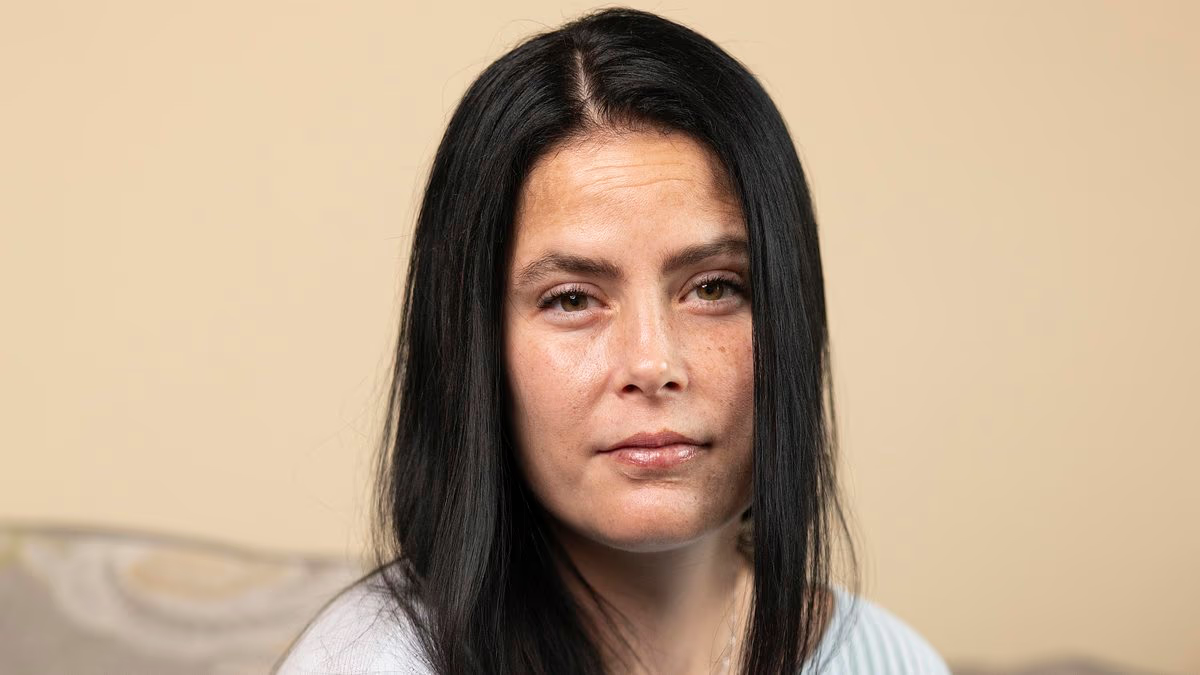
Lindsey Collins, 38, knows that need only too well. She was diagnosed with invasive aspergillosis in her brain shortly after giving birth to her son, Noah, in 2020.

Lindsey Collins, 38, was diagnosed with an invasive aspergillosis infection in her brain, which led to a series of strokes and a cardiac arrest
She had undergone an emergency caesarean after developing pre-eclampsia — dangerously high blood pressure during pregnancy — as well as a chest infection.
After giving birth, Lindsey was placed in an induced coma to help her body fight the infection. She then suffered several strokes and a cardiac arrest.
As she began to recover, scans showed masses in her lungs and brain. A biopsy later confirmed that they were caused by Aspergillus fungi. The strokes had temporarily left Lindsey paralysed.
‘I had to learn how to walk again. By the time I finally got to hold Noah for the first time he was nine weeks old,’ Lindsey recalls. ‘The journey through it was very, very hard – and now I had this other thing on top of it.’
It was not until three years later, however, that she discovered how serious her long-term outlook was. ‘The doctor said, “You have up to five years, and we’ll be kind of lucky if we can push it after that”,’ she says.
Now approaching six years since her diagnosis, Lindsey lives with the uncertainty as a single mother in Cork, Ireland, where she shares a home with her parents.
‘I’m not ready to go,’ she says. ‘But I have prepared for Noah. I got him books on how to understand that I was gone, and where I had gone. I’ve tried to get things in order, but it’s so hard.’
For the past six years, Lindsey has also experienced chronic chest infections.
‘I can’t help but wonder every morning, is this my last day? Will I see Christmas, and the joy it brings Noah?’ she asks.
Symptoms including poor memory and extreme fatigue eventually forced her to leave her job caring for adults with disabilities. ‘Before I was pregnant with Noah, I was such an active person. I was constantly out. I was working 12-hour shifts,’ she says.
Powerful antifungal treatment has reduced some of the masses in her brain, but a large mass at the front remains. For Lindsey, the possibility of another treatment option becoming available is therefore ‘fantastic’.
The potential problem with Olorofim is that a fungicide called ipflufenoquin, used on crops, targets the same enzyme. When fungus is exposed to an antifungal drug or a fungicide, it gives that fungus the chance to develop resistance to the chemical.
‘The fungus that we get infected with typically comes from the environment – it lives on grasses, soil and things like that,’ says Professor Rebecca Drummond, a specialist in fungal immunology at the University of Birmingham.
‘If they are picking up drug resistance in the environment, then before your patient has even been given a medication, they can be infected with a drug-resistant strain.’
The threat is not purely theoretical, but has played out before with other antifungal drugs known as azoles – one of the most widely used because they are cheap, can be given in various formulations including orally and work against a variety of fungi (Lindsey is being treated with an azole, Cresemba).

A scan of Aspergillus fungi. The mould can lurk in compost heaps, rotting leaves or even pillows and duvets

Lindsey’s symptoms, such as poor memory and extreme fatigue, meant she had to give up her job as a carer for adults with disabilities. She has had chronic chest infections for the past six years
Already, Professor Drummond says, there is ‘quite good evidence that some of the drug-resistant infections that we see in patients [were] acquired in the environment because of agricultural use of antifungal drugs’.
Indeed, resistance to azoles used in farming to protect cereal crops from Aspergillus is a growing problem.
And a study published in the journal Nature Microbiology in 2024 showed that exposing Aspergillus mould to ipflufenoquin led to the development of strains resistant to Olorofim.
David Denning, a professor of infectious diseases in global health at The University of Manchester, who founded the company behind Olorofim, says being faced with a patient whose fungal infection cannot be cured with existing drugs is ‘awful’.
‘There’s the invasive ones, which kill people in the space of a week or two – and then there’s the chronic ones, which just get worse and worse over weeks or months,’ he says. ‘Both of those situations are dire. I’ve seen many patients who have died due to resistant fungi who could have been saved if we had new drugs.’
Most people breathe in hundreds or thousands of Aspergillus spores daily with no ill-effects, he adds – ‘just living your life, walking around, going to bed with a bit of Aspergillus in your pillow and the duvet [where they thrive in the moist, warm conditions] – we are all exposed to this’.
But if someone’s immune system is weakened, such as cancer patients, or they have a lung condition such as cystic fibrosis or chronic obstructive pulmonary disease then they are particularly vulnerable.
Lindsey does not know how or where she picked up the fungal infection, although she fears that renovations in hospital while she was an inpatient might have released spores into the air.
Drug-resistant fungal infections in general are an increasing concern. For example, Candida auris is resistant to many drugs and has caused outbreaks in hospitals globally, including in the UK.
When it comes to antifungal drugs, ‘we don’t have a huge number of options’, says Darius Armstrong-James, a professor of infectious diseases and medical mycology at Imperial College London. ‘If a new one becomes available, then we want to do everything we can to preserve it.’
But it is not as simple as banning fungicides. Globally, some 10 to 23 per cent of crops are lost to fungal infections each year.
‘What we’re talking about is the balance between food security by protecting crops against preserving critical drugs for human use,’ says Professor Armstrong-James.
He was one of 130 experts who wrote to a parliamentary inquiry on antimicrobial resistance last year warning that the UK was ‘lagging behind’ other countries which had specific frameworks in place to assess those risks.
Ipflufenoquin is used on crops such as apples, pears and almonds in Canada, Australia, US and Japan, with EU approval pending. While it’s not used in the UK, Professor Denning believes it ‘very likely’ that resistant fungi would find their way here.
‘There’s a need to protect food resources – the challenge is that many of these fungicides are used in specialised crops,’ he says. ‘You wonder what the equation is, with almonds or almond milk, versus patients who are dying of untreatable fungal infections.’
Separately, Lindsey worries that illnesses in pregnant women are overlooked – she felt her chest infection was dismissed. ‘I’m sure that if I didn’t have the complications I had, this [fungal infection] would have been avoided.
‘People who work in healthcare should always have awareness, understanding and patience.’
Meanwhile, she takes much delight in seeing her ‘caring and lovable’ son flourish, adding: ‘I would like very much to see the man Noah grows up to be.’


