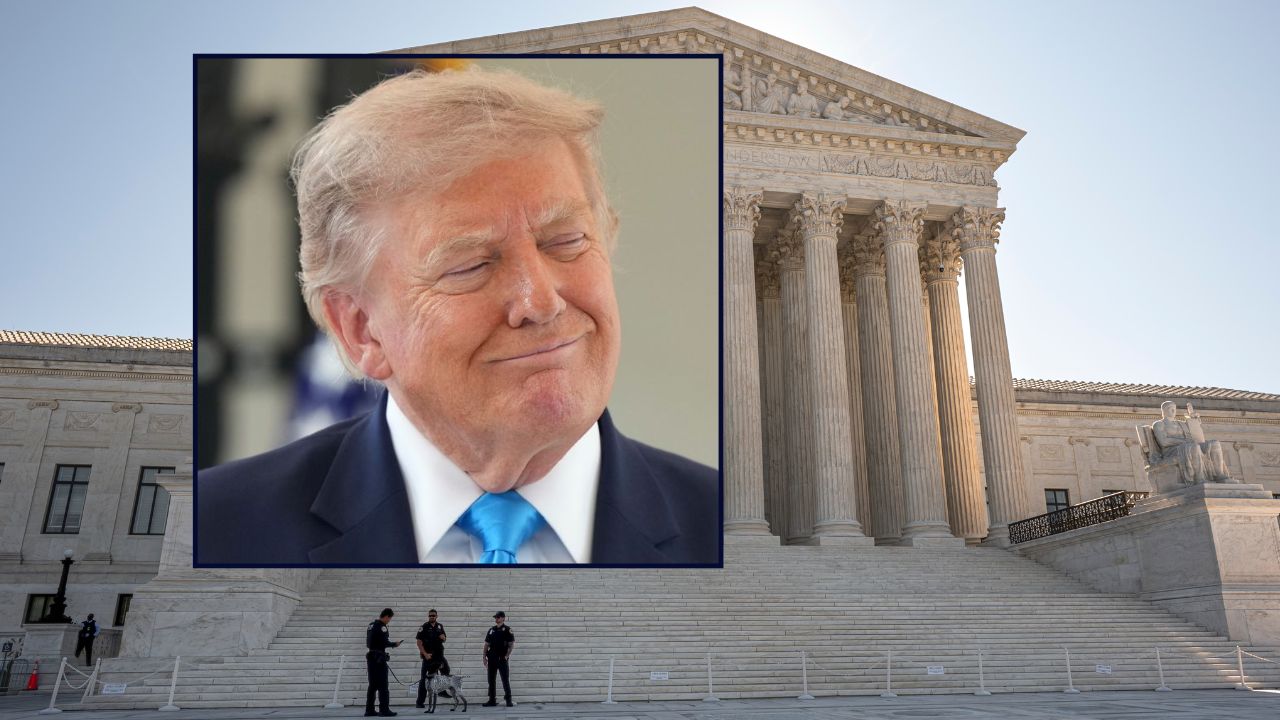

Inset: President Donald Trump listens at a White House event unveiling the Freedom Haulers initiative on Thursday, July 30, 2026, in Washington (AP Photo/Alex Brandon). Background: The Supreme Court is pictured on Capitol Hill the morning after its conservative majority ruled in favor of the Trump administration in a case involving the president’s executive order limiting mail-in voting, Tuesday, Aug. 25, 2026 (AP Photo/J. Scott Applewhite).
The U.S. Supreme Court has agreed to hear the Trump administration’s latest challenge involving the United States DOGE Service, potentially shielding presidential advisers from a lower-court discovery order.
U.S. DOGE Service v. U.S. District Court for the District of Columbia appeared first among the cases granted review in the Supreme Court’s Tuesday orders.
In a petition filed in March, Solicitor General D. John Sauer—who previously served as President Donald Trump’s personal attorney—accused U.S. District Judge Christopher “Casey” Cooper and the D.C. Circuit of authorizing “wide-ranging and intrusive discovery” into Elon Musk’s Department of Government Efficiency. Sauer argued that DOGE is part of the Executive Office of the President and exists to advise the president.
Cooper, an Obama appointee overseeing the Kennedy Center dispute, ruled for Citizens for Responsibility and Ethics in Washington and allowed the group to pursue expedited discovery. The judge also rejected the administration’s claim that DOGE is not an agency covered by the Freedom of Information Act.
The Justice Department told the Supreme Court that it had already sought the justices’ intervention, secured a stay and obtained a “limited narrowing of the discovery.” But the department said the D.C. Circuit continued approving what it called invasive requests involving a presidential advisory body, without properly weighing separation-of-powers concerns, FOIA’s requirements or the Supreme Court’s earlier order.
RELATED: Missing Air Force General’s UFO Links Fuel Fresh Allegations
The administration presented the justices with two questions, grounding its arguments in the “critical separation of powers principles” the Supreme Court outlined in a 2004 decision involving then-Vice President Dick Cheney:
1. Whether the appeals court’s ruling conflicted with the Supreme Court’s instructions and the separation-of-powers standards established in Cheney v. United States District Court, 542 U.S. 367 (2004).
2. Whether a court can require extensive discovery from an advisory body within the Executive Office of the President—potentially revealing information central to the substance of a plaintiff’s FOIA case—in order to decide whether FOIA applies to that body at all.
The Trump administration maintained that the inner workings of a presidential advisory body, particularly its most sensitive operations, should remain protected. It argued that Judge Cooper’s discovery order—not DOGE’s conduct—should be the focus of the Supreme Court’s review.
“The Court could either grant plenary review of both the separation-of-powers issues concerning discovery into part of the Executive Office of the President and the statutory question of how to tell whether a body counts as an ‘agency’ for FOIA purposes,” the Justice Department wrote. “Or the Court could summarily reverse on the separation-of-powers issue alone because the order below so seriously departs from Cheney’s principles.”
The post Supreme Court to examine judge’s discovery order after Trump DOJ calls demands against “presidential advisors” “intrusive” first appeared on Law & Crime.


