
Beneath Jerusalem’s Church of the Holy Sepulchre, archaeologists have found a possible clue to the landscape surrounding the place where Christians believe Jesus was crucified and buried.
The church was established in the fourth century after Roman Emperor Constantine commissioned a sanctuary around the site traditionally identified as Jesus’ tomb.
Earlier excavations revealed traces of plants, indicating that portions of the area may once have been cultivated. The evidence appears to fit the Gospel of John’s account of a garden containing a newly cut tomb close to the crucifixion site.
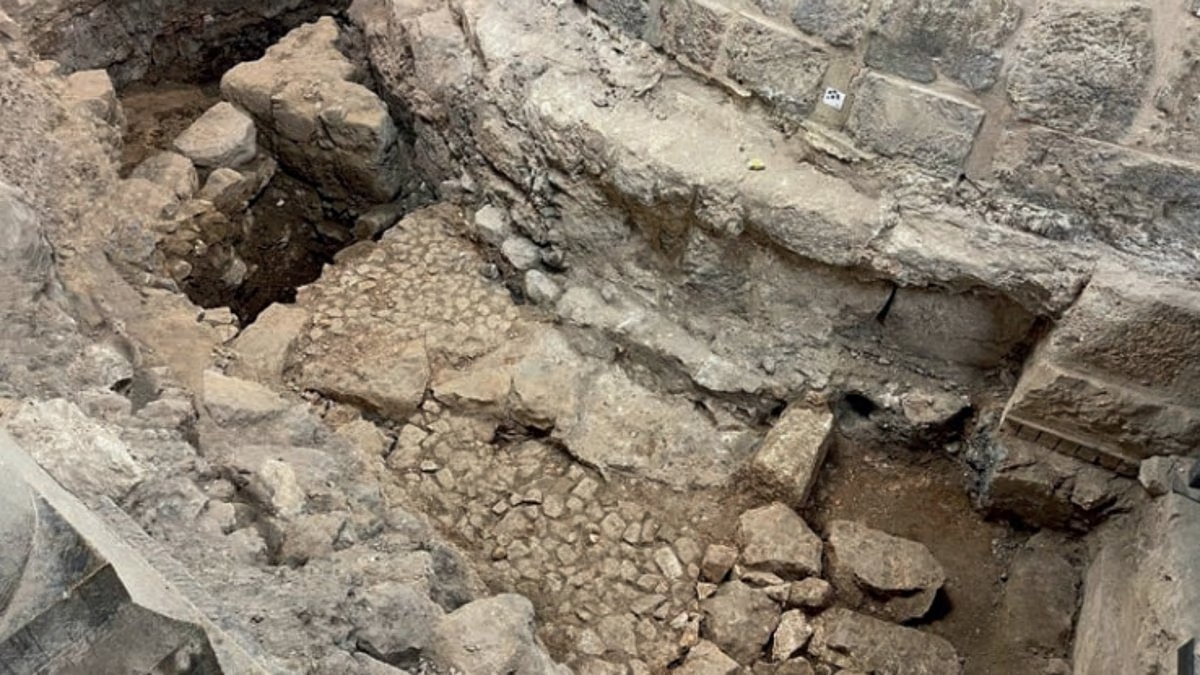
Now, a recently released archaeological study has described an additional feature: a paved stone roadway incorporating a wide, low step bordered by larger blocks.
The preserved portion is approximately 10 feet by 12 feet and sits below a walkway dating to the Crusader period. While the road’s original boundaries have disappeared, its curved form and steep gradient indicate that it once rose toward the southwest.
Professor Francesca Romana Stasolla, director of the excavation, proposed that the feature may have been a suburban road leading upward toward Calvary, provided the area was used for public executions. Calvary is the name given in the Bible to the place where Jesus was crucified.
The excavation team also examined the possibility that the route was built for Roman workers. However, the prominent step would have interfered with carts carrying heavy materials. Its scale and design likewise make it unlikely to have been a minor track leading to nearby burial sites.
Because Roman crucifixions were intended as public displays, roads approaching execution sites had to be open and accessible to crowds. Spectators were part of the punishment’s deliberate public humiliation.

An ancient paved road discovered beneath the church may have formed part of the route taken toward the cross nearly 2,000 years ago
“What is certain is that the place of execution must have been public and accessible,” wrote Stasolla, of Sapienza University of Rome in Italy.
Historical sources mention large-scale crucifixions in and around Jerusalem, but archaeologists have not yet confirmed the location of a formal execution ground.
The roadway belongs to an early Roman period, before Emperor Hadrian’s redevelopment of Jerusalem in the second century. That dating leaves open the possibility that it was in use during Jesus’ lifetime.
Researchers have also asked whether the route played a role in Hadrian’s rebuilding programme, when the surrounding area was absorbed into the expanding city.
Construction roads of this kind, known in Italian as “strade di lizza,” were designed to move stone and other building supplies.
Yet the raised step appears to argue against that interpretation. It would have blocked carts and complicated the movement of large architectural components, whether they were being taken uphill or downhill.
The section of roadway was eventually abandoned when Constantine’s church complex was built in the fourth century.
By then, Christians were already travelling to locations linked with Jesus’ suffering and death, although their visits did not yet follow a fixed or formally recognised route.

Israel has closed the Church of the Holy Sepulchre indefinitely amid rising security concerns as the conflict involving Iran intensifies
The route now known as the Via Dolorosa took shape much later, especially during the Crusader era. It became a series of streets commemorating Jesus’ journey from the Roman governor’s headquarters to Calvary.
Stasolla’s excavation ran from May 2022 until October 2025, although the larger archaeological project began in 2019. Her team is continuing to analyse the discoveries and records collected during the work.
In April 2025, she and her team announced they had uncovered remnants of an ancient garden beneath the foundation of the Church of the Holy Sepulchre.
The analysis dated the remains to the pre-Christian era, around the time of Jesus’ crucifixion and burial. Historians generally date his death to around 33 AD.
The discovery adds new detail to the longstanding debate over the location of Jesus’ burial.

Archeologists were excavating the floor of the church (pictured) when the uncovered signs of an ancient garden that is mentioned in the Bible as where Jesus was laid to rest

There is a long-held debate over where Jesus was laid to rest. Some say the church while others believe he was put inside an ancient rock-cut tomb, known as the Garden Tomb (pictured), which aligns with Biblical text
Many scholars favor the Church of the Holy Sepulchre, citing evidence that the surrounding area contained rock-cut tombs during the period in which Jesus lived. The Garden Tomb, another ancient burial site in Jerusalem, remains an alternative location favored by some Christians.
The original Holy Sepulchre church was commissioned by Roman Emperor Constantine I and inaugurated in AD 335, roughly 300 years after Jesus’ death.
Ancient accounts describe Roman religious structures associated with the worship of Venus being cleared from the site, exposing a tomb identified by Christians as Jesus’ burial place.
Stasolla suggested that knowledge of the tomb’s location may have passed down through generations of the early Christian community. Constantine’s builders cut away the surrounding rock, preserving the burial chamber and making it a focal point of the new sanctuary.
The team also uncovered part of a circular base made from reused marble beneath the shrine enclosing the revered tomb. Measuring approximately 20 feet in diameter, the base may belong partly or entirely to a later rebuilding rather than Constantine’s original construction.
Analyses of the mortar joining its slabs are underway to help establish the sequence in which the structure was built and altered.