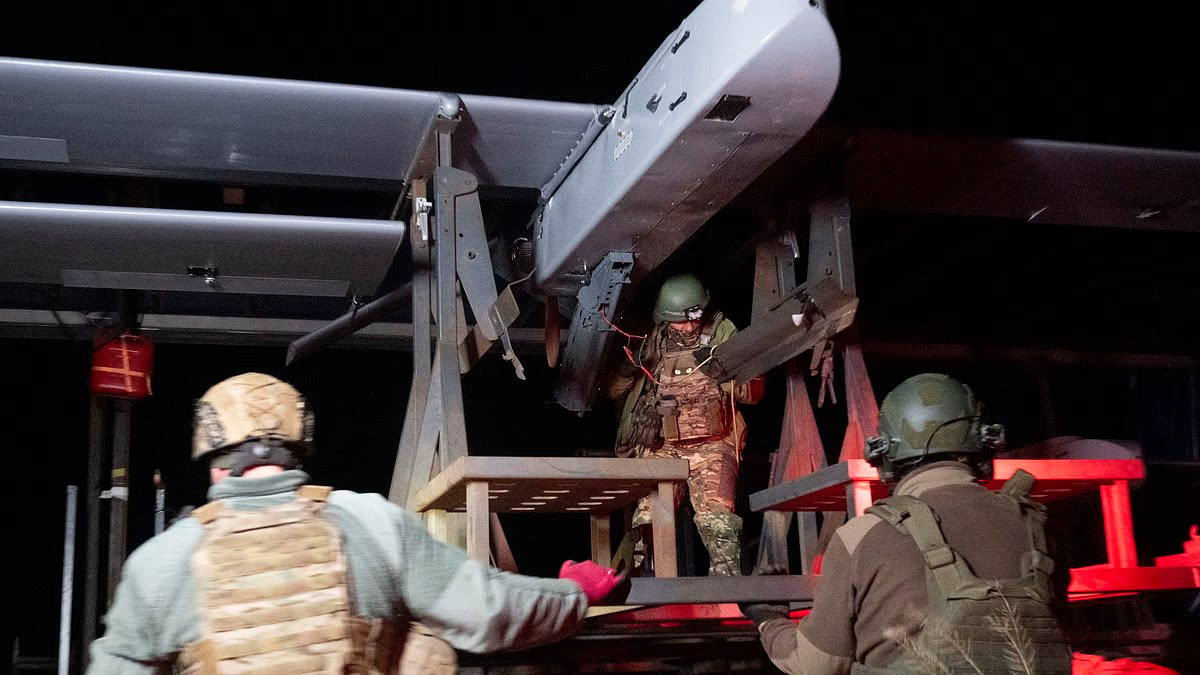

“Get down!” the Ukrainian commander shouts as a high-speed drone carrying a 105kg warhead hurtles across the field.
We drop to the ground. The rocket booster designed to accelerate the unmanned kamikaze monoplane to 60mph in less than a second has come loose too early.
The drone spins erratically, blazing across the night like a Catherine wheel on Bonfire Night. Without the booster’s additional thrust, the aircraft and its enormous payload struggle to climb. We prepare for the worst.
The Ukrainian-built weapon is meant for an enemy target, yet it appears to be heading back towards home soil, threatening to detonate in a shower of razor-sharp shrapnel. Seconds tick by before the propeller’s familiar whine begins to fade.
Despite the booster malfunction, the drone is airborne and eventually settles into its flight at 16,000ft, heading towards a target more than 100 miles away in occupied Ukraine.
Scrawled in Ukrainian marker pen across its wing are the words: “Greetings to you, you bitches, from all the children who were killed.” It is the fourth drone launched in just a few minutes from our concealed position in eastern Ukraine.
The bearded commander, whose call sign is “Variah”—Ukrainian for “Viking”—rises to his feet. “This is why we need a shelter,” he jokes as the drone vanishes into the darkness.

Deadly: A specialist unit prepares a drone launch site near Kharkiv in eastern Ukraine

The drones are built in covert factories across Ukraine, preventing Russia from destroying the entire production network with a single strike
These Ukrainian-made FP-2 drones are emerging as a major threat to Russia. They have helped slow the Russian advance in the Donbas while targeting Vladimir Putin’s oil exports and the lucrative “shadow fleet” operating in the Black Sea off Crimea.
There is no time to construct a shelter here. If Moscow located the launch site, it could unleash everything from jet-powered Shahed drones to ballistic missiles, destroying the position long before the £50,000 monoplanes cleared the “kill zone” and reached enemy territory.
Another drone soon fires up, its two-stroke piston engine rising to a shrill pitch like a deranged grass trimmer.
We are standing 100 metres from the launch platform, where a team crowds around a control box connected to the aircraft.
“Pusk!” the launch pilot calls—“Fire!” A switch is flicked and a trigger pressed, igniting the rocket fixed beneath the drone.
The rocket erupts with the thud and hiss of an enormous match, propelling the aircraft skyward in an ear-splitting roar. This launch, thankfully, is flawless.
I watch six FP-2 drones leave the site. From several miles to the south, we can hear the buzz of more aircraft being launched by another special-forces team.
The operation is led by Ukraine’s elite 20th Unmanned Systems Brigade, known as “K-2”. It forms part of Kyiv’s urgent effort to strike Russian logistics, reduce Moscow’s revenues and secure the breathing space needed to survive the coming winter.
The FP-2s seen by Our News Outlet were all bound for a major Russian base in occupied Luhansk. Elsewhere in the Donbas, similar attacks have cut railway routes and destroyed fuel depots.
Long-range strikes inside Russia have also damaged oil refineries, with the broader aim of weakening the domestic economy and bringing the consequences of the war directly to Putin’s population.
Against the odds, this combination of daring tactics and technological ingenuity has helped shift battlefield momentum back towards Kyiv once again this year.
But now, unbelievably, this entire strategy stands at risk following an extraordinary decision, allegedly made by Donald Trump, to restrict Elon Musk’s Starlink internet connection for Ukrainians. It is only through the billionaire’s satellite network that pilots can guide the drones remotely to their targets.
On Wednesday, a 100mph ‘speed limit’ was imposed on its small terminals, which are attached to drones to pick up the Starlink signal.

These Ukrainian built FP-2 drones are proving to be Russia’s nemesis

The FP-2s Our News Outlet saw were all destined for a key Russian base in occupied Luhansk
If they travel faster than that, which drones must do to evade Russian defences, the feed cuts and they crash. While K-2 could not comment on current operations, it is middle and deep strike missions that have been disrupted.
A Ukrainian military source told Our News Outlet some teams have been grounded, with fears Russia will now seize the advantage.
Musk insists that while his firm SpaceX produces the terminals, its military use is run by the Pentagon.
‘Any limits on speed or usage are decided by the US military and POTUS [President of the US],’ he said yesterday. If it is the work of Donald Trump, it would reinforce Kyiv’s suspicion that he is trying to stop them attacking Putin’s oil refineries.
Last Friday, the US President –desperate to lower fuel prices ahead of next month’s midterm elections – announced a deal to buy 1.8million tonnes of Russian diesel in the coming months.
He then declared it is ‘time for Ukraine to get a new President’ as he blamed Mr Zelensky’s deep strikes inside Russia for rising fuel costs globally (while ignoring the impact of his own war on Iran).
Despite Kyiv pledging to adhere to an amnesty on such strikes if Russia reciprocated, Mr Trump appears determined to force them to kneel. But for Ukraine, this strategy matters more than the tumbling poll numbers of a US President.
One only has to talk to the men and women of K-2 to understand how personal this fight is. ‘For me, this story started in Mariupol,’ says ‘Hrynia’, one of the launch pilots, who studied at the university in the city on the Sea of Azov coast before the war.
‘I don’t even know how to describe it,’ he says of Russia’s brutal siege and capture of Mariupol in 2022 in which tens of thousands of civilians were killed. ‘They took something from me for which I want to punish them, let’s say, and take revenge.’
Asked what it feels like to watch his drones hit their targets, he adds: ‘I couldn’t say that it’s a joy. It is not satisfying. There is just a clear understanding that it has to be done.’
Much of the FP-2 drone operation is shrouded in secrecy but Our News Outlet was granted remarkable access to watch this elite unit in action for five days. The launch teams learn of their missions only hours before they take place.

Despite Kyiv pledging to adhere to an amnesty on such strikes if Russia reciprocated, Donald Trump appears determined to force them to kneel. Pictured: Mr Trump speaks with Russian President Vladimir Putin in August 2025
The drones are assembled in covert factories spread across Ukraine, so that the Russians cannot cripple their capacity with a single strike. (In recent weeks, the Kremlin has hit several such depots including in a massive ballistic strike on Kyiv to mark Putin’s birthday on October 7.) Once assembled, they are transported to a makeshift launch site in a field.
Under cover of darkness, engineers conduct final checks on the drones, which are mounted on launch rails pulled out to three metres ready for take-off.
We are ordered to put on body armour and retreat to a safe distance as an explosives team arrives separately to arm the drones moments before they are fired.
Then everything is swiftly packed up, and the nondescript vehicles that carried the drones drive off into the night.
It can take several hours for the FP-2s to reach their targets, with elite Ukrainian drone pilots controlling them using a live-view from hundreds of miles away in secret underground bunkers. By the time we made it back to the command post, the drones we had watched launch had already hit their target in Luhansk.
‘We are satisfied with the result,’ the pilots’ commander, who can only be identified as ‘John’ – not his real name – says with a smile.
‘I can’t give you specifics, but we did our job today. There will be confirmation and we are sure it will be positive.’
On another mission earlier that week from the same command post, Our News Outlet watched K-2’s pilots targeting Russia’s shadow fleet with six more FP-2s.
This was part of Operation MoLoChKa, which has disabled 300 vessels in two months, according to Kyiv. An acronym for ‘Moscow Will Fall Through Crimea’, which spells ‘milk’ in Ukrainian, the mission is designed to ‘milk’ Russia dry.
Putin’s ‘shadow fleet’ in Crimea uses unregistered tankers, sometimes flying under false flags, to move 3.7 million barrels of oil per day, accounting for up to 70 per cent of all its maritime oil exports.
Kyiv is understandably keen to smash this trade. Among the pilots is a 22-year-old woman, call-sign ‘Maksymivna’, with perfectly manicured black and white nails, a matching purple velour hoody and tracksuit and Balenciaga trainers.
She was just 10 when Vladimir Putin seized Crimea illegally in 2014, and was 18 when the dictator launched his full-scale invasion. By then she had begun vocational training in Kharkiv to become a welder.
Maksymivna was encouraged to go abroad and earn good money but, after watching a TikTok video of female soldiers fighting Russia, she felt inspired to join up in 2023. After starting as a combat soldier, she joined K-2 a few months ago.
‘It is very personal to me,’ she says. ‘The Russians came to my country and destroyed everything. I have this strong desire to destroy their country and everything that belongs to them.’

Among the drone pilots was a 22-year-old woman, with the call-sign ‘Maksymivna’
Steering with a joystick, she manoeuvres her FP-2 into its designated hunting zone in the Black Sea. The section where tankers are known to be carrying sanctioned oil from Russia, or stolen grain from occupied Ukraine, has been split by the Ukrainians into six lanes. The other five are being targeted by five pilots, all male.
She squints intently through her live view, looking for any sign of a vessel. Half an hour passes.
The Kids Aren’t Alright by US punk band The Offspring blares from speakers.
Suddenly Maksymivna leans forward and taps the screen. She’s spotted something. For a minute it is unclear what she has seen. But then an impossibly small fleck appears in the distance. Soon it grows into the unmistakable outline of a cargo vessel.
As Maksymivna closes in on the unidentified vessel, John explains the plan. ‘We need to identify if it is under sanctions and make a decision whether to hit it or not. We will make two or three low passes to make sure exactly, and then prepare for hitting it.’
Maksymivna duly obliges, swooping within a few dozen metres of the stern of the ship. The footage from her live view camera is beamed to the operations team in the corner.
They examine the film and send it on to the intelligence team, who check the ship’s name and identifying features against a huge database of Russia’s shadow fleet of roughly 1,200 vessels.
As Maksymivna turns her drone for a second pass, a senior commander behind her receives a phone call. He quietly walks over to her.
The playlist is turned off. The room grows hushed. ‘A decision has been made to hit,’ John explains, as he asks us to give Maksymivna space.
The ship has been identified as one implicated in grain theft and fuel-smuggling.
Maksymivna swoops in once more, buzzing the ship. The commander points to the ship’s bridge on the screen and says: ‘This is where you need to hit.’
The team aims to disable the steering by striking here. In order to avoid unnecessary casualties, the drone’s repeated flyovers warn the crew that a hit is coming, so they have time to retreat to an armour-plated safe room.
Once she hits, they need a second drone in position ready to film the damage.
Maksymivna moves in. Her eyes narrow on the target. The commander moves a cursor on the live view screen with a mouse, indicating where she must aim for.
But then the vessel appears to accelerate and the wind gusts. ‘Pull out,’ Maksymivna is told. She eases the craft left, flies away, then calmly pulls the drone round once more.
It feels like a frustrating video game, with her comrades watching on. But once more the wind is far too strong, the vessel too fast, and again she is told to pull out.
This time though, the drone jerks violently out of control. There is an audible gasp as it nosedives towards the sea. Somehow, Maksymivna pulls up the £50,000 craft at the last second.
Her fellow pilots laugh with relief. The drone has survived. It is free for a third attempt. Maksymivna takes off the balaclava, which she wore to protect her identity as we took her photograph, pulls out a red vape, and takes a puff. Someone turns the playlist back on to steady her nerves.
She puts the vape down beside the controller and makes a third approach, but again pulls out. The vape comes back up. It feels like an impossible target.
But then, on her fourth attempt, Maksymivna makes her mark. The screen freezes the moment before impact. A dozen windows from the ship’s bridge fill the monitor, now presumably blown apart. Were there any crew behind them?
Suddenly this no longer feels like a video game. Maksymivna’s team applauds. Her eyes well with tears. The commander shakes her hand. Job done.
After her initial hit, more drone pilots strike the ship. Reports and videos are sent to HQ to assess the damage and establish whether the strikes also set the cargo ablaze, which could cost Russia tens of millions of pounds.
‘Usually I get it on the first attempt,’ Maksymivna tells us with frustration afterwards. ‘But I felt great joy when I hit it. I’m very happy that I managed to. There is room for error, but not much.’
Ukraine must hope that Mr Trump and Mr Musk do not stand in Maksymivna’s way of hitting many more such targets.


