
Labour has been cautioned against unveiling unaffordable cost-of-living support after the International Monetary Fund downgraded Britain’s economic prospects.
The IMF warned that governments under pressure from a cost-of-living squeeze should resist the temptation to increase spending and instead begin rebuilding their finances.
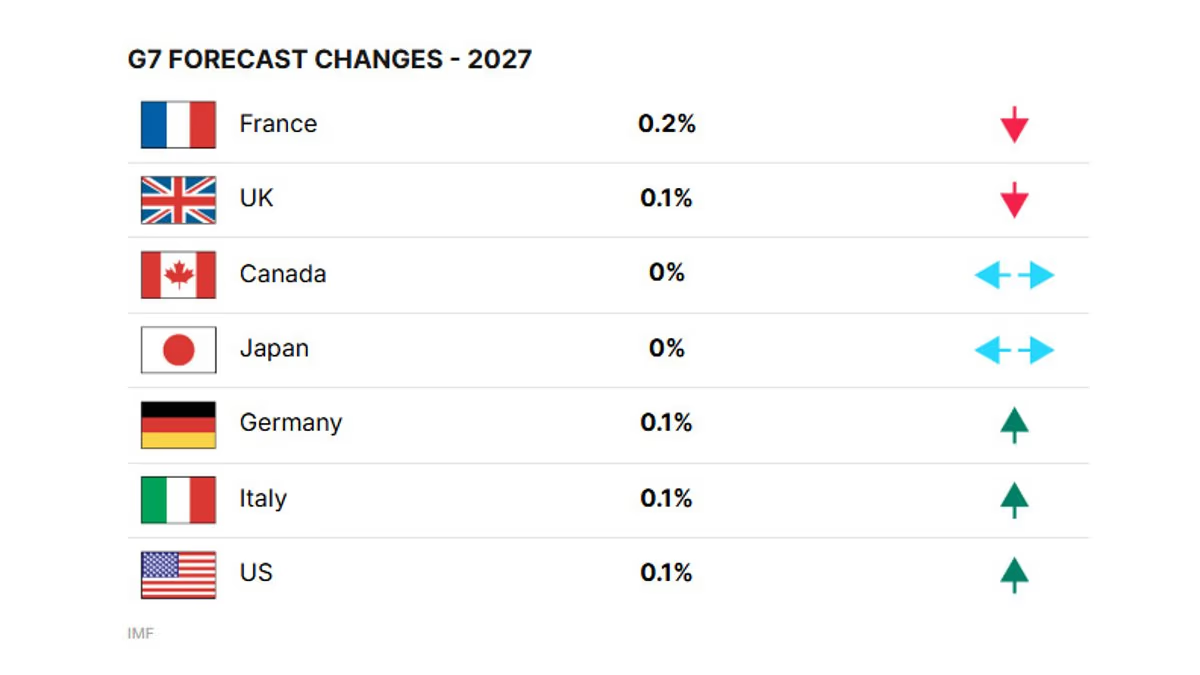
The latest World Economic Outlook delivered a setback for Chancellor John Healey, with Britain and crisis-hit France the only G7 economies to receive lower growth forecasts for next year.
The downgrade undermines Prime Minister Andy Burnham’s ambition to restore prosperity and Labour’s election promise to achieve the strongest growth among major advanced economies.
The warning comes as Mr Healey prepares a Budget intended to provide households with ‘breathing space’ as energy costs climb, with annual bills expected to exceed £2,000 in the New Year.
The IMF’s intervention could prompt the Chancellor to reconsider any expensive support package. It said rebuilding public finances was an ‘urgent’ priority and insisted that any additional spending ‘should be well funded’.

The International Monetary Fund’s latest World Economic Outlook was a setback for Chancellor John Healey (pictured in September last year)
With government debt rising and turmoil in bond markets driving up borrowing costs, the IMF said governments now have ‘less room to manoeuvre’ than they did in the past. It pointed to Britain’s more than £40 billion package in 2022 to shield households from surging bills.
The report said emergency support should be deployed ‘sparingly’ and withdrawn quickly once the economic shock begins to fade.
‘Broad-based fuel subsidies, generalized tax cuts, and price controls should be avoided,’ the IMF said.
Such policies, it added, are often poorly targeted, expensive for taxpayers, economically distorting and politically difficult to remove once introduced.
In a pointed message to Britain and other wealthy nations, the IMF urged governments to reduce their debt burdens so they can better withstand future economic shocks.
It warned that borrowing costs had risen sharply, accompanied by growing fiscal and credit risks.
The financial ‘buffers’ governments had set aside to manage pressures including ageing populations and climate change have instead been depleted while absorbing a succession of shocks, the IMF said.
The combination of elevated debt and higher interest rates has exposed weaknesses in public finances.
The Chancellor may find little comfort in the IMF’s recommendation for ‘strong and deliberate actions to rebuild buffers and shore up capacity to withstand fiscal shocks’.
The call for tighter spending is likely to intensify pressure on Labour to reduce the rapidly expanding welfare bill. However, the Prime Minister’s reluctance to pursue that course could fuel fears of further tax rises, following the £75 billion increase imposed on Britain by Rachel Reeves.
The IMF’s language echoed remarks by Bank of England governor Andrew Bailey, who warned last week that the Chancellor must deliver a ‘credible’ Budget or risk renewed turmoil in the bond market.
The IMF lowered its forecast for Britain’s economic growth in 2027 from 1.3 per cent to 1.2 per cent, citing the impact of higher energy prices and elevated long-term interest rates on consumer spending and business investment.
France was the only other member of the G7 group of advanced economies to receive a downgrade for next year. Its forecast was cut from 0.9 per cent to 0.7 per cent as the country faces a budget crisis, major student protests and prolonged political paralysis.
Britain’s forecast for this year was however upgraded from 1 per cent to 1.3 per cent after a better expected performance so far.
But despite continuing boasts from the Government that the UK is the fastest growing nation in the G7, it is projected to lag the United States, whose growth of 2.3 per cent expected in 2026 will be driven by artificial intelligence investment.
Britain will only perform in line with Germany despite the severe problems of that country’s beleaguered car industry. France’s struggling economy will barely grow this year, up by just 0.4 per cent.
The latest forecasts in the IMF’s outlook, released at the Fund’s annual meeting in Bangkok, show no improvement in Britain’s soft jobs market with unemployment remaining at 5.3 per cent this year and next.
And inflation is expected to remain elevated at 3.3 per cent in 2026 before falling back to 2.8 per cent next year.
The continued upward pressure on inflation in Britain, with the cost of energy forecast to jump sharply in January, will intensify pressure on the Bank of England to raise Bank rate from 3.75 per cent to 4 per cent before the end of the year, lifting the cost of home loans and business lending.
Pressure on the Chancellor is intensifying with the influential Institute for Fiscal Studies predicting a £35 billion black hole in the public finances by the end of this Parliament.


