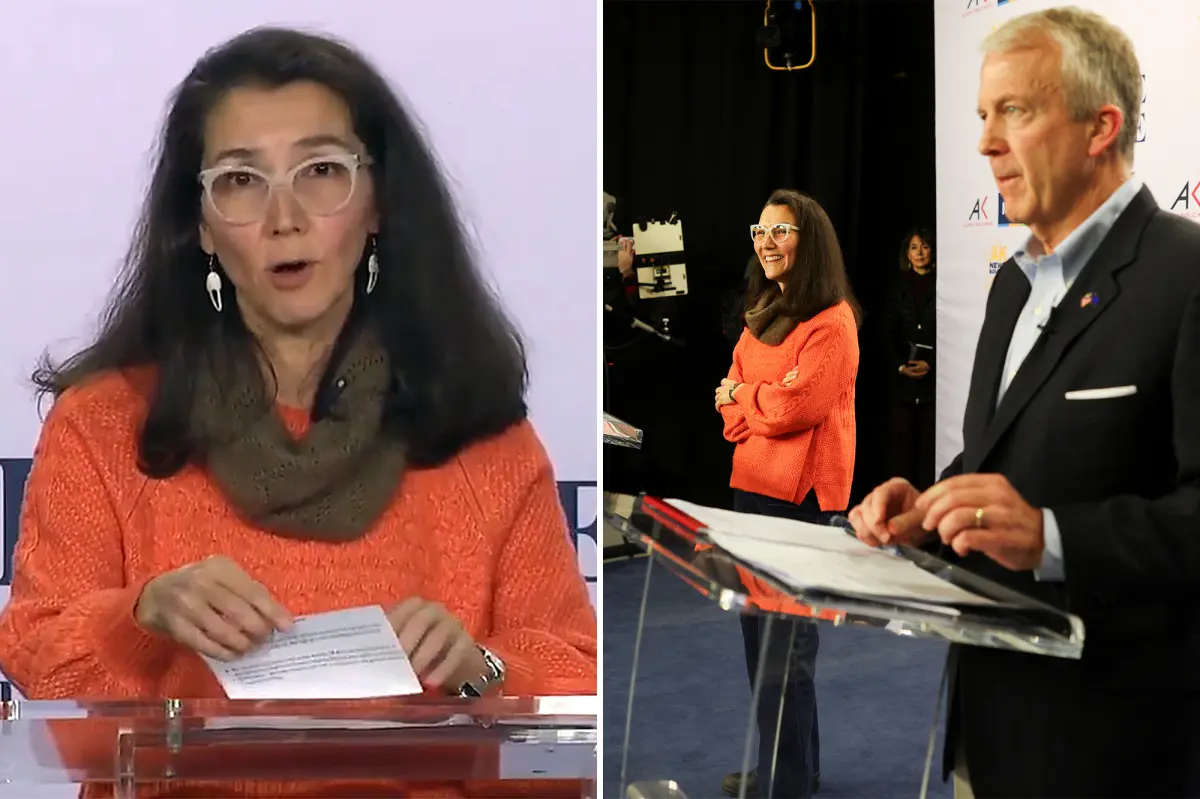

Mary Peltola, the Democratic candidate challenging Alaska Sen. Dan Sullivan, became the target of Republican mockery Thursday night after appearing to consult notecards during a closely watched Senate debate. Sullivan himself joined the criticism, turning the moment into one of the evening’s most contentious exchanges.
The contest between Sullivan and Peltola, a former congresswoman, is unusually competitive as Republicans work to preserve their slim Senate majority. The race is also complicated by a second candidate named Dan Sullivan, who has a different middle initial from the incumbent.
“Really, Mary? Reading off a script? You can’t cue-card your way through the Senate,” Sullivan posted on X. His comment came after Peltola appeared to glance down for several seconds at a small paper containing bullet points while answering an earlier question.
Peltola’s use of what appeared to be prepared notes quickly became a central topic online and during the debate, as Republican critics portrayed it as evidence that she was overly dependent on talking points.
NRSC official Joanna Rodriguez amplified the criticism on X, writing: “Mary, blink twice if you are okay. It seems you can’t string a sentence together without reading from the talking points your Lower 48 handlers wrote you.”
Other social media users also mocked Peltola’s apparent reliance on the card, including when she discussed personal information about herself.
“Mary Peltola can’t read her name or that she’s a grandmother without needing a cue card,” one user posted, accompanying the comment with a laughing emoji.
When Peltola appeared to consult the card again, Sullivan interrupted to raise a question with the moderators.
“We weren’t supposed to get these questions beforehand, were we?” Sullivan asked.
“No sir,” Alaska’s News Source reporter Wil Courtney responded. Alaska Public Media chief editor Lori Townsend followed by saying, “Absolutely not.”
“OK,” Sullivan replied. “I’m just watching my opponent.”
Peltola pushed back, interjecting that she was simply better “prepared.”
The Republican Party’s research operation then circulated a video clip on X that appeared to show Peltola reading from her notes.
“Mary Peltola — who did not introduce a single bill to help Alaska fisherman during her first term in Congress — has to read off of a script when talking about Alaska’s fishing industry,” the party wrote.
The debate grew more heated when Sullivan challenged Peltola over allegations involving her treatment of former employees. Citing reporting from The New York Times, he claimed that 25 staff members had left while working for her.
Peltola dismissed the claims as “outright fabrications or mass exaggerations of the truth.” She argued that voters should not judge her campaign solely through what she described as her “worst day.”
As the candidates repeatedly spoke over one another, moderators urged them to maintain decorum and warned that they could mute the microphones if the interruptions continued.
Sullivan said the allegations pointed to a broader pattern, while Peltola accused him of using the controversy as a political weapon.
The candidates also addressed Alaska’s proposed liquefied natural gas pipeline, a long-running development project. Moderators noted that South Korea had not committed to financing the plan, despite President Trump’s public promotion of a possible agreement.
Sullivan defended the administration’s negotiations, saying Seoul had pledged financial support as part of a wider trade agreement. He acknowledged, however, that the precise amount tied to the pipeline investment was still being negotiated.
Peltola also expressed support for the pipeline but cautioned against raising expectations without firm commitments, saying Alaska should not be “promoting falsehoods that just have no substance.”
Both candidates emphasized the project’s economic potential, although the exchange exposed uncertainty over whether promised foreign investment would materialize.
Peltola previously became the first Democrat in decades to represent Alaska in the House after the death of Republican Rep. Don Young, and her Senate candidacy again carries potentially sweeping statewide and national repercussions.
The showdown comes as Republicans fight to defend their narrow Senate majority, with Sullivan’s seat emerging as a major Democratic pickup opportunity in a state President Trump carried in 2024.
The Cook Political Report rates the contest a toss-up, making Alaska one of several battlegrounds that could determine which party controls the chamber in January.